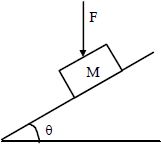
A block of mass $M$ is sliding down the plane. Coefficient of static friction is $\mu _s$ and kinetic friction is $\mu _k.$ Then friction force acting on the block is :-
Medium


Download our appand get started for free
Experience the future of education. Simply download our apps or reach out to us for more information. Let's shape the future of learning together!No signup needed.*
Similar Questions
- 1An isolated rail car originally moving with speed $v_0$ on a straight, frictionles, level track contains a large amount of sand. $A$ release valve on the bottom of the car malfunctions, and sand begins to pour out straight down relative to the rail car. What happens to the speed of the rail car as the sand pours out?View Solution
- 2A block of mass $70\,kg$ is kept on a rough horizontal surface $(\mu = 0.4)$. A person is trying to pull the block by applying a horizontal force, but the block is not moving. The net contact force exerted by the surface on the block is $F$, thenView Solution
- 3View SolutionThe limiting friction between two bodies in contact is independent of
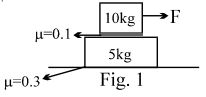
- 4When $F = 2N$, the frictional force between $10 kg$ block and $5 kg$ block is ...... $N$View Solution
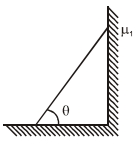
- 5In the figure, a ladder of mass $m$ is shown leaning against a wall. It is in static equilibrium making an angle $\theta$ with the horizontal floor. The coefficient of friction between the wall and the ladder is $\mu_1$ and that between the floor and the ladder is $\mu_2$. The normal reaction of the wall on the ladder is $N_1$ and that of the floor is $N_2$. If the ladder is about to slip, thenView Solution
$Image$
$(A)$ $\mu_1=0 \mu_2 \neq 0$ and $N _2 \tan \theta=\frac{ mg }{2}$
$(B)$ $\mu_1 \neq 0 \mu_2=0$ and $N_1 \tan \theta=\frac{m g}{2}$
$(C)$ $\mu_1 \neq 0 \mu_2 \neq 0$ and $N _2 \tan \theta=\frac{ mg }{1+\mu_1 \mu_2}$
$(D)$ $\mu_1=0 \mu_2 \neq 0$ and $N _1 \tan \theta=\frac{ mg }{2}$
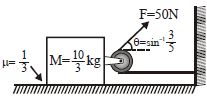
- 6In the given figure the acceleration of $M$ is $(g = 10 \,ms^{-2})$View Solution
- 7Consider a car moving on a straight road with a speed of $100\, m/s$. The distance at which car can be stopped, is ........ $m$. $[\mu_k = 0.5]$View Solution
- 8Two bodies of equal masses revolve in circular orbits of radii ${R_1}$ and ${R_2}$ with the same period. Their centripetal forces are in the ratioView Solution
- 9If a cyclist moving with a speed of $4.9\, m/s$ on a level road can take a sharp circular turn of radius $4 \,m$, then coefficient of friction between the cycle tyres and road isView Solution
- 10A rocket is fired vertically frorn the earth with an acceleration of $2\,g,$ where $g$ is the gravitational acceleration. On an inclined plane inside the rocket, making an angle $\theta $ with the horizontal, a point object of mass $m$ is kept. The minimum coefficient of friction $\mu _{min}$ between the mass and the inclined surface such that the mass does not move isView Solution