MCQ
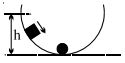
$A$ block of mass $m$ starts from rest and slides down $a$ frictionless semi-circular track from $a$ height $h$ as shown. When it reaches the lowest point of the track, it collides with a stationary piece of putty also having mass $m$. If the block and the putty stick together and continue to slide, the maximum height that the block-putty system could reach is:
  • $h/4$
  • B
    $h/2$
  • C
    $h$
  • D
    independent of $h$

Answer

Correct option: A.
$h/4$
a
The velocity of block just before hitting the putty (by energy conservation)

$K . E_{i}+P . E_{i}=K . E_{f}+P . E_{f}$

$\Rightarrow 0+m g h=\frac{1}{2} m v^{2}$

$\Rightarrow v=\sqrt{2 g h}$

Let the common velocity of both block and putty be $v^{\prime}$

At collision momentum balance:

$m v=m v^{\prime}+m v^{\prime}$

$\Rightarrow \sqrt{2 g h}=2 v^{\prime}$

$\Rightarrow v^{\prime}=\sqrt{\frac{g h}{2}}$

Again applying energy conservation (both block and putty at max height)

$K . E_{i}+P . E_{i}=K . E_{f}+P . E_{f}$

$\Rightarrow \frac{1}{2} 2 m v^{\prime 2}=2 m g h^{\prime}$

$\Rightarrow \frac{1}{2} \frac{g h}{2}=g h^{\prime}$

$\Rightarrow h^{\prime}=h / 4$

Need a full question paper?

Generate a complete, print-ready paper with questions like this in minutes — across 16+ boards, with answer keys.

Start Generating Free

Similar questions

If error in measuring diameter of a circle is $4\%$, the error in circumference of the circle would be
The equation of a progressive wave is $y = 0.02\,\sin \,2\pi \left[ {\frac{t}{{0.01}} - \frac{x}{{0.30}}} \right]$ Here $x$ and $y$ are in metre and $t$ is in second. The velocity of propagation of the wave is .... $ms^{-1}$
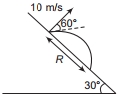
A projectile is launched with a speed of $10\,m / s$ at an angle $60^{\circ}$ with the horizontal from a sloping surface of inclination $30^{\circ}$. The range $R$ is $........\,m$ (Take $g=10\,m / s ^2$ )
A solid cube of side $l$ is made to oscillate about a horizontal axis passing through one of its edges. Its time period will be
The equation of motion of a particle is $x = a\,cos (\alpha\, t)$ . The motion is
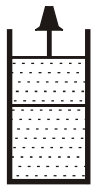
In the figure a container is shown to have a movable (without friction) piston on top. The container and the piston are all made of perfectly insulating material allowing no heat transfer between outside and inside the container. The container is divided into two compartments by a rigid partition made of a thermally conducting material that allows slow transfer of heat. The lower compartment of the container is filled with $2$ moles of an ideal monatomic gas at $700 \ K$ and the upper compartment is filled with $2$ moles of an ideal diatomic gas at $400$

K. The heat capacities per mole of an ideal monatomic gas are $C_v=\frac{3}{2} \ R, C_p=\frac{5}{2} R$, and those for an ideal diatomic gas are $C _{ v }=\frac{5}{2} \ R , C _{ P }=\frac{7}{2} R$.

$1.$ Consider the partition to be rigidly fixed so that it does not move. When equilibrium is achieved, the final temperature of the gases will be :

$(A)$ $550 \ K$ $(B)$ $525 \ K$ $(C)$ $513 \ K$ $(D)$ $490 \ K$

$2.$ Now consider the partition to be free to move without friction so that the pressure of gases in both compartments is the same. Then total work done by the gases till the time they achieve equilibrium will be:

$(A)$ $250 \ R$ $(B)$ $200 \ R$ $(C)$ $100 \ R$ $(D)$ $-100 \ R$

Give the answer question $1$ and $2.$

A particle slides from the top of a smooth hemispherical surface of radius $R$ which is fixed on a horizontal surface. If it separates from the hemisphere at a height $h$ from the horizontal surface, then the speed of the particle is
The displacements of two particles executing $S.H.M.$ on the same line are given. as $y_1=a \sin \left(\frac{\pi}{2} t+\phi\right)$ and $y_2=b \sin \left(\frac{2 \pi}{3} t+\phi\right)$. The phase difference between them at $t=1 \,s$ is .........
A spherical drop of liquid splits into $1000$ identical spherical drops. If $u _{ i }$ is the surface energy of the original drop and $u_f$ is the total surface energy of the resulting drops, the (ignoring evaporation). $\frac{u_f}{u_i}=\left(\frac{10}{x}\right)$. Then value of $x$ is $......$
Three balls of same masses are projected with equal speeds at angle $15^{\circ}, 45^{\circ}, 75^{\circ}$, and their ranges are respectively $R_1, R_2$ and $R_3$, then