Question
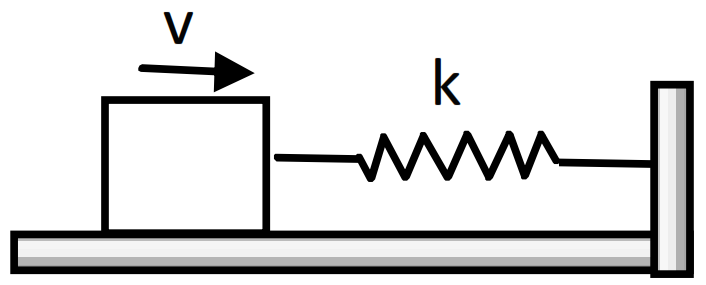
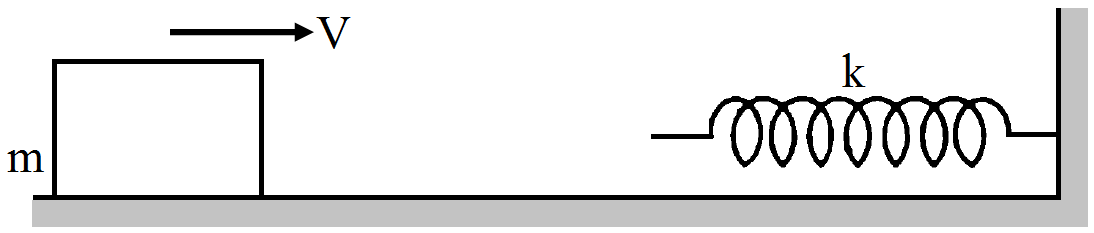
A block of massip, sliding on a smooth horizontal surface with a velocity $\vec{\text{v}}$ meets a long horizontal spring fixed at one end and having spring constant k as shown in figure. Find the maximum compression of tin spring. Will the velocity of the block be the same $\vec{\text{v}}$ when it comes back to the original position shown?
Answer


Let the compression be x.
According to law of conservation of energy,
$\frac{1}{2}\text{mv}^2=\frac{1}{2}\text{k}\text{x}^2$
$\Rightarrow\text{x}^2=\frac{\text{mv}^2}{\text{k}}$
$\Rightarrow\text{x}=\text{v}\sqrt{\Big({\frac{\text{m}}{\text{k}}\Big)}}$
No. It will be in the opposite direction and magnitude will be less due to loss in spring.

Need a full question paper?

Generate a complete, print-ready paper with questions like this in minutes — across 16+ boards, with answer keys.

Start Generating Free

Similar questions

In the given progressive wave $​​​​\text{y}=5\sin(100\pi\text{t+0.4x})$ where y and x are in m, t is in s. What is the:
Wave length
Quantitative measurement plays major role in Physics, why?
When two waves of almost equal frequencies $n_1$ and $n_2$ reach at a point simultaneously, what is the time interval between successive maxima?
Pure water vapour is trapped in a vessel of volume $10 \mathrm{~cm}^3$. The relative humidity is $40 \%$. The vapour is compressed slowly and isothermally. Find the volume of the vapour at which it will start condensing.
A 0.1 kg stone tied to a thread of 1 m long and moves in a horizontal circular path at a speed of 2 rotations per second. Calculate the tension on the thread.
The displacement of an object changes with time according to $s=t^3-6 t^2+3 t+4$, then the acceleration of the object at instant is zero. What is its velocity?
Find the dimensions of :
  1. The specific heat capacity $c.$
  2. The coefficient of linear expansion $a$.
  3. The gas constant $R.$
Some of the equations involving these quantities are $\text{Q = mc(T}_2-\text{T}_1),\text{l}_{\text{t}}=\text{l}_0[1+\alpha(\text{T}_2-\text{T}_1)]$ and $\text{PV = nRT}.$
Calculate the solid angle subtended by the periphery of an area of $1\text{cm}^2$ at a point situated symmetrically at a distance of 5cm from the area.
Can a gravitational field be added vectorially to an electric field to get a total field?
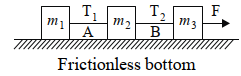
In the figure, three blocks are tied with two strings $A$ and $B . m_1=10 kg, m_2=5 kg, m_3=5 kg$. The bottom is frictionless. If $m _3$ is pulled to the right by applying a horizontal force of 50 N then calculate the tension in the strings.
Image