Question
The displacement of an object changes with time according to $s=t^3-6 t^2+3 t+4$, then the acceleration of the object at instant is zero. What is its velocity?

Answer

 Given :
$s=t^3-6 t^2+3 t+4$
$\begin{aligned}
\therefore \quad \text { Velocity } v & =\frac{ds}{dt}=\frac{d}{dt}\left(t^3-6 t^2+3 t+4\right) \\
v & =3 t^2-6 \times 2 t+3 \times 1+0 \\
v & =3 t^2-12 t+3 .......(1)\\
\text { Acceleration } a & =\frac{dv}{dt}=\frac{d}{dt}\left(3 t^2-12 t+3\right) \\
a & =3 \times 2 t-12 \times 1+0 \\
a & =6 t-12 ....(2)
\end{aligned}$
When acceleration $a =0$ then from equation (2)
$\begin{aligned}
6 t-12 & =0 \\
t & =2 \text { second }
\end{aligned}$
$t =2$ velocity per second from equ. (1)
$\begin{array}{l}
v=3(2)^2-12(2)+3 \\
v=12-24+3=-9 m / s
\end{array}$
Here the negative sign indicates that the displacement of the object is decreasing with time.

Need a full question paper?

Generate a complete, print-ready paper with questions like this in minutes — across 16+ boards, with answer keys.
Start Generating Free

Similar questions

Can you ever have a situation in which a light ray goes undeviated through a prism?
Can a vector have zero component along a line and still have nonzero magnitude?
A barometer correctly reads the atmospheric pressure as 76cm of mercury. Water droplets are slowly introduced into the barometer tube by a dropper. The height of the mercury column first decreases and then becomes constant. lf the saturation vapour pressure at the atmospheric temperature is 0.80cm of mercury, find the height of the mercury column when it reaches its minimum value.
Calculate the energy required to move a body of mass $m$ from an orbit of radius $2 R$ to $3 R$.
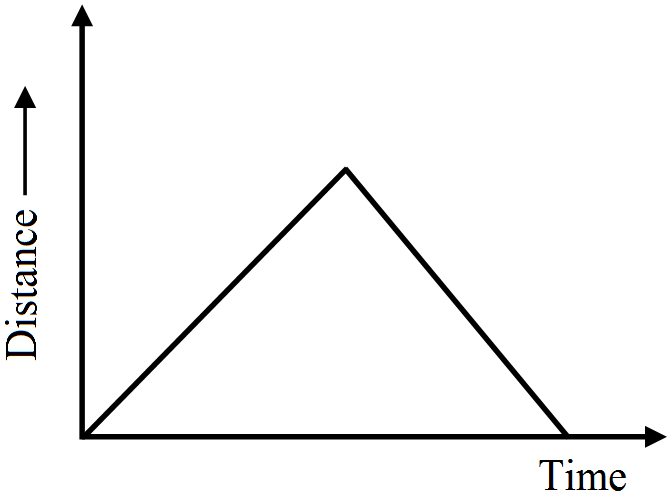
The graph between total path length and time for a particle moving along a straight line as shown in figure is not possible. Explain why?
In some old texts it is mentioned that $4\pi$ lines of force originate from each unit positive charge. Comment on the statement in view of the fact that $4\pi$ is not an integer.
The torque of the weight of any body about any vertical axis is zero. Is it always correct?
Two boys of the same weight sit at the opposite ends of a diameter of a rotating circular table. What happens to the speed of rotation if they move nearer to the axis of rotation?
Choose the correct alternative: If the zero of potential energy is at infinity, the total energy of an orbiting satellite is negative of its kinetic/ potential energy.