Question
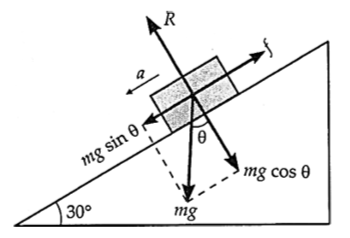
A block of metal of mass 50 g when placed over an inclined plane at an angle of $15^{\circ}$ slides down without acceleration. If the inclination is increased by $15^{\circ}$, what would be the acceleration of the block?
Answer

Here $m =50 g=0.05 kg$
Angle of repose,
$
\begin{aligned}
& \alpha=15^{\circ} \\
& \therefore \mu=\tan \mu=\tan 15^{\circ}=0.2679
\end{aligned}
$
New angle of inclination $=15+15=30^{\circ}$
Let a be the downward acceleration produced in the block.
Image
Net downward force on the block is
$
F=mg \sin \theta-f
$
$\begin{aligned} & ma = mg \sin \theta- u mg \cos \theta[\because f=\mu R=\mu m g \cos \theta] \\ & \therefore \quad a=g(\sin \theta-\mu \cos \theta) \\ & =9.8\left(\sin 30^{\circ}-0.2679 \cos 30^{\circ}\right) \\ & =9.8(0.5-0.2679 \times 0.866) \\ & =9.8 \times 0.2680=2.6 ms^{-2}\end{aligned}$

Need a full question paper?

Generate a complete, print-ready paper with questions like this in minutes — across 16+ boards, with answer keys.

Start Generating Free

Similar questions

A 100 kg gun fires a ball of 1 kg horizontally from a cliff of height 500 m . It falls on the ground at a distance of 400 m from the bottom of the cliff. Find the recoil velocity of the gun. (acceleration due to gravity $=10 ms^{-2}$ ).
The geostationary orbit of the earth is at a distance of about $36000km$ from the earth's surface. Find the weight of a $120kg$ equipment placed in a geostationary satellite. The radius of the earth is $6400km$.
An electric bulb of volume $250cm^3$ was sealed off during manufacture at a pressure of $10^{-3} mm$ of Hg at $27^\circ C$. Find the number of air molecules in the bulb.
The weight of a body at the poles is greater than the weight at the equator. Is it the actual weight or the apparent weight we are talking about? Does your answer depend on whether only the earth's rotation is taken into account or the flattening of the earth at the poles is also taken into account?​​​​​
By suddenly compressing a gas at a temperature of 300 K, its pressure is made 8 times the initial pressure. Calculate the temperature increase due to compression $(\gamma=1.5)$.
There are two displacement vectors, one of magnitude $3m$ and the other of $4m$. How would the two vectors be added so that the magnitude of the resultant vector be $(i)\  7m\  (ii)\  1m$ and $(iii)\  5m$?
What is the coefficient of performance $(\beta)$ of a Carnot refrigerator working between 30°C and 0°C?
A uniform circular disc of radius $R$ is rolling on a horizontal surface. Determine the tangential velocity at :
  1. Upper most point.
  2. At centre of mass.
  3. At point of contact.
Derive an expression for the orbital velocity of a satellite in the orbit. Reduce it to an orbit close to the surface of earth. How is it related to escape velocity?
A clock with an iron pendulum keeps the correct time at $20^{\circ} C$. How much will it lose or gain if the temperature changes to $40^{\circ} C$ ? Coefficient of cubical expansion of iron $=36 \times 10^{-6}{ }^{\circ} C ^{-1}$.