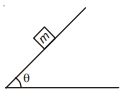
A block of weight $1 \,N$ rests on an inclined plane of inclination $\theta$ with the horizontal. The coefficient of friction is $\mu$ The minimum force that has to be applied parallel to the inclined plane to make the body just move up the plane is
Easy


Download our appand get started for free
Experience the future of education. Simply download our apps or reach out to us for more information. Let's shape the future of learning together!No signup needed.*
Similar Questions
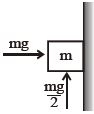
- 1View SolutionA block pressed against the vertical wall is in equilibrium. The minimum coefficient of friction is:-
- 2View SolutionWhich of the following is correct, when a person walks on a rough surface
- 3View SolutionA hockey player is moving northward and suddenly turns westward with the same speed to avoid an oopponent. The force that acts on the player is
- 4View SolutionAmong the forces in nature, friction can be classified into
- 5A $2\,kg$ block slides on a horizontal floor with a speed of $4\, m/s$. It strikes a uncompressed spring, and compresses it till the block is motionless. The kinetic friction force is $110\,N$ and spring constant is $1000\, N/m$. The spring compresses by ........ $cm$View Solution
- 6$Assertion$ : Angle of repose is equal to the angle of limiting friction.View Solution
$Reason$ : When the body is just at the point of motion, the force of friction in this stage is called limiting friction. - 7A person with his hand in his pocket is skating on ice at the rate of $10 m / s$ and describes a circle of radius $50 m$. What is his inclination to vertical: $\left( g =10 m / sec ^2\right)$View Solution
- 8A body $B$ lies on a smooth horizontal table and another body $A$ is placed on $B$. The coefficient of friction between $A$ and $B$ is $\mu $. What acceleration given to $B$ will cause slipping to occur between $A$ and $B$View Solution
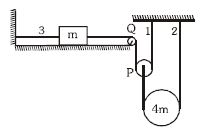
- 9Shown in the diagram is a system of two bodies, a block of mass $m$ and a disc of mass $4\ m$ , held in equilibrium. If the string $3$ is burnt, find the acceleration of the disc. Neglect the masses of the pulleys $P$ and $Q$ . The co-efficient of friction between the block and horizontal surface is $0.5$ and friction between disc and string is zero ........ $m/s^2$View Solution
- 10An annular ring with inner and outer radii $R_{1}$ and $R_{2}$ is rolling without slipping with a uniform angular speed. The ratio of the forces experienced by the two particles situated on the inner and outer parts of the ring, $\frac{F_{1}}{F_{2}}$ isView Solution