A person with his hand in his pocket is skating on ice at the rate of $10 m / s$ and describes a circle of radius $50 m$. What is his inclination to vertical: $\left( g =10 m / sec ^2\right)$
Easy
Download our app for free and get started
(b)
Since surface $(ice)$ is frictionless, so the centripetal force required for skating will be provided by inclination of boy with the vertical and that angle is given as $\tan \theta=\frac{v^2}{r g}$ where $v$ is speed of skating and $r$ is radius of circle in which he moves.

Download our appand get started for free
Experience the future of education. Simply download our apps or reach out to us for more information. Let's shape the future of learning together!No signup needed.*
Similar Questions
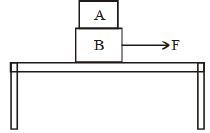
- 1Two blocks $A$ and $B$ of masses $m_A = 1\,kg$ and $m_B = 3\,kg$ are kept on the table as shown in figure. The coefficient of friction between $A$ and $B$ is $0.2$ and between $B$ and the surface of the table is also $0.2.$ The maximum force $F$ that can be applied on $B$ horizontal, so that the block $A$ does not slide over the block $B$ is ........ $N$. [Take $g = 10\,m/s^2$ ]View Solution
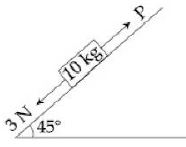
- 2A block of mass $10\, kg$ is kept on a rough inclined plane as shown in the figure. A force of $3\, N$ is applied on the block. The coefficient of static friction between the plane and the block is $0.6$. What should be the minimum value of force $P$, such that the block does not move downward? (take $g = 10\, ms^{-2}$) ........ $N$View Solution
- 3When a body slides down from rest along a smooth inclined plane making an angle of $30^{\circ}$ with the horizontal, it takes time $T$. When the same body slides down from the rest along a rough inclined plane making the same angle and through the same distance, it takes time $\alpha {T}$, where $\alpha$ is a constant greater than $1 .$ The co-efficient of friction between the body and the rough plane is $\frac{1}{\sqrt{{x}}}\left(\frac{\alpha^{2}-1}{\alpha^{2}}\right)$ where ${x}=..... .$View Solution
- 4A particle of mass $M$ moves with constant speed along a circular path of radius $ r$ under the action of a force $F$. Its speed isView Solution
- 5A conveyor belt is moving at a constant speed of $2\, ms^{-1}$. A box is gently dropped on it. The coefficient of friction between them is $\mu = 0.5$. The distance that the box will move relative to belt before coming to rest on it, (taking $g = 10\, ms^{-2}$) is ........ $m$.View Solution
- 6A car of mass $m$ is moving on a level circular track of radius $R.$ If $\mu_s $ represents the static friction between the road and tyres of the car, the maximum speed of the car in circular motion is given byView Solution
- 7A block of mass $M$ rests on a rough horizontal table. A steadily increasing horizontal force is applied such that the block starts to slide on the table without toppling. The force is continued even after sliding has started. Assume the coefficients of static and kinetic friction between the table and the block to be equal. The correct representation of the variation of the frictional force $f$, exerted by the table on the block with time $t$ is given byView Solution
- 8A block of mass $5 kg$ is at rest on a rough inclined surface. If angle of inclination of plane is $60^{\circ}$, then force applied by it on block is .......... $N$View Solution
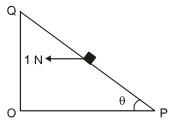
- 9A small block of mass of $0.1 \ kg$ lies on a fixed inclined plane $P Q$ which makes an angle $\theta$ with the horizontal. A horizontal force of $1 \ N$ on the block through its center of mass as shown in the figure. The block remains stationary if (take $g =10 \ m / s ^2$ ) $Image$View Solution
$(A)$ $\theta=45^{\circ}$
$(B)$ $\theta>45^{\circ}$ and a frictional force acts on the block towards $P$.
$(C)$ $\theta>45^{\circ}$ and a frictional force acts on the block towards $Q$.
$(D)$ $\theta<45^{\circ}$ and a frictional force acts on the block towards $Q$.
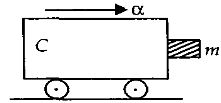
- 10A block of mass $m$ is in contact with the cart $C$ as shown in the figure. The coefficient of static friction between the block and the cart is $\mu .$ The acceleration $\alpha$ of the cart that will prevent the block from falling satisfiesView Solution