Question
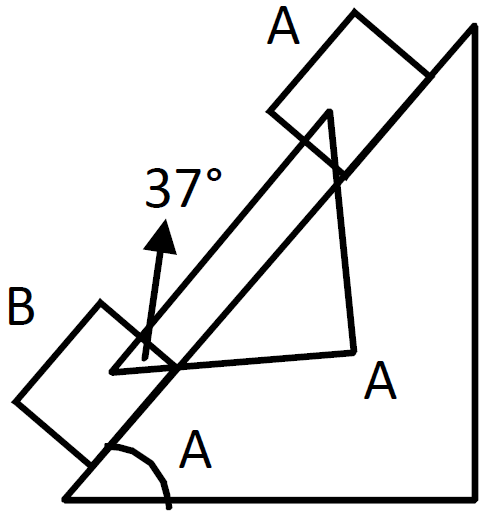
A block of weight $100N$ is slowly slid up on a smooth incline of inclination $37^\circ$ by a person. Calculate the work done by the person in moving the block through a distance of $2.0m$, if the driving force is:
  1. Parallel to the incline.
  2. In the horizontal direction.

Answer

$\text{W}=100\text{N},\theta=37^\circ,\text{S}=2\text{m}$`
  1. $\text{F}=\text{mg}\sin37^\circ=100\times0.60=60\text{N}$
So, work done, when the force is parallel to incline.
$\text{W}=\text{FS}\cos\theta=60\times2\times\cos\theta=120\text{J}$
  1. In $\triangle\text{ABC }\text{AB}=2\text{m}$
$CB = 37^\circ$
So, $h = C = 1m$
$\therefore$ Work done when the force in horizontal direction.
$W = mgh = 100 \times 1.2 = 120J$

Need a full question paper?

Generate a complete, print-ready paper with questions like this in minutes — across 16+ boards, with answer keys.

Start Generating Free

Similar questions

Explain Doppler effect in sound. Obtain an expression for apparent frequency of sound when source moves and listener is at rest.
A spherical ball of surface area $20 \mathrm{~cm}^2$ absorbs any radiation that falls on it. It is suspended in a closed box maintained at $57^{\circ} \mathrm{C}$.
a. Find the amount of radiation falling on the ball per second.
b. Find the net rate of heat flow to or from the ball at an instant when its temperature is $200^{\circ} \mathrm{C}$. Stefan constant $=$ $6.0 \times 10^{-8} \mathrm{Wm}^{-2} \mathrm{~K}^{-4}$.
A $100kg$ block is started with a speed of $2.0ms^{-1}$ on a long, rough belt kept fixed in a horizontal position. The coefficient of kinetic friction between the block and the belt is $0.20$.
  1. Calculate the change in the internal energy of the block-belt system as the block comes to a stop on the belt.
  2. Consider the situation from a frame of reference moving at $2.0ms^{-1}$ along the initial velocity of the block. As seen from this frame, the block is gently put on a moving belt and in due time the block starts moving with the belt at $2.0ms^{-1}$ Calculate the increase in the kinetic energy of the block as it stops slipping past the belt.
  3. Find the work done in this frame by the external force holding the belt.
Let $\text{X}=\overline{\text{ABC}}+\overline{\text{BCA}}+\overline{\text{CAB}}.$ Evaluate X for:
  1. $\text{A}=1,\text{B}=0,\text{C}=1$
  2. $\text{A}=\text{B}=\text{C}=1$
  3. $\text{A}=\text{B}=\text{C}=0$
A person of mass $60kg$ wants to lose $5kg$ by going up and down a $10m$ high stairs. Assume he burns twice as much fat while going up than coming down. If $1kg$ of fat is burnt on expending $7000$ kilo calories, how many times must he go up and down to reduce his weight by $5kg$?
A solid sphere of mass $0.50kg$ is kept on a horizontal surface. The coefficient of static friction between the surfaces in contact is $\frac{2}{7}.$ What maximum force can be applied at the highest point in the horizontal direction so that the sphere does not slip on the surface?
A block of mass $200g$ is suspended through a vertical spring. The spring is stretched by $1.0cm$ when the block is in equilibrium. A particle of mass $120g$ is dropped on the block from a height of $45cm$. The particle sticks to the block after the impact. Find the maximum extension of the spring. Take $g = 10m/s^2$.
Consider a cycle tyre being filled with air by a pump. Let V be the volume of the tyre (fixed) and at each stroke of the pump $\Delta\text{V}(<<\text{V})$ of air is transferred to the tube adiabatically. What is the work done when the pressure in the tube is increased from $P_1$ to $P_2$?
A stream of water flowing horizontally with a speed of $15ms^{-1}$ gushes out of a tube of cross-sectional area $10^{-2}m^2$, and hits a vertical wall nearby. What is the force exerted on the wall by the impact of water, assuming it does not rebound?
A long wire carries a current of 4.00A. Find the energy stored in the magnetic field inside a volume ot 1.00mm at a distance of 10.0cm from the wire.