Question
Consider a cycle tyre being filled with air by a pump. Let V be the volume of the tyre (fixed) and at each stroke of the pump $\Delta\text{V}(<<\text{V})$ of air is transferred to the tube adiabatically. What is the work done when the pressure in the tube is increased from $P_1$ to $P_2$?
Answer

Air is transferred into tyre adiabatically let initial volume of air in tyre V and after pumping one stroke it become (V + dV) and pressure increase from P to (P + dP) then $\text{P}_{1}\text{V}_{1}^\gamma=\text{P}_{2}\text{V}_{2}^\gamma$
$\text{P}(\text{d}+\text{dv})^\gamma=(\text{P}+\text{dp})\text{V}^\gamma$
$\text{PV}\Big[1+\frac{\text{dV}}{\text{V}}\Big]^\gamma=\text{P}\Big[1+\frac{\text{dP}}{\text{P}}\Big]\text{V}^\gamma$
As volume of tyre V remains constant $\text{PV}^\gamma\Big[1+\gamma\frac{\text{dV}}{\text{V}}\Big]=\text{PV}^\gamma\Big[1+\frac{\text{dP}}{\text{P}}\Big]$
$\big[$on expanding by binomial theorm neglecting the higher terms of $\Delta\text{V}$ as $\Delta\text{V}<<\text{V}\big]$$1+\gamma\frac{\text{dV}}{\text{V}}=1+\frac{\text{dP}}{\text{P}}$
$\text{dV}=\frac{\text{VdP}}{\gamma\text{P}}$
Integrating both side in limits $W_1$ to $W_2$ and $P_1 → P_2$$\int\text{pdV}=\int\limits^{\text{p}_2}_{\text{p}_1}\frac{\text{VdP}}{\gamma}$
$\int\limits^{\text{w}_2}_{\text{w}_1}\text{dw}=\frac{\text{V}}{\gamma}(\text{P}_{2}-\text{P}_{1})(\text{V}=\text{constant})$
$\text{W}=\frac{(\text{P}_{2}-\text{P}_{1})\text{V}}{\gamma}$

Need a full question paper?

Generate a complete, print-ready paper with questions like this in minutes — across 16+ boards, with answer keys.

Start Generating Free

Similar questions

The electric potential existing m space is V(x, y, z) = A(xy + yz + zx).
  1. Write the dimensional formula of A.
  2. Find the expression for the electric field.
  3. If A is 10 SI units, find the magnitude of the electric field at (1m, 1m, 1m).
A small object is placed at the centre of the bottom of a cylindrical vessel of radius 3cm and height 4cm filled completely with water. Consider the ray leaving the vessel through a corner. Suppose this ray and the ray along the axis of the vessel are used to trace the image. Find the apparent depth of the image and the ratio of real depth to the apparent depth under the assumptions taken. Refractive index of water = 1.33
What is meant by limit of elasticity? Write Hooke's law of elasticity. Based on this establish the formula of Young's Modulus of elasticity and give the definition of Young's Modulus of elasticity.
Consider an ideal gas with following distribution of speeds.
Speed m/s
200
400
600
800
1000
% of molecules
10
20
40
20
10
If all the molecules with speed 1000m/s escape from the system, calculate new $V_{rms}$ and hence T.
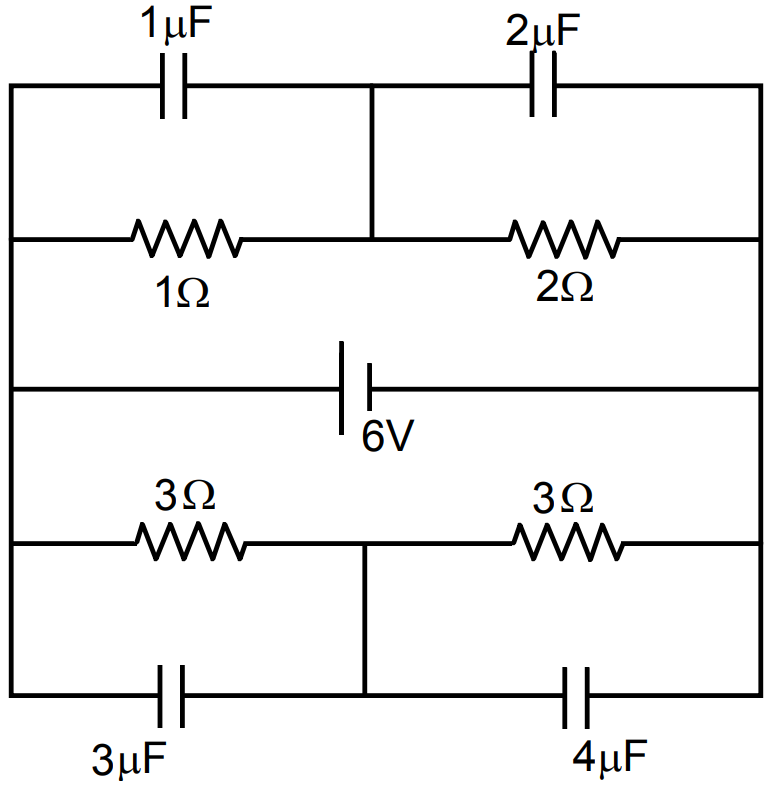
Find the charges on the four capacitors of capacitances $1\mu\text{F},2\mu\text{F},3\mu\text{F}$ and $4\mu\text{F}$ shown in the figure.
A wire loaded by a weight of density $7.6g/ cm^{-3}$ is found to measure 90cm. On immersing the weight in water, the length decreased by 0.18cm. Find the original length of wire.
Define conservative and non-conservative forces and also describe their examples.
In a series RC circuit with an AC source, $\text{R}=300\Omega,\text{C}=25\mu\text{F},\in_0=50\text{V}$ and $\nu=\frac{50}{\pi}\text{Hz}.$ Find the peak current and the average power dissipated in the circuit.
Given below are observations on molar specific heats at room temperature of some common gases.
Gas Molar specific heat (Cv)
$(cal ~mo1^{–1} K^{–1})$
Hydrogen 4.87
Nitrogen 4.97
Oxygen 5.02
Nitric oxide 4.99
Carbon monoxide 5.01
Chlorine 6.17
The measured molar specific heats of these gases are markedly different from those for monatomic gases. Typically, molar specific heat of a monatomic gas is $2.92$ cal/ mol K. Explain this difference. What can you infer from the somewhat larger (than the rest) value for chlorine?
A body of mass $0.40kg$ moving initially with a constant speed of $10ms^{-1}$ to the north is subject to a constant force of $8.0 N$ directed towards the south for $30s$. Take the instant the force is applied to be $t = 0$, the position of the body at that time to be $x = 0$, and predict its position at $t = –5s, 25s, 100s$.