Question
A block placed on a rough horizontal surface is pulled by a horizontal force F. Let f be the force applied by the rough surface on the block. Plot a graph of f versus F.
Answer

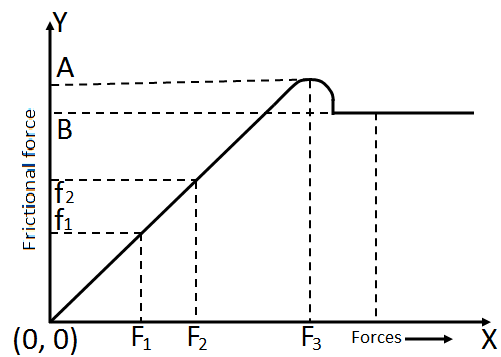
When a small force $F_1$ is applied on a heavier box, it does not move At this state force of friction $f_1$ is equal to $F_1$. On increasing force box does not move till $F = F_s$ the maximum static frictional or limiting force. Its corresponding frictional force $f_s$ on Y-axis.
 
After force $F_s$, the frictional force decrease i.e., less force $\text{F}_\text{k}<\text{F}_\text{s}$ is applied on body and it starts to move with less friction $\text{f}_\text{k}<\text{f}_\text{s}$A = limiting frictional force and at B = kinetic frictional force.

Need a full question paper?

Generate a complete, print-ready paper with questions like this in minutes — across 16+ boards, with answer keys.
Start Generating Free

Similar questions

A car is moving in a circular horizontal track of radius 10m with constant speed of 10m/s. A plumb bob is suspended from roof by a light rigid rod of length 1m. Find the angle made by the rod with the track.
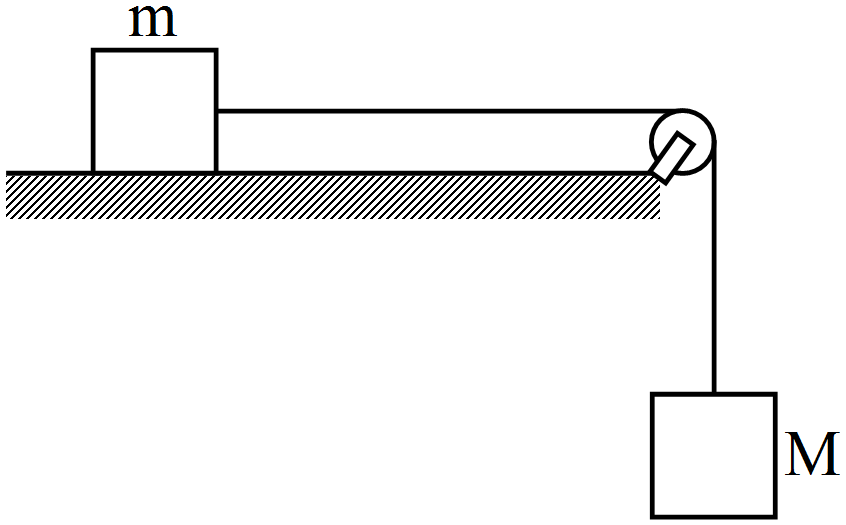
Figure shows two blocks of masses m and M connected by a string passing over a pulley. The horizontal table over which the mass m slides is smooth. The pulley has a radius r and moment of inertia I about its axis and it can freely rotate about this axis. Find the acceleration of the mass M assuming that the string does not slip on the pulley.
A wire carries an alternating current $\text{i}=\text{i}_0\sin\omega\text{t}.$ Is there an electric field in the vicinity of the wire?
A man of mass $70kg$ stands on a weighing scale in a lift which is moving. Upwards with a uniform acceleration of $5ms^{-2}$. What would be the readings on the scale in each case?
State the first law of thermodynamics. List the sign conventions used in the energy dealt by the law.
It is a common observation that rain clouds can be at about a kilometre altitude above the ground.
If a rain drop falls from such a height freely under gravity, what will be its speed? Also calculate in km/h. ($g = 10m/s^2$)
Two small bodies of masses $10kg$ and $20kg$ are kept a distance $1.0m$ apart and released, Assuming that only mutual gravitational forces are acting, find the speeds of the particles when the separation decreases to $0.5m$.
When you lift a box from the floor and put it on an almirah the potential energy of the box increases, but there is no change in its kinetic energy. Is it a violation of conservation of energy?
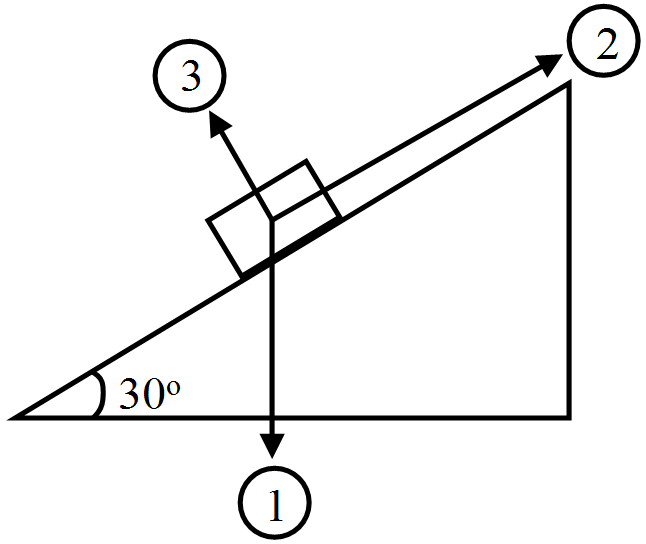
A block of wood of mass 3kg is resting on the surface of a rough inclined surface, inclined at an angle $\theta$ as shown in the figure:
  1. Name the forces $(1, 2, 3).$
  2. If the coefficient of static friction is 0.2, calculate the value of all the three forces. (may use $g = 10m/ s^2)$
 A source and an observer are approaching one another with velocity $4 m / s$. If the true frequency is $1200 Hz$ , deduce the observed frequency under the following conditions:
i. All velocity is in the source alone.
ii. All velocity is in the observer alone.
Take the velocity of sound waves in air to be $340 ms^{-1}$.