Question
Figure shows two blocks of masses m and M connected by a string passing over a pulley. The horizontal table over which the mass m slides is smooth. The pulley has a radius r and moment of inertia I about its axis and it can freely rotate about this axis. Find the acceleration of the mass M assuming that the string does not slip on the pulley. 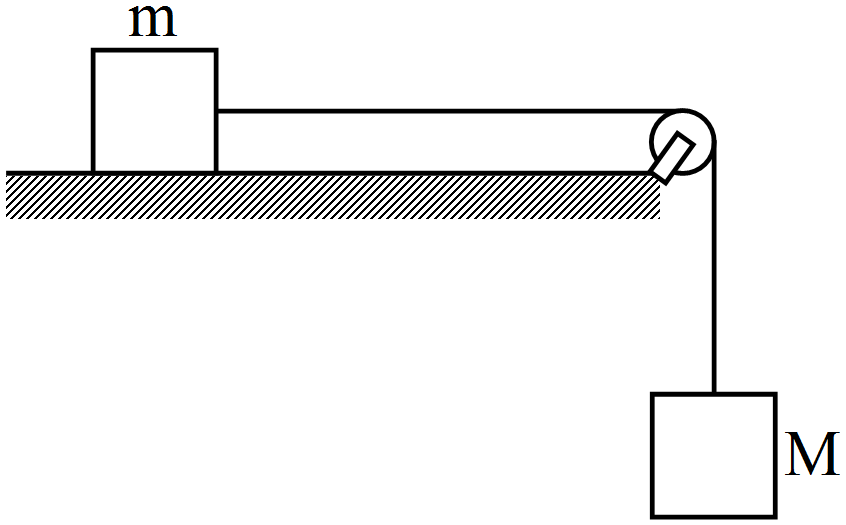
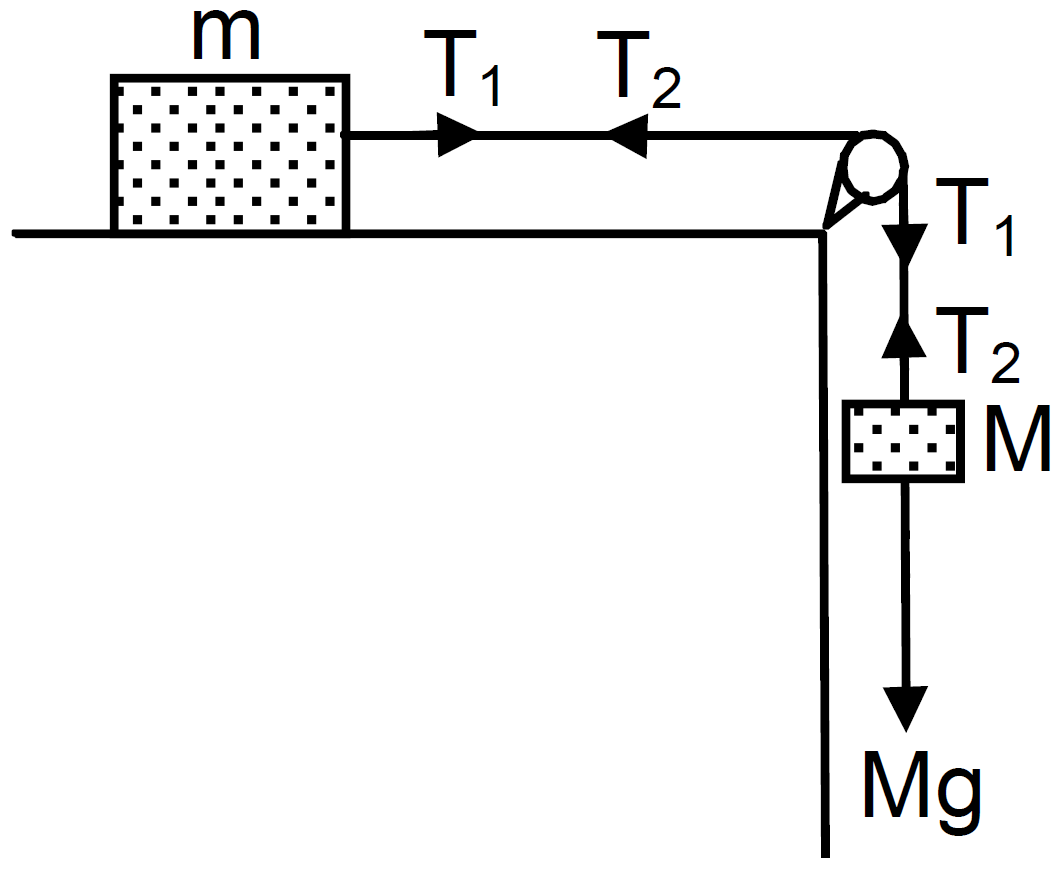 $\text{Mg}-\text{T}_1=\text{ma}\ \dots(1)$ $\text{T}_2=\text{ma}\ \dots(2)$ $\big(\text{T}_1-\text{T}_2\big)=\frac{1\text{a}}{\text{r}^2}\ \dots(3)$ $[$ because $\text{a}=\text{r}\alpha]\ \dots\ \Big[\text{T}.\text{r}=\text{l}\Big(\frac{\text{a}}{\text{r}}\Big)\Big]$ If we add the equation 1 and 2 we will get $\text{Mg}+(\text{T}_2-\text{T}_1)=\text{ma}+\text{ma}\ \dots(4)$ $\Rightarrow\text{Mg}-\frac{\text{la}}{\text{r}^2}=\text{Ma}+\text{ma}$ $\Rightarrow\Big(\text{M}+\text{m}+\frac{\text{l}}{\text{r}^2}\Big)\text{a}=\text{Mg}$ $\Rightarrow\text{a}=\frac{\text{Mg}}{\big(\text{M}+\text{m}+\frac{\text{l}}{\text{r}^2}\big)}$