Question
A block placed on a rough horizontal surface is pulled by a horizontal force F. Let f be the force applied by the rough surface on the block. Plot a graph of f versus F.
Answer

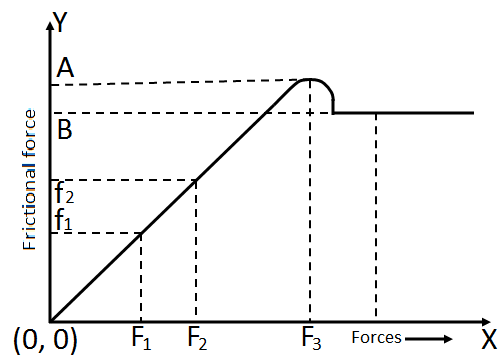
When a small force $F_1$ is applied on a heavier box, it does not move At this state force of friction $f_1$ is equal to $F_1$. On increasing force box does not move till $F=F_S$ the maximum static frictional or limiting force. Its corresponding frictional force $f_S$ on $Y$-axis.
 
After force $F_s$, the frictional force decrease i.e., less force $\text{F}_\text{k}<\text{F}_\text{s}$ is applied on body and it starts to move with less friction $\text{f}_\text{k}<\text{f}_\text{s}$A = limiting frictional force and at $B =$ kinetic frictional force.

Need a full question paper?

Generate a complete, print-ready paper with questions like this in minutes — across 16+ boards, with answer keys.

Start Generating Free

Similar questions

A player throws a ball upwards with an initial speed of $29.4m s^{–1}$. Choose the $x = 0m$ and $t = 0s$ to be the location and time of the ball at its highest point, vertically downward direction to be the positive direction of x-axis, and give the signs of position, velocity and acceleration of the ball during its upward, and downward motion.
A man stands on a weighing machine placed on a horizontal platform. The machine reads $50kg$. By means of a suitable mechanism the platform is made to execute harmonic vibrations up and down with a frequency of $2$ vibrations per second. What will be the effect on the reading of the weighing machine? The amplitude of vibrations of platform is 5cm. Take $g = 10ms^{-2}$?
A geostationary satellite is orbiting the earth at a height of 6R above the surface of the earth; R being the radius of the earth. What will be the time period of another satellite at a height 2.5R from the surface of the earth?
On complete combustion a litre of petrol gives off heat equivalent to $3 × 10⁷J$. In a test drive a car weighing $1200kg$. including the mass of driver, runs $15km$ per litre while moving with a uniform speed on a straight track. Assuming that friction offered by the road surface and air to be uniform, calculate the force of friction acting on the car during the test drive, if the efficiency of the car engine were $0.5$
The current through a wire depends on time as $\text{i}=\text{i}_0+\alpha\text{t},$
Where $\text{i}_0=10\text{A}$ and $\alpha=4\text{A/ s}.$ Find the charge that crosses through a section of the wire in 10 seconds.
A satellite is revolving around the earth, close to the surface of earth with a kinetic energy E. How much kinetic energy should be given to it so that it escapes from the surface of earth?
There are two displacement vectors, one of magnitude $3m$ and other of magnitude $4m$. How should the two vectors be added so that the magnitude of resultant vector be $(i)\  7m \ (ii)\  1m$ and $(iii)\  5m$?
The centre of mass is defined as $\overrightarrow{\text{R}}=\frac{1}{\text{M}}\sum\limits_\text{i}\text{m}_\text{i}\overrightarrow{\text{r}_{\text{i}}}.$ Suppose we define "centre of charge" as $\overrightarrow{\text{R}}_\text{c}=\frac{1}{\text{Q}}\sum\limits_\text{i}\text{q}_\text{i}\overrightarrow{\text{r}_{\text{i}}}$ where $q_i$ represents the $i^{th}$ charge placed at $\overrightarrow{\text{r}_\text{i}}$ and $Q$ is the total charge of the system.
  1. Can the centre of charge of a two$-$charge system be outside the line segment joining the charges?
  2. If all the charges of a system are in $X-Y$ plane, is it necessary that the centre of charge be in $X-Y$ plane?
  3. If all the charges of a system lie in a cube, is it necessary that the centre of charge be in the cube?
Calculate the angular speed of the seconds hand of a clock. If the length of the seconds hand is 4cm, calculate the speed of the tip of the seconds hand.
A dumb-bell consists of two identical small balls of mass $\frac{1}{2}\text{kg}$ each connected to the two ends of a 50cm long light rod. The dumb-bell is rotating about a fixed axis through the centre of the rod and perpendicular to it at an angular speed of 10rad/s. An impulsive force of average magnitude 5.0N acts on one of the masses in the direction of its velocity for 0.10s. Find the new angular velocity of the system.