Question
The current through a wire depends on time as $\text{i}=\text{i}_0+\alpha\text{t},$
Where $\text{i}_0=10\text{A}$ and $\alpha=4\text{A/ s}.$ Find the charge that crosses through a section of the wire in 10 seconds.
Answer

$\text{i}=\text{i}_0+\alpha\text{t},\ \text{t}=10\text{sec},$ $\text{i}_0=10\text{A},\alpha=4\text{A}/\text{ sec}$$\text{q}=\int\limits^\text{t}_0\text{idt}=\int\limits^\text{t}_0(\text{i}_0+\alpha\text{t})\text{dt}=\int\limits^\text{t}_0\text{i}_0\text{dt}+\int\limits^\text{t}_0\alpha\text{tdt}$
$=\text{i}_0\text{t}+\alpha\frac{\text{t}^2}{2}=10\times10+4\times\frac{10\times10}{2}$
$=100+200=300\text{C}.$

Need a full question paper?

Generate a complete, print-ready paper with questions like this in minutes — across 16+ boards, with answer keys.

Start Generating Free

Similar questions

When an object cools down, heat is withdrawn from it. Does the entropy of the object decrease in this process? If yes, is it a violation of the second law of thermodynamics stated in terms of increase in entropy?
Show that the horizontal range of a projectile is same for angles of projection $(45+\alpha)^\circ$ and $(45-\alpha)^\circ.$
What is the change in momentum between the initial and final points of the projectile path, if the range is maximum?
In giving a patient a blood transfusion, the bottle is set up so that the level of blood is 1.3 m above needle, which has an internal diameter of 0.36 mm and is 3 cm in length. If $4.5 cm^3$ of blood passes through the needle in one minute, calculate the viscosity of blood. The density of blood is $1020 kgm ^{-3}$.
What are reversible and irreversible processes? Explain giving one example of each.
Two waves, travelling in the same direction through the same region, have equal frequencies, wavelengths and amplitudes. If the amplitude of each wave is 4mm and the phase difference between the waves is 90°, what is the resultant amplitude?
Plot the corresponding reference circle for each of the following simple harmonic motions. Indicate the initial (t = 0) position of the particle, the radius of the circle, and the angular speed of the rotating particle. For simplicity, the sense of rotation may be fixed to be anticlockwise in every case: (x is in cm and t is in s).$\text{x}=-2\sin\Big(3\text{t}+\frac{\pi}{3}\Big)$
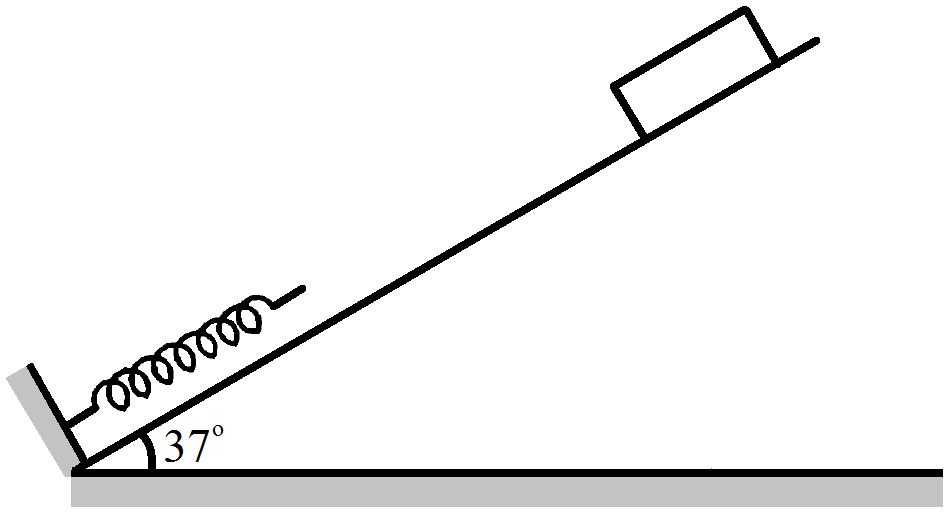
Figure shows a spring fixed at the bottom end of an incline of inclination $37^\circ $. A small block of mass $2\ kg$ starts slipping down the incline from a point $4.8m$ away from the spring. The block compresses the spring by $20\ cm$, stops momentarily and then rebounds through a distance of $1m$ up the incline. Find.
  1. The friction coefficient between the plane and the block.
  2. The spring constant of the spring. Take $g = 10m/s^2$​​​​​​​.
Repeat the previous exercise if the angle between each pair of springs is 120° initially.
In a photodiode, the conductivity increases when the material is exposed to light. It is found that the conductivity changes only if the wavelength is less than 620nm. What is the band gap?