MCQ
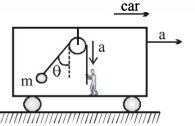
A bob is hanging over a pulley inside a car through, a string. The second end of the string is in the hand of a person standing in the car. The car is moving with constant acceleration ' $a$ ' directed horizontally as shown in figure. Other end of the string is pulled with constant acceleration ' $a$ ' vertically. The tension in the string is equal to-
  • A
    $m \sqrt{g^2+a^2}$
  • B
    $m \sqrt{ g ^2+ a ^2}- ma$
  • $m \sqrt{g^2+a^2}+m a$
  • D
    $m ( g + a )$

Answer

Correct option: C.
$m \sqrt{g^2+a^2}+m a$
c
(c)

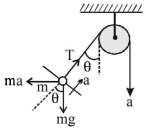
Applying Newton's law along string

$\Rightarrow T - m \sqrt{ g ^2+ a ^2}= ma$

$\text { or } T = m \sqrt{ g ^2+ a ^2}+ ma$

Need a full question paper?

Generate a complete, print-ready paper with questions like this in minutes — across 16+ boards, with answer keys.

Start Generating Free

Similar questions

Which physical quantities have the same dimension
The ratio of thermal conductivity of two rods of different material is $5 : 4$ . The two rods of same area of cross-section and same thermal resistance will have the lengths in the ratio
A gas at ${27}^\circ C$ temperature and $30$ atmospheric pressure is allowed to expand to the atmospheric pressure. If the volume becomes $10$ times its initial volume, then the final temperature becomes ...... $^oC$
Escape velocity of an atmospheric particle which is $1000 \,km$ above the earth's surface, is ..........$km / s$ (radius of earth is $6400 \,km$ and $g=9.8 \,m / s ^2$ )
The number of molecules in one litre of an ideal gas at $300 \,{K}$ and $2$ atmospheric pressure with mean kinetic energy $2 \times 10^{-9}\, {J}$ per molecules is $....\, \times 10^{11}$
Supposing Newton's law of gravitation for gravitation forces $F_1$ and $F_2$ between two masses $m_1$ and $m_2$ at positions $r_1$ and $r_2$ read $F_1=-F_2=-\frac{r^{12}}{r_{12}^3} G_0^2\left(\frac{m_1 m_2}{M_0^2}\right)^n$ where $M_0$ is a constant of dimension of mass, $r_{12}=r_1-r_2$ and $n$ is a number. In such a case,
  1. The acceleration due to gravity on earth will be different for different objects.
  2. None of the three laws of Kepler will be valid.
  3. Only the third law will become invalid.
  4. For $n$ negative, an object lighter than water will sink in water.
A liquid will not wet the surface of a solid, if the angle of contact is:
The time of flight of an object projected with speed $20 \,ms ^{-1}$ at an angle $30^{\circ}$ with the horizontal, is .... $s$
A tap supplies water at $10\,^oC$ and another tap at $100\,^oC$. .......... $kg$ hot water must be taken so that we get $20\, kg$ water at $35\,^oC$ ?
The correct statement from the following is