MCQ
The correct statement from the following is
  • A body having zero velocity will not necessarily have zero acceleration
  • B
    A body having zero velocity will necessarily have zero acceleration
  • C
    A body having uniform speed can have only uniform acceleration
  • D
    A body having non-uniform velocity will have zero acceleration
Answer

Correct option: A.
A body having zero velocity will not necessarily have zero acceleration
a
(a)When the body is projected vertically upward then at the highest point its velocity is zero but acceleration is not equal to zero $(g = 9.8m/{s^2})$.

Need a full question paper?

Generate a complete, print-ready paper with questions like this in minutes — across 16+ boards, with answer keys.

Start Generating Free

Similar questions

The two thigh bones (femures), each of cross-sectional area $10 \,cm ^2$ support the upper part of a person of mass $50 \,kg$. The average pressure sustained by the femures is ............. $N / m ^2$
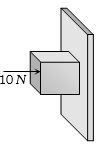
A horizontal force of $10 \,N$ is necessary to just hold a block stationary against a wall. The coefficient of friction between the block and the wall is $0.2$. the weight of the block is ........ $N$
An object of mass $3\,m$ splits into three equal fragments. Two fragments have velocities $v\hat j$ and $v\hat i$. The velocity of the third fragment is
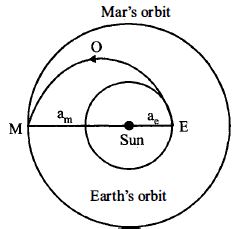
India's Mangalyan was sent to the Mars by launching it into a transfer orbit $EOM$ around the sun . It leaves the earth at $E$ and meets Mars at $M$ . If the semi-major axis of Earth's orbit is $a_e = 1.5 \times 10^{11}\, m$, that of Mars orbit $a_m= 2.28 \times 10^{11}\, m$, taken Kepler's laws give the estimate of time for Mangalyan to reach Mars from Earth to be close to ........ $days$.
A sphere, a cube and a thin circular plate, all of same material and same mass are initially heated to same high temperature.
Two identical cylindrical vessels with their bases at same level, each contains a liquid of density $d$ . The height of the liquid in one vessel is $ h_1$ and that in the other vessel is $h_2$ . The area of either base is $A$ . The work done by gravity in equalizing the levels when the two vessels are connected is
For hydrogen gas, $C_p-C_v=b$. The relation between $a$ and $b$ is:
A $5$ metre long wire is fixed to the ceiling. A weight of $10\, kg$ is hung at the lower end and is $1$ metre above the floor. The wire was elongated by $1\, mm$. The energy stored in the wire due to stretching is ......... $ joule$
A beaker of height $H$ is made up of a material whose coefficient of linear thermal expansion is $3\alpha $ . It is filled up to the brim by a liquid whose coefficient of thermal expansion is $\alpha $. If now the beaker along with its contents is uniformly heated through a small temperature $T$ the level of liquid will reduce by (given $\alpha  << 1$) 
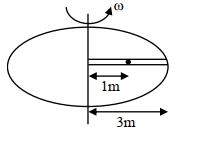
A circular table is rotating with an angular velocity of $\omega \mathrm{rad} / \mathrm{s}$ about its axis (see figure). There is a smooth groove along a radial direction on the table. A steel ball is gently placed at a distance of $1 \mathrm{~m}$ on the groove. All the surface are smooth. If the radius of the table is $3 \mathrm{~m}$, the radial velocity of the ball w.r.t. the table at the time ball leaves the table is $x \sqrt{2} \omega \mathrm{m} / \mathrm{s}$, where the value of $x$ is............