MCQ
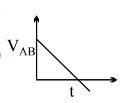
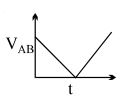
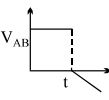
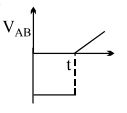
$A$ body $A$ is thrown vertically upwards with such a velocity that it reaches a maximum height of $h$. Simultaneously another body $B$ is dropped from height $h$. It strikes the ground and does not rebound. The velocity of $A$ relative to $B v/s$ time graph is best represented by : (upward direction is positive)
  • A

  • B


  • D

Answer

Correct option: C.

c
For first half,

$V_{a}=u-g t$

$V_{b}=-g t$

$V_{a b}=u-g t-(-g t)$

$=u \quad \Rightarrow \text { constant }$

For Second half.

$V_{a}=-g t$

$V_{b}=0$

$V_{a b}=-g t \Rightarrow-v e$ slope

$\Rightarrow$ Option $\mathrm{C}$

Need a full question paper?

Generate a complete, print-ready paper with questions like this in minutes — across 16+ boards, with answer keys.

Start Generating Free

Similar questions

Two vectors $\overrightarrow a $ and $\overrightarrow b $ are at an angle of $60^o$ with  each other. Their resultant makes an angle of $45^o$ with $\overrightarrow a $ . If $|\overrightarrow b | = 2\,units$ then $|\overrightarrow a |$ is:-
The earth, moving around the sun in a circular orbit, is acted upon by a force and hence work done on the earth by the force is:
From a building two balls $A$ and $B$ are thrown such that $A$ is thrown upwards and $B$ downwards with the same speed (both vertically). If $v_{A}$ and $v_{B}$ are their respective velocities on reaching the ground then,
Two wires A and B are made of same material. The wore A has a length l and diameter r while the wire B has a length 2l and diameter $\frac{\text{r}}{2}$. If the two wires are stretched by the same force, the elongation in A divided by the elongation in 8 is:

  1. $\frac{1}{8}$

  2. $\frac{1}{4}$

  3. $4$

  4. $8$

A particle of mass $1 kg$ is subjected to a force which depends on the position as $\vec{F}=-k(x \hat{i}+y \hat{j}) kgms ^{-2}$ with $k=1 kgs ^{-2}$. At time $t=0$, the particle's position $\vec{r}=\left(\frac{1}{\sqrt{2}} \hat{i}+\sqrt{2} \hat{j}\right) m$ and its velocity $\vec{v}=\left(-\sqrt{2} \hat{i}+\sqrt{2} \hat{j}+\frac{2}{\pi} \hat{k}\right) m s^{-1}$. Let $v_x$ and $v_y$ denote the $x$ and the $y$ components of the particle's velocity, respectively. Ignore gravity. When $z=0.5 m$, the value of $\left(x v_y-y v_x\right)$ is. . . . . $m^2 s^{-1}$
Consider a thin uniform square sheet made of a rigid material. If its side is $‘a’$ mass $m$ and moment of inertia $I$ about one of its diagonals, then
A bomb of mass $16\ kg$ at rest explodes into two pieces of masses $4\ kg$ and $12\ kg.$ The velolcity of the $12\ kg$ mass is $4$ $ms^{-1}$. The kinetic energy of the other mass is .............. $\mathrm{J}$
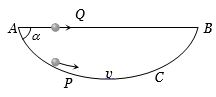
A particle $P$ is sliding down a frictionless hemispherical bowl. It passes the point $A$ at $t = 0$. At this instant of time, the horizontal component of its velocity is $v$. A bead $Q$ of the same mass as $P$ is ejected from $A$ at $t = 0$ along the horizontal string $AB$ (see figure) with the speed $v$. Friction between the bead and the string may be neglected. Let ${t_P}$ and ${t_Q}$ be the respective time taken by $P$ and $Q$ to reach the point $B$. Then
A body is moving forwards and backward. Change in frequency observed of source is 2%. What is velocity of the body? (Speed of sound is 300 m/s)
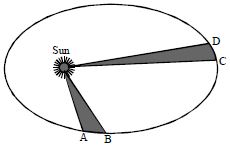
The fig. shows the motion of a planet around the un in an elliptical orbit with sun at the  focus. The shaded areas can be assumed to be equal. If $t_1$ and $t_2$ represent the  time taken for the planet to move from $A$ to $B$ and $C$ to $D$ respectively, then