MCQ 11 Mark
A particle moving with uniform speed in a circular path maintains:
- A
- B
Constant velocity but varying acceleration
- ✓
Varying velocity and varying acceleration
- D
AnswerCorrect option: C. Varying velocity and varying acceleration
c
A particle moving with uniform speed in a circular path maintains varying velocity and varying acceleration. It is because direction of both velocity as well as acceleration will change continuously.
View full question & answer→MCQ 21 Mark
A bob is whirled in a horizontal plane by means of a string with an initial speed of $\omega \mathrm{rpm}$. The tension in the string is $T$. If speed becomes $2 \omega$ while keeping the same radius, the tension in the string becomes:
- ✓
$4 T$
- B
$\frac{T}{4}$
- C
$\sqrt{2} T$
- D
$T$
Answera
(image)
$T=m / \omega^2$
(image)
$T^{\prime}=m \ell(2 \omega)^2$
$T^{\prime}=4$

View full question & answer→MCQ 31 Mark
A particle moving with uniform speed in a circular path maintains:
- A
- B
Constant velocity but varying acceleration
- ✓
Varying velocity and varying acceleration
- D
AnswerCorrect option: C. Varying velocity and varying acceleration
c
A particle moving with uniform speed in a circular path maintains varying velocity and varying acceleration. It is because direction of both velocity as well as acceleration will change continuously.
View full question & answer→MCQ 41 Mark
A bob is whirled in a horizontal plane by means of a string with an initial speed of $\omega \mathrm{rpm}$. The tension in the string is $T$. If speed becomes $2 \omega$ while keeping the same radius, the tension in the string becomes:
- ✓
$4 T$
- B
$\frac{T}{4}$
- C
$\sqrt{2} T$
- D
$T$
Answera
(image)
$T=m / \omega^2$
(image)
$T^{\prime}=m \ell(2 \omega)^2$
$T^{\prime}=4$
View full question & answer→MCQ 51 Mark
A bullet is fired from a gun at the speed of $280\,ms ^{-1}$ in the direction $30^{\circ}$ above the horizontal. The maximum height attained by the bullet is $........\,m$ $\left(g=9.8\,ms ^{-2}, \sin 30^{\circ}=0.5\right):-$
- A
$3000$
- B
$2800$
- C
$2000$
- ✓
$1000$
AnswerCorrect option: D. $1000$
d
$H _{\max }=\frac{ u ^2 \sin ^2 \theta}{2 g }$
$=\frac{(280)^2\left(\sin 30^{\circ}\right)^2}{2(9.8)}$
$=1000\,m$
View full question & answer→MCQ 61 Mark
The angular acceleration of a body, moving along the circumference of a circle, is :
- ✓
along the axis of rotation
- B
along the tangent to its position
- C
along the radius towards the centre
- D
along the radius, away from centre
AnswerCorrect option: A. along the axis of rotation
a
Along the axis of rotation

View full question & answer→MCQ 71 Mark
A bullet is fired from a gun at the speed of $280\,ms ^{-1}$ in the direction $30^{\circ}$ above the horizontal. The maximum height attained by the bullet is $........\,m$ $\left(g=9.8\,ms ^{-2}, \sin 30^{\circ}=0.5\right):-$
- A
$3000$
- B
$2800$
- C
$2000$
- ✓
$1000$
AnswerCorrect option: D. $1000$
d
$H _{\max }=\frac{ u ^2 \sin ^2 \theta}{2 g }$
$=\frac{(280)^2\left(\sin 30^{\circ}\right)^2}{2(9.8)}$
$=1000\,m$
View full question & answer→MCQ 81 Mark
The angular acceleration of a body, moving along the circumference of a circle, is :
- ✓
along the axis of rotation
- B
along the tangent to its position
- C
along the radius towards the centre
- D
along the radius, away from centre
AnswerCorrect option: A. along the axis of rotation
a
Along the axis of rotation
View full question & answer→MCQ 91 Mark
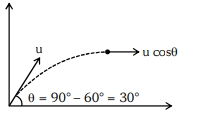
A ball is projected with a velocity, $10 ms ^{-1}$, at an angle of $60^{\circ}$ with the vertical direction. Its speed at the highest point of its trajectory will be$............... ms ^{-1}$
- ✓
$5 \sqrt{3}$
- B
$5$
- C
$10$
- D
AnswerCorrect option: A. $5 \sqrt{3}$
a
At highest point only horizontal component of velocity remains $\Rightarrow u _{ x }= u \cos \theta$
$u _{ x }= u \cos \theta =10 \cos 30^{\circ}$
$=5 \sqrt{3} ms ^{-1}$
View full question & answer→MCQ 101 Mark
A ball is projected with a velocity, $10 ms ^{-1}$, at an angle of $60^{\circ}$ with the vertical direction. Its speed at the highest point of its trajectory will be$............... ms ^{-1}$
- ✓
$5 \sqrt{3}$
- B
$5$
- C
$10$
- D
AnswerCorrect option: A. $5 \sqrt{3}$
a
At highest point only horizontal component of velocity remains $\Rightarrow u _{ x }= u \cos \theta$
$u _{ x }= u \cos \theta =10 \cos 30^{\circ}$
$=5 \sqrt{3} ms ^{-1}$
View full question & answer→MCQ 111 Mark
A cricket ball is thrown by a player at a speed of $20\,m / s$ in a direction $30^{\circ}$ above the horizontal. The maximum height attained by the ball during its motion is $........\,m$ $\left( g =10\,m / s ^2\right)$
Answera
$H =\frac{ u ^2 \sin ^2 \theta}{2 g }=\frac{(20)^2 \sin ^2 30^{\circ}}{2(10)}$
$=5$
View full question & answer→MCQ 121 Mark
A cricket ball is thrown by a player at a speed of $20\,m / s$ in a direction $30^{\circ}$ above the horizontal. The maximum height attained by the ball during its motion is $........\,m$ $\left( g =10\,m / s ^2\right)$
Answera
$H =\frac{ u ^2 \sin ^2 \theta}{2 g }=\frac{(20)^2 \sin ^2 30^{\circ}}{2(10)}$
$=5$
View full question & answer→MCQ 131 Mark
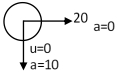
A car starts from rest and accelerates at $5 \,\mathrm{~m} / \mathrm{s}^{2}$. At $t=4 \mathrm{~s}$, a ball is dropped out of a window by a person sitting in the car. What is the velocity and acceleration of the ball at $\mathrm{t}=6\, \mathrm{~s}$ ?
(Take g $\left.=10\, \mathrm{~m} / \mathrm{s}^{2}\right)$
- A
$20\, \mathrm{~m} / \mathrm{s}, 5 \,\mathrm{~m} / \mathrm{s}^{2}$
- B
$20 \,\mathrm{~m} / \mathrm{s}, 0$
- C
$20\, \sqrt{2} \mathrm{~m} / \mathrm{s}, 0$
- ✓
$20 \,\sqrt{2} \mathrm{~m} / \mathrm{s}, 10\, \mathrm{~m} / \mathrm{s}^{2}$
AnswerCorrect option: D. $20 \,\sqrt{2} \mathrm{~m} / \mathrm{s}, 10\, \mathrm{~m} / \mathrm{s}^{2}$
d
$\mathrm{u}=0$
$\mathrm{a}=5$
$\mathrm{t}=4$
$V=u+a t$
$V=0+5 \times 4$
$V=20$
$\mathrm{V}_{\mathrm{x}}=20\, \mathrm{~m} / \mathrm{sec}$
$\mathrm{V}_{\mathrm{y}}=\mathrm{u}+\mathrm{ut}$
$=10 \times 2$
$\mathrm{~V}_{\mathrm{y}}=20\, \mathrm{~m} / \mathrm{sec}$
$\mathrm{V}=20 \sqrt{2}$
and $\mathrm{a}=10\, \mathrm{~m} / \mathrm{sec}^{2}$
View full question & answer→MCQ 141 Mark
A particle moving in a circle of radius $R$ with a uniform speed takes a time $T$ to complete one revolution. If this particle were projected with the same speed at an angle ' $\theta$ ' to the horizontal, the maximum height attained by it equals $4 \mathrm{R}$. The angle of projection, $\theta$, is then given by
- A
$\theta=\cos ^{-1}\left(\frac{g T^{2}}{\pi^{2} R}\right)^{1 / 2}$
- B
$\theta=\cos ^{-1}\left(\frac{\pi^{2} R}{g T^{2}}\right)^{1 / 2}$
- C
$\theta=\sin ^{-1}\left(\frac{\pi^{2} R}{g T^{2}}\right)^{1 / 2}$
- ✓
$\theta=\sin ^{-1}\left(\frac{2 \mathrm{~g} T^{2}}{\pi^{2} R}\right)^{1 / 2}$
AnswerCorrect option: D. $\theta=\sin ^{-1}\left(\frac{2 \mathrm{~g} T^{2}}{\pi^{2} R}\right)^{1 / 2}$
d
$T=\frac{2 \pi R}{V}$
$V=\frac{2 \pi R}{T}$
$H=\frac{u^{2} \sin ^{2} \theta}{2 g}$
$4 R=\frac{4 \pi^{2} R^{2} \sin ^{2} \theta}{T^{2} 2 g}$
$\sin ^{2} \theta=\frac{8 R T^{2} g}{4 \pi^{2} R^{2}}$
$\sin \theta=\sqrt{\frac{2 T^{2} g}{\pi^{2} R}}$
$\theta=\sin ^{-1}\left(\frac{2 T^{2} g}{\pi^{2} R}\right)^{1 / 2}$
View full question & answer→MCQ 151 Mark
A car starts from rest and accelerates at $5 \,\mathrm{~m} / \mathrm{s}^{2}$. At $t=4 \mathrm{~s}$, a ball is dropped out of a window by a person sitting in the car. What is the velocity and acceleration of the ball at $\mathrm{t}=6\, \mathrm{~s}$ ?
(Take g $\left.=10\, \mathrm{~m} / \mathrm{s}^{2}\right)$
- A
$20\, \mathrm{~m} / \mathrm{s}, 5 \,\mathrm{~m} / \mathrm{s}^{2}$
- B
$20 \,\mathrm{~m} / \mathrm{s}, 0$
- C
$20\, \sqrt{2} \mathrm{~m} / \mathrm{s}, 0$
- ✓
$20 \,\sqrt{2} \mathrm{~m} / \mathrm{s}, 10\, \mathrm{~m} / \mathrm{s}^{2}$
AnswerCorrect option: D. $20 \,\sqrt{2} \mathrm{~m} / \mathrm{s}, 10\, \mathrm{~m} / \mathrm{s}^{2}$
d
$\mathrm{u}=0$
$\mathrm{a}=5$
$\mathrm{t}=4$
$V=u+a t$
$V=0+5 \times 4$
$V=20$
$\mathrm{V}_{\mathrm{x}}=20\, \mathrm{~m} / \mathrm{sec}$
$\mathrm{V}_{\mathrm{y}}=\mathrm{u}+\mathrm{ut}$
$=10 \times 2$
$\mathrm{~V}_{\mathrm{y}}=20\, \mathrm{~m} / \mathrm{sec}$
$\mathrm{V}=20 \sqrt{2}$
and $\mathrm{a}=10\, \mathrm{~m} / \mathrm{sec}^{2}$
View full question & answer→MCQ 161 Mark
A particle moving in a circle of radius $R$ with a uniform speed takes a time $T$ to complete one revolution. If this particle were projected with the same speed at an angle ' $\theta$ ' to the horizontal, the maximum height attained by it equals $4 \mathrm{R}$. The angle of projection, $\theta$, is then given by
- A
$\theta=\cos ^{-1}\left(\frac{g T^{2}}{\pi^{2} R}\right)^{1 / 2}$
- B
$\theta=\cos ^{-1}\left(\frac{\pi^{2} R}{g T^{2}}\right)^{1 / 2}$
- C
$\theta=\sin ^{-1}\left(\frac{\pi^{2} R}{g T^{2}}\right)^{1 / 2}$
- ✓
$\theta=\sin ^{-1}\left(\frac{2 \mathrm{~g} T^{2}}{\pi^{2} R}\right)^{1 / 2}$
AnswerCorrect option: D. $\theta=\sin ^{-1}\left(\frac{2 \mathrm{~g} T^{2}}{\pi^{2} R}\right)^{1 / 2}$
d
$T=\frac{2 \pi R}{V}$
$V=\frac{2 \pi R}{T}$
$H=\frac{u^{2} \sin ^{2} \theta}{2 g}$
$4 R=\frac{4 \pi^{2} R^{2} \sin ^{2} \theta}{T^{2} 2 g}$
$\sin ^{2} \theta=\frac{8 R T^{2} g}{4 \pi^{2} R^{2}}$
$\sin \theta=\sqrt{\frac{2 T^{2} g}{\pi^{2} R}}$
$\theta=\sin ^{-1}\left(\frac{2 T^{2} g}{\pi^{2} R}\right)^{1 / 2}$
View full question & answer→MCQ 171 Mark
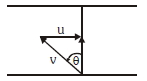
The speed of a swimmer in still water is $20 \;\mathrm{m} / \mathrm{s}$. The speed of river water is $10\; \mathrm{m} / \mathrm{s}$ and is flowing due east. If he is standing on the south bank and wishes to cross the river along the shortest path, the angle at which he should make his strokes w.r.t. north is given by ......$^o$ west
Answera
$\mathrm{v}=20 \mathrm{m} / \mathrm{s}$
$\mathrm{u}=10 \mathrm{m} / \mathrm{s}$
$\sin \theta=\frac{u}{v}=\frac{10}{20}=\frac{1}{2}$
$\Rightarrow \theta=30^{\circ}$ west
View full question & answer→MCQ 181 Mark
Two bullets are fired horizontally and simultaneously towards each other from roof tops of two buldings $100 \;\mathrm{m}$ apart and of same helght of $200 \;\mathrm{m}$ with the same velocity of $25\; \mathrm{m} / \mathrm{s}$. When and where will the two bullets collide. $\left(g=10 \;\mathrm{m} / \mathrm{s}^{2}\right)$
- ✓
after $2\; s$ at a helght $180\; \mathrm{m}$
- B
after $2\; s$ at a helght of $20\; \mathrm{m}$
- C
after $4\;s$ at a height of $120\; \mathrm{m}$
- D
AnswerCorrect option: A. after $2\; s$ at a helght $180\; \mathrm{m}$
a
$\mathrm{t}=\frac{\mathrm{d}}{\mathrm{v}_{\mathrm{rel}}}=\frac{100}{50}=2$
$\mathrm{s}_{\mathrm{y}}=-\frac{1}{2} \mathrm{gt}^{2}=-\frac{1}{2} \times 10 \times 4=-20$
Height $=180 \mathrm{m}$
View full question & answer→MCQ 191 Mark
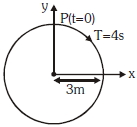
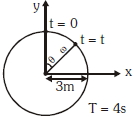
The radius of circle the period of revolution initial position and sense of revolution are indicated in the figure.
$y-$projection of the radius vector of rotating particle $\mathrm{P}$ is
- A
$y(t)=-3 \cos 2 \pi t,$ where $y$ in $m$
- B
$y(t)=4 \sin \left(\frac{\pi t}{2}\right),$ where $y$ in $m$
- C
$y(t)=3 \cos \left(\frac{3 \pi t}{2}\right),$ where $y$ in $m$
- ✓
$y(t)=3 \cos \left(\frac{\pi t}{2}\right),$ where $y$ in $m$
AnswerCorrect option: D. $y(t)=3 \cos \left(\frac{\pi t}{2}\right),$ where $y$ in $m$
d
$\omega=\frac{2 \pi}{4}=\frac{\pi}{2}$
For $y-$projection,
$y=A \cos \omega t$
$\Rightarrow y=3 \cos \left(\frac{\pi t}{2}\right)$
View full question & answer→MCQ 201 Mark
Two particles $A$ and $B$ are moving in uniform circular motion in concentric cirdes of radius $r_{A}$ and $r_{B}$ with speed $v_A$ and $v_B$ respectively. The time period of rotation is the same. The ratio of angular speed of $A$ to that of $B$ will be
AnswerCorrect option: D. $1: 1$
d
$\mathrm{T}_{\mathrm{A}}=\mathrm{T}_{\mathrm{B}}$
$\Rightarrow \frac{2 \pi}{\omega_{A}}=\frac{2 \pi}{\omega_{B}}$
$\Rightarrow \frac{\omega_{A}}{\omega_{B}}=1: 1$
View full question & answer→MCQ 211 Mark
When an object is shot from the bottom of a long smooth inclined plane kept at an angle $60^{\circ}$ with horizontal. it can travel a distance $\mathrm{x}_{1}$ along the plane. But when the inclination is decreased to $30^{\circ}$ and the same object the shot with the same velocity, it can travel $x_{2}$ distance. Then $x_{1}: x_{2}$ will be
- A
$1: \sqrt{2}$
- B
$\sqrt{2}: 1$
- ✓
$1: \sqrt{3}$
- D
$1: 2 \sqrt{3}$
AnswerCorrect option: C. $1: \sqrt{3}$
c
$v^{2}=u^{2}-2 a s$
$\Rightarrow \mathrm{s}=\frac{\mathrm{u}^{2}}{2 \mathrm{a}}=\frac{\mathrm{u}^{2}}{2 \mathrm{gsin} \theta}$
$\frac{\mathrm{x}_{1}}{\mathrm{x}_{2}}=\frac{\sin \theta_{2}}{\sin \theta_{1}}=\frac{\sin 30^{\circ}}{\sin 60^{\circ}}=\frac{1 / 2}{\sqrt{3} / 2}$
$\Rightarrow \frac{x_{1}}{x_{2}}=\frac{1}{\sqrt{3}}$
View full question & answer→MCQ 221 Mark
A particle starting from rest, moves in a circle of radius $r$. It attains a velocity of $\mathrm{V}_{0} \;\mathrm{m} / \mathrm{s}$ in the $\mathrm{n}^{\text {th }}$ round. Its angular acceleration will be
- A
$\frac{\mathrm{V}_{0}}{\mathrm{n}}\; \mathrm{rad} / \mathrm{s}^{2}$
- B
$\frac{\mathrm{V}_{0}^{2}}{2 \pi \mathrm{nr}^{2}} \; \mathrm{rad} / \mathrm{s}^{2}$
- ✓
$\frac{\mathrm{V}_{0}^{2}}{4 \pi \mathrm{nr}^{2}}\; \mathrm{rad} / \mathrm{s}^{2}$
- D
$\frac{V_{0}^{2}}{4 \pi n r}\; \mathrm{rad} / \mathrm{s}^{2}$
AnswerCorrect option: C. $\frac{\mathrm{V}_{0}^{2}}{4 \pi \mathrm{nr}^{2}}\; \mathrm{rad} / \mathrm{s}^{2}$
c
$\theta=(2 \pi n), \omega_{0}=0, \omega=V_{0} / r$
$\alpha=\frac{\omega^{2}-\omega_{0}^{2}}{2 \theta}=\frac{\left(\mathrm{V}_{0} / \mathrm{r}\right)^{2}-0}{2(2 \pi \mathrm{n})}$$=\frac{\mathrm{V}_{0}^{2}}{4 \pi \mathrm{nr}^{2}}$
View full question & answer→MCQ 231 Mark
Two bullets are fired horizontally and simultaneously towards each other from roof tops of two buldings $100 \;\mathrm{m}$ apart and of same helght of $200 \;\mathrm{m}$ with the same velocity of $25\; \mathrm{m} / \mathrm{s}$. When and where will the two bullets collide. $\left(g=10 \;\mathrm{m} / \mathrm{s}^{2}\right)$
- ✓
after $2\; s$ at a helght $180\; \mathrm{m}$
- B
after $2\; s$ at a helght of $20\; \mathrm{m}$
- C
after $4\;s$ at a height of $120\; \mathrm{m}$
- D
AnswerCorrect option: A. after $2\; s$ at a helght $180\; \mathrm{m}$
a
$\mathrm{t}=\frac{\mathrm{d}}{\mathrm{v}_{\mathrm{rel}}}=\frac{100}{50}=2$
$\mathrm{s}_{\mathrm{y}}=-\frac{1}{2} \mathrm{gt}^{2}=-\frac{1}{2} \times 10 \times 4=-20$
Height $=180 \mathrm{m}$
View full question & answer→MCQ 241 Mark
The radius of circle the period of revolution initial position and sense of revolution are indicated in the figure.
$y-$projection of the radius vector of rotating particle $\mathrm{P}$ is
- A
$y(t)=-3 \cos 2 \pi t,$ where $y$ in $m$
- B
$y(t)=4 \sin \left(\frac{\pi t}{2}\right),$ where $y$ in $m$
- C
$y(t)=3 \cos \left(\frac{3 \pi t}{2}\right),$ where $y$ in $m$
- ✓
$y(t)=3 \cos \left(\frac{\pi t}{2}\right),$ where $y$ in $m$
AnswerCorrect option: D. $y(t)=3 \cos \left(\frac{\pi t}{2}\right),$ where $y$ in $m$
d
$\omega=\frac{2 \pi}{4}=\frac{\pi}{2}$
For $y-$projection,
$y=A \cos \omega t$
$\Rightarrow y=3 \cos \left(\frac{\pi t}{2}\right)$
View full question & answer→MCQ 251 Mark
Two particles $A$ and $B$ are moving in uniform circular motion in concentric cirdes of radius $r_{A}$ and $r_{B}$ with speed $v_A$ and $v_B$ respectively. The time period of rotation is the same. The ratio of angular speed of $A$ to that of $B$ will be
AnswerCorrect option: D. $1: 1$
d
$\mathrm{T}_{\mathrm{A}}=\mathrm{T}_{\mathrm{B}}$
$\Rightarrow \frac{2 \pi}{\omega_{A}}=\frac{2 \pi}{\omega_{B}}$
$\Rightarrow \frac{\omega_{A}}{\omega_{B}}=1: 1$
View full question & answer→MCQ 261 Mark
When an object is shot from the bottom of a long smooth inclined plane kept at an angle $60^{\circ}$ with horizontal. it can travel a distance $\mathrm{x}_{1}$ along the plane. But when the inclination is decreased to $30^{\circ}$ and the same object the shot with the same velocity, it can travel $x_{2}$ distance. Then $x_{1}: x_{2}$ will be
- A
$1: \sqrt{2}$
- B
$\sqrt{2}: 1$
- ✓
$1: \sqrt{3}$
- D
$1: 2 \sqrt{3}$
AnswerCorrect option: C. $1: \sqrt{3}$
c
$v^{2}=u^{2}-2 a s$
$\Rightarrow \mathrm{s}=\frac{\mathrm{u}^{2}}{2 \mathrm{a}}=\frac{\mathrm{u}^{2}}{2 \mathrm{gsin} \theta}$
$\frac{\mathrm{x}_{1}}{\mathrm{x}_{2}}=\frac{\sin \theta_{2}}{\sin \theta_{1}}=\frac{\sin 30^{\circ}}{\sin 60^{\circ}}=\frac{1 / 2}{\sqrt{3} / 2}$
$\Rightarrow \frac{x_{1}}{x_{2}}=\frac{1}{\sqrt{3}}$
View full question & answer→MCQ 271 Mark
A particle starting from rest, moves in a circle of radius $r$. It attains a velocity of $\mathrm{V}_{0} \;\mathrm{m} / \mathrm{s}$ in the $\mathrm{n}^{\text {th }}$ round. Its angular acceleration will be
- A
$\frac{\mathrm{V}_{0}}{\mathrm{n}}\; \mathrm{rad} / \mathrm{s}^{2}$
- B
$\frac{\mathrm{V}_{0}^{2}}{2 \pi \mathrm{nr}^{2}} \; \mathrm{rad} / \mathrm{s}^{2}$
- ✓
$\frac{\mathrm{V}_{0}^{2}}{4 \pi \mathrm{nr}^{2}}\; \mathrm{rad} / \mathrm{s}^{2}$
- D
$\frac{V_{0}^{2}}{4 \pi n r}\; \mathrm{rad} / \mathrm{s}^{2}$
AnswerCorrect option: C. $\frac{\mathrm{V}_{0}^{2}}{4 \pi \mathrm{nr}^{2}}\; \mathrm{rad} / \mathrm{s}^{2}$
c
$\theta=(2 \pi n), \omega_{0}=0, \omega=V_{0} / r$
$\alpha=\frac{\omega^{2}-\omega_{0}^{2}}{2 \theta}=\frac{\left(\mathrm{V}_{0} / \mathrm{r}\right)^{2}-0}{2(2 \pi \mathrm{n})}$$=\frac{\mathrm{V}_{0}^{2}}{4 \pi \mathrm{nr}^{2}}$
View full question & answer→MCQ 281 Mark
The speed of a swimmer in still water is $20 \;\mathrm{m} / \mathrm{s}$. The speed of river water is $10\; \mathrm{m} / \mathrm{s}$ and is flowing due east. If he is standing on the south bank and wishes to cross the river along the shortest path, the angle at which he should make his strokes w.r.t. north is given by ......$^o$ west
Answera
$\mathrm{v}=20 \mathrm{m} / \mathrm{s}$
$\mathrm{u}=10 \mathrm{m} / \mathrm{s}$
$\sin \theta=\frac{u}{v}=\frac{10}{20}=\frac{1}{2}$
$\Rightarrow \theta=30^{\circ}$ west
View full question & answer→MCQ 291 Mark
The $x$ and $y$ coordinates of the particle at any time are $x = 5t - 2t^2$ and $y = 10t$ respectively, where $x$ and $y$ are in metres and $t$ in seconds. The acceleration of the particle at $t = 2\, s$ is......$m/sec^2$
Answera
$\begin{array}{l}
\,\,\,\,\,\,\,x = 5t - 2{t^2},y = 10t\\
\frac{{dx}}{{dt}} = 5 - 4t,\frac{{dy}}{{dt}} = 10\,\,\,\,\,\,\therefore {v_x} = 5 - 4t,{v_y} = 10\\
\frac{{d{v_x}}}{{dt}} = - 4,\frac{{d{v_y}}}{{dt}} = 0\,\,\,\,\,\,\,\,\,\,\therefore {a_x} = - 4,{a_y} = 0\\
Acceleration,\,\vec a = {a_x}\hat i + {a_y}\hat j = 4\hat i\\
\therefore \,The\,acceleration\,of\,the\,particle\,at\,t = 2\,s\\
is\, - 4\,m\,{s^{ - 2}}
\end{array}$
View full question & answer→MCQ 301 Mark
A ball of mass $1 \;kg$ is thrown vertically upwards and returns to the ground after $3\; seconds$. Another ball, thrown at $60^{\circ}$ with vertical also stays in air for the same time before it touches the ground. The ratio of the two heights are
Answerb
$T _{1}=\frac{2 u _{1}}{ g }$
$T _{2}=\frac{2 u _{2} \sin \theta}{ g }$
$T _{1}= T _{2}$
$\Rightarrow \frac{2}{ g } u _{1}=\frac{2 u _{2} \sin \theta}{ g } \Rightarrow u _{1}= u _{2} \sin \theta$
$\text { Height }=\frac{ u ^{2} \sin ^{2} \theta}{2 g } \Rightarrow \frac{ H _{1}}{ H _{2}}=\frac{u_{1}^{2}}{u_{2}^{2} \sin ^{2} \theta}$
$\Rightarrow \frac{ H _{1}}{ H _{2}}=1$
View full question & answer→MCQ 311 Mark
The $x$ and $y$ coordinates of the particle at any time are $x = 5t - 2t^2$ and $y = 10t$ respectively, where $x$ and $y$ are in metres and $t$ in seconds. The acceleration of the particle at $t = 2\, s$ is......$m/sec^2$
Answera
$\begin{array}{l}
\,\,\,\,\,\,\,x = 5t - 2{t^2},y = 10t\\
\frac{{dx}}{{dt}} = 5 - 4t,\frac{{dy}}{{dt}} = 10\,\,\,\,\,\,\therefore {v_x} = 5 - 4t,{v_y} = 10\\
\frac{{d{v_x}}}{{dt}} = - 4,\frac{{d{v_y}}}{{dt}} = 0\,\,\,\,\,\,\,\,\,\,\therefore {a_x} = - 4,{a_y} = 0\\
Acceleration,\,\vec a = {a_x}\hat i + {a_y}\hat j = 4\hat i\\
\therefore \,The\,acceleration\,of\,the\,particle\,at\,t = 2\,s\\
is\, - 4\,m\,{s^{ - 2}}
\end{array}$
View full question & answer→MCQ 321 Mark
A ball of mass $1 \;kg$ is thrown vertically upwards and returns to the ground after $3\; seconds$. Another ball, thrown at $60^{\circ}$ with vertical also stays in air for the same time before it touches the ground. The ratio of the two heights are
Answerb
$T _{1}=\frac{2 u _{1}}{ g }$
$T _{2}=\frac{2 u _{2} \sin \theta}{ g }$
$T _{1}= T _{2}$
$\Rightarrow \frac{2}{ g } u _{1}=\frac{2 u _{2} \sin \theta}{ g } \Rightarrow u _{1}= u _{2} \sin \theta$
$\text { Height }=\frac{ u ^{2} \sin ^{2} \theta}{2 g } \Rightarrow \frac{ H _{1}}{ H _{2}}=\frac{u_{1}^{2}}{u_{2}^{2} \sin ^{2} \theta}$
$\Rightarrow \frac{ H _{1}}{ H _{2}}=1$
View full question & answer→MCQ 331 Mark
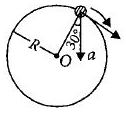
In the given figure, $a = 15 \,m s^{- 2}$ represents the total acceleration of a particle moving in the clockwise direction in a circle of radius $R = 2.5\, m$ at a given instant of time. The speed of the particle is ........ $m/s$
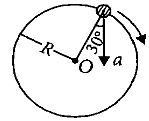
Answera
$\begin{gathered}
\,\,\,\,\,Here,a = 15\,m{s^{ - 2}} \hfill \\
\,\,\,\,\,R = 2.5\,m \hfill \\
From\,figure, \hfill \\
{a_c} = a\,\cos \,{30^ \circ } = 15 \times \frac{{\sqrt 3 }}{2}\,m{s^{ - 2}} \hfill \\
As\,we\,know,\,{a_c} = \frac{{{v^2}}}{R} \Rightarrow v = \sqrt {{a_c}R} \hfill \\
\therefore \,\,\,\,\,v = \sqrt {15 \times \frac{{\sqrt 3 }}{2} \times 2.5} = 5.69 = 5.7m\,{s^{ - 1}} \hfill \\
\end{gathered} $
View full question & answer→MCQ 341 Mark
A particle moves so that its position vector is given by $\overrightarrow {\;r} = cos\omega t\,\hat x + sin\omega t\,\hat y$ , where $\omega$ is a constant. Which of the following is true?
- A
Velocity and acceleration both are parallel to $\overrightarrow {\;r} $
- ✓
Velocity is perpendicular to $\overrightarrow {\;r} \;$ and acceleration is directed towards the origin.
- C
Velocity is perpendicular to $\vec r$ and acceleration is directed away from the origin.
- D
Velocity and acceleration both are perpendicular to $\vec r$
AnswerCorrect option: B. Velocity is perpendicular to $\overrightarrow {\;r} \;$ and acceleration is directed towards the origin.
b
$\begin{array}{l} \,\,\,\,\,\,\,\,\,\,\,\,\,Give,\,\vec r = \cos \omega t\,\hat x + \sin \,\omega t\,\hat y\\ \therefore \,\,\,\,\vec v = \frac{{d\vec r}}{{dt}} = - \omega \,\sin \,\omega t\,\hat x + \omega \,\cos \omega t\,\hat y\\ \,\,\,\,\,\,\mathord{\buildrel{\lower3pt\hbox{$\scriptscriptstyle\rightharpoonup$}} \over a} = \frac{{d\vec v}}{{dt}} = - {\omega ^2}\,\cos \,\omega t\,\hat x - {\omega ^2}\,\sin \,\omega t\,\hat y = - {\omega ^2}\vec r\\ {\rm{Since}}\,position\,vector\,\left( {\bar r} \right)\,is\,directed\,away\\ from\,the\,origin,\,so,\,acceleration\,\left( { - {\omega ^2}\bar r} \right)\\ is\,directed\,towards\,the\,origin.\\ Also,\\ \vec r \cdot \vec v = \left( {\cos \omega t\,\hat x + \sin \,\omega t\,\hat y} \right) \cdot \left( { - \omega \sin \omega t\,\hat x + \omega \cos \omega t\,\hat y} \right)\\ = - \omega \sin \omega t\cos \omega t + \omega \sin \omega t\cos \omega t = 0\\ \,\,\,\,\,\,\,\,\,\,\,\, \Rightarrow \bar r\, \bot \bar v \end{array}$
View full question & answer→MCQ 351 Mark
In the given figure, $a = 15 \,m s^{- 2}$ represents the total acceleration of a particle moving in the clockwise direction in a circle of radius $R = 2.5\, m$ at a given instant of time. The speed of the particle is ........ $m/s$
Answera
$\begin{gathered}
\,\,\,\,\,Here,a = 15\,m{s^{ - 2}} \hfill \\
\,\,\,\,\,R = 2.5\,m \hfill \\
From\,figure, \hfill \\
{a_c} = a\,\cos \,{30^ \circ } = 15 \times \frac{{\sqrt 3 }}{2}\,m{s^{ - 2}} \hfill \\
As\,we\,know,\,{a_c} = \frac{{{v^2}}}{R} \Rightarrow v = \sqrt {{a_c}R} \hfill \\
\therefore \,\,\,\,\,v = \sqrt {15 \times \frac{{\sqrt 3 }}{2} \times 2.5} = 5.69 = 5.7m\,{s^{ - 1}} \hfill \\
\end{gathered} $
View full question & answer→MCQ 361 Mark
A particle moves so that its position vector is given by $\overrightarrow {\;r} = cos\omega t\,\hat x + sin\omega t\,\hat y$ , where $\omega$ is a constant. Which of the following is true?
- A
Velocity and acceleration both are parallel to $\overrightarrow {\;r} $
- ✓
Velocity is perpendicular to $\overrightarrow {\;r} \;$ and acceleration is directed towards the origin.
- C
Velocity is perpendicular to $\vec r$ and acceleration is directed away from the origin.
- D
Velocity and acceleration both are perpendicular to $\vec r$
AnswerCorrect option: B. Velocity is perpendicular to $\overrightarrow {\;r} \;$ and acceleration is directed towards the origin.
b
$\begin{array}{l} \,\,\,\,\,\,\,\,\,\,\,\,\,Give,\,\vec r = \cos \omega t\,\hat x + \sin \,\omega t\,\hat y\\ \therefore \,\,\,\,\vec v = \frac{{d\vec r}}{{dt}} = - \omega \,\sin \,\omega t\,\hat x + \omega \,\cos \omega t\,\hat y\\ \,\,\,\,\,\,\mathord{\buildrel{\lower3pt\hbox{$\scriptscriptstyle\rightharpoonup$}} \over a} = \frac{{d\vec v}}{{dt}} = - {\omega ^2}\,\cos \,\omega t\,\hat x - {\omega ^2}\,\sin \,\omega t\,\hat y = - {\omega ^2}\vec r\\ {\rm{Since}}\,position\,vector\,\left( {\bar r} \right)\,is\,directed\,away\\ from\,the\,origin,\,so,\,acceleration\,\left( { - {\omega ^2}\bar r} \right)\\ is\,directed\,towards\,the\,origin.\\ Also,\\ \vec r \cdot \vec v = \left( {\cos \omega t\,\hat x + \sin \,\omega t\,\hat y} \right) \cdot \left( { - \omega \sin \omega t\,\hat x + \omega \cos \omega t\,\hat y} \right)\\ = - \omega \sin \omega t\cos \omega t + \omega \sin \omega t\cos \omega t = 0\\ \,\,\,\,\,\,\,\,\,\,\,\, \Rightarrow \bar r\, \bot \bar v \end{array}$
View full question & answer→MCQ 371 Mark
Two projectiles $A$ and $B$ are thrown with the same speed such that $A$ makes angle $\theta$ with the horizontal and $B$ makes angle $\theta$ with the vertical, then
AnswerCorrect option: D. Both may have same time of flight
d
Depending on the value of $\theta$ one can have same or different time of flight, range o maximum height. Therefore must statement is wrong. They may be equal or may not be. This is only possible for $\theta=45^{\circ}$
View full question & answer→MCQ 381 Mark
Suppose a player hits several baseballs. Which baseball will be in the air for the longest time?
AnswerCorrect option: B. The one which reaches maximum height.
b
Time of flight $=2 \cdot \sqrt{\frac{2 h}{g}}$
$\therefore T \propto \sqrt{h}$
Hence the one which reaches maximum height flies for longer time.
View full question & answer→MCQ 391 Mark
Two projectiles are thrown simultaneously in the same plane from the same point. If their velocities are $v_1$ and $v_2$ at angles $\theta _1$ and $\theta_2$ respectively from the horizontal, then answer the following question
If $v_1\,\,cos\,\,\theta _1 = v_2\,\,cos\,\,\theta _2$, then choose the incorrect statement
- A
one particle will remain exactly below or above the other particle
- B
the trajectory of one with respect to other will be a vertical straight line
- ✓
both will have the same range
- D
AnswerCorrect option: C. both will have the same range
View full question & answer→MCQ 401 Mark
Two projectiles are thrown simultaneously in the same plane from the same point. If their velocities are $v_1$ and $v_2$ at angles $\theta _1$ and $\theta_2$ respectively from the horizontal, then answer the following question
If $v_1\,\,sin\,\,\theta _1 = v_2\,\,sin\,\,\theta _2$, then choose the incorrect statement
- A
the time of flight of both the particles will be same
- B
the maximum height attained by the particles will be same
- C
the trajectory of one with respect to another will be a horizontal straight line
- ✓
Answerd
$y=\frac{V_{21(y)}}{v_{21(x)}} x \Rightarrow y=\frac{v \sin \theta_{2}-\sin \theta_{1}}{v\left(\cos \theta_{2}-\cos \theta_{1}\right)} x$
$y=\frac{\sin \theta_{2}-\sin \theta_{1}}{\cos \theta_{2}-\cos \theta_{1}} x$
View full question & answer→MCQ 411 Mark
Two projectiles are thrown simultaneously in the same plane from the same point. If their velocities are $v_1$ and $v_2$ at angles $\theta _1$ and $\theta_2$ respectively from the horizontal, then answer the following question
If $v_1 = v_2$ and $\theta _1 > \theta _2$, then choose the incorrect statement
- A
The slope of the trajectory of particle $2$ with respect to $1$ is always positive
- ✓
Particle $2$ moves under the particle $1$
- C
Both the particle will have the same range if $\theta _1 > 45^o$ and $\theta _2 < 45^o$ and $\theta _1 + \theta _2 = 90^o$
- D
AnswerCorrect option: B. Particle $2$ moves under the particle $1$
b
$x=v \cos \theta t=50 \times \frac{3}{5} \times 2=60 \mathrm{m}$
$y=u \sin \theta t-\frac{1}{2} g t^{2}=50 \times \frac{4}{5} \times 2-\frac{1}{2} \times 10 \times 2^{2}=60 m$
$d=\sqrt{x^{2}+y^{2}}$
$=\sqrt{60^{2}+60^{2}}=60 \sqrt{2} m$
View full question & answer→MCQ 421 Mark
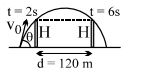
A projectile crosses two walls of equal height $H$ symmetrically as shown The time of flight $T$ is given by ........ $\sec$
View full question & answer→MCQ 431 Mark
A projectile crosses two walls of equal height $H$ symmetrically as shown The maximum height of the projectile is ........ $m$
View full question & answer→MCQ 441 Mark
A projectile is thrown with a velocity of $50\,\, ms^{^{-1}}$ at an angle of $53^o$ with the horizontal .Choose the incorrect statement
- ✓
It travels vertically with a velocity of $40 \,\,ms^{^{-1}}$
- B
It travels horizontally with a velocity of $30\,\, ms^{^{-1}}$
- C
The minimum velocity of the projectile is $30\,\, ms^{^{-1}}$
- D
AnswerCorrect option: A. It travels vertically with a velocity of $40 \,\,ms^{^{-1}}$
View full question & answer→MCQ 451 Mark
A projectile is thrown with a velocity of $50\,\, ms^{^{-1}}$ at an angle of $53^o$ with the horizontal The equation of the trajectory is given by
- ✓
$180y = 240x - x^2$
- B
$180y = x^2 - 240x$
- C
$180y = 135x - x^2$
- D
$180y = x^2 - 135x$
AnswerCorrect option: A. $180y = 240x - x^2$
View full question & answer→MCQ 461 Mark
A particle is projected from the ground with velocity $u$ at angle $\theta$ with horizontal. The horizontal range, maximum height and time of flight are $R, H$ and $T$ respectively. They are given by $R = \frac{{{u^2}\sin 2\theta }}{g}$, $H = \frac{{{u^2}{{\sin }^2}\theta }}{{2g}}$ and $T = \frac{{2u\sin \theta }}{g}$ Now keeping $u $ as fixed, $\theta$ is varied from $30^o$ to $60^o$. Then,
- A
$R$ will first increase then decrease, $H$ will increase and $T$ will decrease
- ✓
$R$ will first increase then decrease while $H$ and $T$ both will increase
- C
$R$ will decrease while $H$ and $T$ will increase
- D
$R$ will increase while $H$ and $T$ will increase
AnswerCorrect option: B. $R$ will first increase then decrease while $H$ and $T$ both will increase
b
$R \propto \sin 2 \theta, H \propto \sin ^{2} \theta$ and $T \propto \sin \theta, \sin 2 \theta$ will first increase, then decrease. While sin $\theta$ will only increase.
View full question & answer→MCQ 471 Mark
The initial position of an object at rest is given by $3 \hat{i}-8 \hat{j}$ It moves with constant acceleration and reaches to the position $2 \hat{i}+4 \hat{j}$ after $4 \,s$. What is its acceleration?
- ✓
$-\frac{1}{8} \hat{i}+\frac{3}{2} \hat{j}$
- B
$2 \hat{i}-\frac{1}{8} \hat{j}$
- C
$-\frac{1}{2} \hat{i}+8 \hat{j}$
- D
$8 \hat{i}-\frac{3}{2} \hat{j}$
AnswerCorrect option: A. $-\frac{1}{8} \hat{i}+\frac{3}{2} \hat{j}$
a
(a)
initial position $\quad x_i=3 \quad y_i=-8$
final position $\quad x_t=2 \quad y_f=4$
$x_f-x_i=\frac{1}{2} a_x t^2=-1$
$y_f-y_i=\frac{1}{2} a_y t^2=12$
$a_x=-\frac{2}{16}=-\frac{1}{8}$
$a y=\frac{24}{16}=\frac{3}{2}$
$a=-\frac{1}{8} \hat{\imath}+\frac{3}{2} \hat{\jmath}=\text { option (A) }$
View full question & answer→MCQ 481 Mark
A body of mass $m$ is thrown upwards at an angle $\theta$ with the horizontal with velocity $v$. While rising up the velocity of the mass after $ t$ seconds will be
- A
$\sqrt {{{(v\,\cos \,\theta )}^2} + {{(v\,\sin \,\theta )}^2}} $
- B
$\sqrt {{{(v\,\cos \,\theta - v\sin \,\theta )}^2} - \,gt} $
- ✓
$\sqrt {{v^2} + {g^2}{t^2} - (2\,v\,\sin \,\theta )\,gt} $
- D
$\sqrt {{v^2} + {g^2}{t^2} - (2\,v\,\cos \,\theta )\,gt} $
AnswerCorrect option: C. $\sqrt {{v^2} + {g^2}{t^2} - (2\,v\,\sin \,\theta )\,gt} $
c
(c) Instantaneous velocity of rising mass after $t$ sec will be ${v_t} = \sqrt {v_x^2 + v_y^2} $
where ${v_x} = v\cos \theta = $Horizontal component of velocity
${v_y} = v\sin \theta - gt = $Vertical component of velocity
${v_t} = \sqrt {{{(v\cos \theta )}^2} + {{(v\sin \theta - gt)}^2}} $
${v_t} = \sqrt {{v^2} + {g^2}{t^2} - 2v\sin \theta \,gt} $
View full question & answer→MCQ 491 Mark
The linear speed of the tip of seconds hand of a wall clock is $1.05\,cm\,s^{-1}.$ The length of the seconds hand is nearly ........ $cm$
Answerc
In $60$ sec the tip of seconds hand travels a distance $2 \pi \ell$
i.e., $\quad \frac{2 \pi \ell}{60}=1.05$
or $\quad \ell=\frac{60 \times 1.05 \times 7}{2 \times 22}=\frac{63 \times 7}{44}$
$=\frac{441}{44} \cong 10 \mathrm{cm}$
View full question & answer→MCQ 501 Mark
A projectile is fired at $30^{\circ}$ to the horizontal, The vertical component of its velocity is $80 \;ms ^{-1}$, Its time flight is $T$. What will be the velocity of projectile at $t =\frac{ T }{2}$?
- A
$80\, ms^{-1}$
- ✓
$80\sqrt 3 ms^{-1}$
- C
$(80/\sqrt 3 ) ms^{-1}$
- D
$40\, ms^{-1}$
AnswerCorrect option: B. $80\sqrt 3 ms^{-1}$
b
$u_{vertical} = u\sin \theta = 80$
$\Rightarrow \,u = \frac{{80}}{{\sin {{30}^o}}} = 160\,m/s$
${u_{horizontal}} = u\cos \theta = 160\,\,\cos {30^o} = 80\sqrt 3 \,m/s.$
View full question & answer→