MCQ
A body $A$ of mass $\mathrm{m}$ is moving in a circular orbit of radius $\mathrm{R}$ about a planet. Another body $\mathrm{B}$ of mass $\frac{\mathrm{m}}{2}$ collides with $\mathrm{A}$ with a velocity which is half $\left(\frac{\overrightarrow{\mathrm{v}}}{2}\right)$ the instantaneous velocity $\overrightarrow{\mathrm{v}}$ of $\mathrm{A}$ The collision is completely inelastic. Then, the combined body
  • starts moving in an elliptical orbit around the planet
  • B
    continues to move in a circular orbit
  • C
    Falls vertically downwards towards the planet
  • D
    Escapes from the Planet's Gravitational field.
Answer

Correct option: A.
starts moving in an elliptical orbit around the planet
a
Initially, the body of mass $\mathrm{m}$ is moving in a circular orbit of radius $\mathrm{R} .$ So it must be moving with orbital speed.

$\mathrm{v}_{0}=\sqrt{\frac{\mathrm{GM}}{\mathrm{R}}}$

After collision, let the combined mass moves with speed $v_{1 }$

${\mathrm{mv}_{0}+\frac{\mathrm{m}}{2} \frac{\mathrm{v}_{0}}{2}=\left(\frac{3 \mathrm{m}}{2}\right) \mathrm{v}_{1}}$

${\mathrm{v}_{1}=\frac{5 \mathrm{v}_{0}}{6}}$

since after collision, the speed is not equal to orbital speed at that point. So motion cannot be circular. since velocity will remain tangential, so it cannot fall vertically towards the planet. Their speed after collision is less than escape speed $\sqrt{2} v_{0}, \quad$

so they cannot escape gravitational field. So their motion will be elliptical around the planet.

Need a full question paper?

Generate a complete, print-ready paper with questions like this in minutes — across 16+ boards, with answer keys.

Start Generating Free

Similar questions

The ratio of work done by an ideal monoatomic gas to the heat supplied to it in an isobaric process is
A man, standing between two cliffs, claps his hands and starts hearing a series of echoes at intervals of one second. If the speed of sound in air is $340 ms^{-1}$, the distance between the cliffs is  .... $m$
The mean kinetic energy of a gas at $300 K$ is $100 J.$ The mean energy of the gas at $450 K$ is equal to ...... $J$
$K$ is the force constant of a spring. The work done in increasing its extension from ${l_1}$ to ${l_2}$ will be
Two stones are projected so as to reach the same distance from the point of projection on a horizontal surface. The maximum height reached by one exceeds the other by an amount equal to half the sum of the height attained by them. Then, angle of projection of the stone which attains smaller height is $........$
The coefficient of performance of a refrigerator is $5$ . If the temperature inside freezer is $-20\,^oC$ , the temperature of the surroundings to which it rejects heat is ....... $^oC$
A body of mass $10 kg$ is projected at an angle of $45^{\circ}$ with the horizontal. The trajectory of the body is observed to pass through a point $(20,10)$. If $T$ is the time of flight, then its momentum vector, at time $t =\frac{ T }{\sqrt{2}}$, is.

$\left[\right.$ Take $\left.g=10 m / s ^{2}\right]$

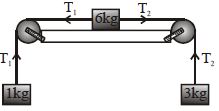
Three masses of $1\, kg$, $6\, kg$ and $3\, kg$ are connected to each other with threads and are placed on a tabel as shown in figure. ....... $ms^{-2}$ is the acceleration with which the block is moving. (Take $g = 10\, ms^2$)
The unification of electromagnetism and optics leads to the:
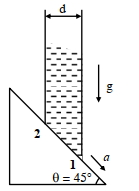
A cylindrical tube, with its base as shown in the figure, is filled with water. It is moving down with a constant acceleration $a$ along a fixed inclined plane with angle $\theta=45^{\circ} . P_1$ and $P_2$ are pressures at points 1 and 2 , respectively, located at the base of the tube. Let $\beta=\left(P_1-P_2\right) /(\rho g d)$, where $\rho$ is density of water, $d$ is the inner diameter of the tube and $g$ is the acceleration due to gravity. Which of the following statement($s$) is(are) correct?

$(A)$ $\beta=0$ when $a= g / \sqrt{2}$

$(B)$ $\beta>0$ when $a= g / \sqrt{2}$

$(C)$ $\beta=\frac{\sqrt{2}-1}{\sqrt{2}}$ when $a= g / 2$

$(D)$ $\beta=\frac{1}{\sqrt{2}}$ when $a= g / 2$