Question
A body $A$ of mass $M$ while falling vertically downwards under gravity breaks into two parts; a body $B$ of mass $\frac{2}{3} M$. The centre of mass of bodies $B$ and $C$ taken together shifts compared to that of body $A$ towards

Answer

Since, the acceleration of centre of mass in both the cases is same equal to $g$. So the centre of mass of the bodies $B$ and $C$ taken together does not shift compared to that of body $A$.

Need a full question paper?

Generate a complete, print-ready paper with questions like this in minutes — across 16+ boards, with answer keys.

Start Generating Free

Similar questions

Given below are two statements

Statement $I:$ The equivalent resistance of resistors in a series combination is smaller than least resistance used in the combination.

Statement $II$ : The resistivity of the material is independent of temperature.

In the light of the above statements, choose the correct answer from the options given below

Thermions are
A particle of mass 10 g is kept on the surface of a uniform sphere of mass 100 kg and radius 10 cm. Find the work to be done against the gravitational force between them to take the particle far away from the sphere. (You may take $G =6.67 \times 10^{-11} n N-\left.m ^2 / kg ^2\right)$
$Assertion$ : The two bodies of masses $M$ and $m$ $(M > m)$ are allowed to fall from the same height if the air resistance for each be the same then both the bodies will reach the earth simultaneously.

$Reason$ : For same air resistance, acceleration of both the bodies will be same
An alternating $e.m.f$. of angular frequency $\omega $ is applied across an inductance. The instantaneous power developed in the circuit has an angular frequency
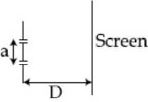
The figure shows a Young’s double slit experimental setup. It is observed that when a thin transparent sheet of thickness $t$ and refractive index $\mu $ is put in front of one of the slits, the central maximum gets shifted by a distance equal to $n$ fringe widths. If the wavelength of light used is $\lambda ,\,t$ will be
A slab of glass, of thickness $6\, cm$ and refractive index $1.5$, is placed in front of a concave mirror, the faces of the slab being perpendicular to the principal axis of the mirror. If the radius of curvature of the mirror is $40\, cm$ and the reflected image coincides with the object, then the distance of the object from the mirror is.....$cm$
The magnetic field at a point $x $ on the axis of a small bar magnet is equal to the field at a point $  y  $ on the equator of the same magnet. The ratio of the distances of $x$ and $y$  from the centre of the magnet is
A body of mass $m $ accelerates uniformly from rest to ${v_1}$ in time ${t_1}$. As a function of time $ t$, the instantaneous power delivered to the body is