MCQ
A body at rest may have
  • Energy
  • B
    Momentum
  • C
    Speed
  • D
    Velocity

Answer

Correct option: A.
Energy
a
(a)Body at rest may possess potential energy.

Need a full question paper?

Generate a complete, print-ready paper with questions like this in minutes — across 16+ boards, with answer keys.

Start Generating Free

Similar questions

A $ U$ tube of uniform bore of cross-sectional area $A$ has been set up vertically with open ends facing up. Now $m$ gm of a liquid of density $d$ is poured into it. The column of liquid in this tube will oscillate with a period $T$ such that
A particle $A$ is projected vertically upwards. Another identical particle $B$ is projected at an angle of $45^o $ . Both reach the same height. The ratio of the initial kinetic energy of $A$ to that of $B$ is
The resistance $\mathrm{R}=\frac{\mathrm{V}}{\mathrm{I}}$ where $\mathrm{V}=(200 \pm 5) \mathrm{V}$ and $I=(20 \pm 0.2) A$, the percentage error in the measurement of $R$ is :
A particle is kept at rest at a distance $R_e ($earth's radius$)$ above the earth's surface. The minimum speed with which it should be projected so that it does not return is $($mass of earth $= M_e)$
The diameter of two pistons of a hydraulic press are $0.1\,\, m$ and $0.6\,\, m$ respectively. Advantage of the hydraulic press assuming effort is applied directly on pump plunger 
Match List$-I$ with List$-II.$

List$-I$ List$-II$
$(a)$ Torque $(i)$ ${MLT}^{-1}$
$(b)$ Impulse $(ii)$ ${MT}^{-2}$
$(c)$ Tension $(iii)$ ${ML}^{2} {T}^{-2}$
$(d)$ Surface Tension $(iv)$ ${MI} {T}^{-2}$

Choose the most appropriate answer from the option given below :
Water rises to a height of $2\, cm$ in a capillary tube. If the tube is tilted $60^o$ from the  vertical, water will rise in the tube to a length ...... $cm$
The thermal conductivity of a rod depends on:
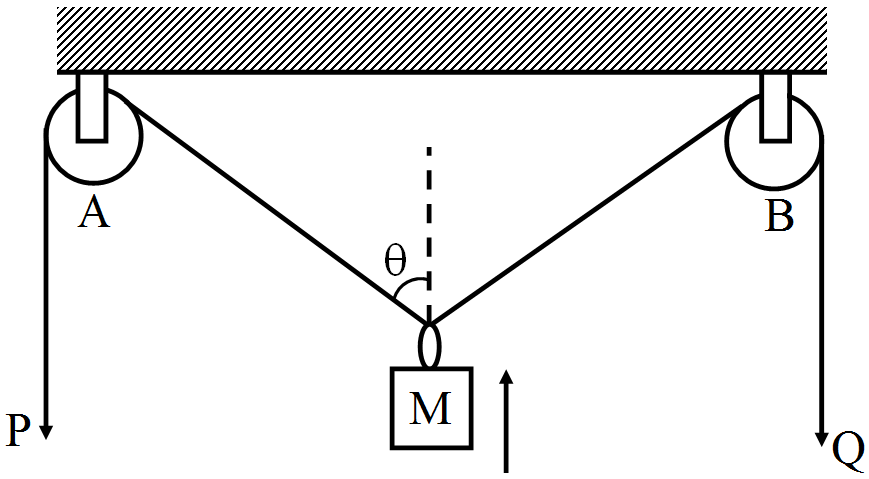
In the arrangement shown in figure, the ends $P$ and $Q$ of an inextensible string move downwards with uniform speed $u$. Pulleys $A$ and $B$ are fixed. The mass $M$ moves upwards with a speed:
Two particles of equal mass $m$ each move in a circle of radius $r$ under the action of their mutual gravitational attraction. Time period of each particle is