Question
A body constrained to move along the z-axis of a coordinate system is subject to a constant force F given by $\text{F}=-\hat{\text{i}}+2\hat{\text{j}}+3\hat{\text{k}}\text{N}$ where $\hat{\text{i}},\hat{\text{j}},\hat{\text{k}}$ are unit vectors along the x, y and z-axis of the system respectively. What is the work done by this force in moving the body a distance of 4m along the z-axis?
Answer

We know that the work done is given as, W = F.s Here F = -i + 2j + 3k s = 0i + 0j + 4k So, we have W = (-i + 2j + 3k).(0i + 0j + 4k) Thus, we get W = 3k.4k = 12J

Need a full question paper?

Generate a complete, print-ready paper with questions like this in minutes — across 16+ boards, with answer keys.

Start Generating Free

Similar questions

A hollow sphere filled with water is used as the bob of a pendulum. Assume that the equation for simple pendulum is valid with the distance between the point of suspension and centre of mass of the bob acting as the effective length of the pendulum. If water slowly leaks out of the bob, how will the time period vary?
The changes in a function y and the independent dy variable x are related as $\frac{\text{dy}}{\text{dx}}=\text{x}^2.$ Find y as a function of x.
A passenger of mass $72.2\ kg$ is riding in an elevator while standing on a platform scale. What does the scale read when the elevator cab is:
  1. Descending with constant velocity,
  2. Ascending with constant acceleration, $3.5\ m/ s$?
The free path of molecules of a gas at $27^{\circ} C$ temperature is $2.76 \times 10^{-5}$ meter. If the diameter of the molcule is $3.0 \text Å $, then find the pressure of the gas.
What do you mean by the elastic limit?
Show that the dimensions of the displacement current $\in_0\frac{\text{d}\phi_\text{E}}{\text{dt}}$ are that of an electric current.
In discussing Doppler effect, we use the word "apparent frequency". Does it mean that the frequency of the sound is still that of the source and it is some physiological phenomenon in the listener's ear that gives rise to Doppler effect? Think for the observer approaching the source and for the source approaching the observer.
Why a tennis ball bounces higher on hills than on plains?
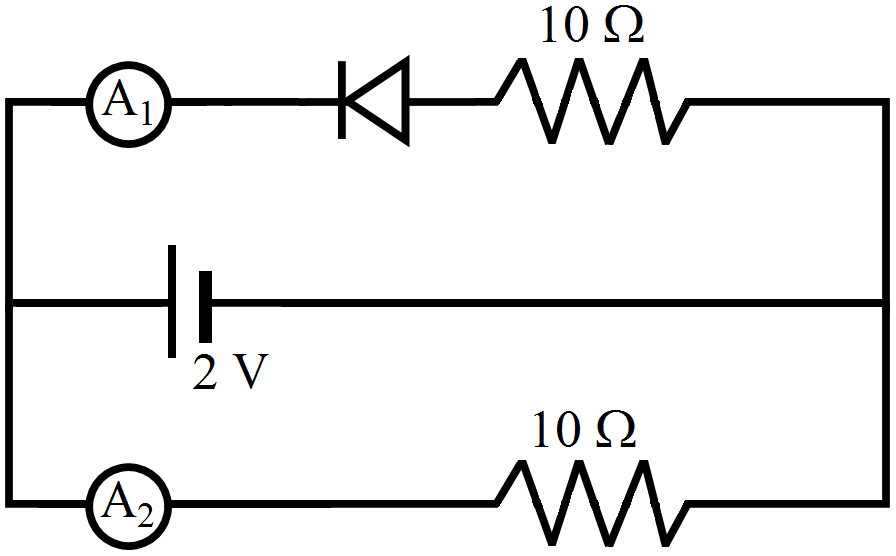
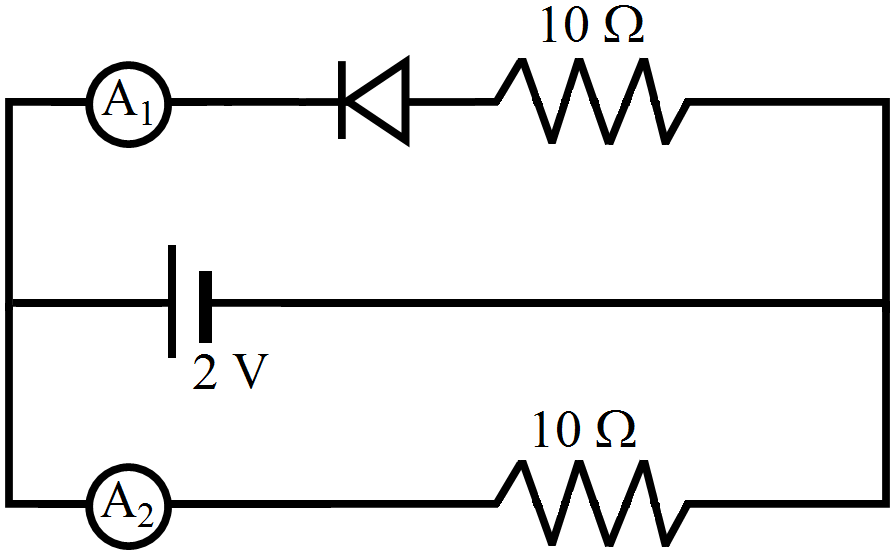
What are the readings of the ammeters $A_1$ and $A_2$ shown in figure. Neglect the resistance of the meters.
Prove that the maximum horizontal range of a projectile is four times the maximum height