A body cools from ${50.0^o}C$ to ${49.9^o}C$ in $5\;s$. How long will it take to cool from ${40.0^o}C$ to ${39.9^o}C$? Assume the temperature of surroundings to be ${30.0^o}C$ and Newton's law of cooling to be valid ....... $\sec$
Medium


Download our appand get started for free
Experience the future of education. Simply download our apps or reach out to us for more information. Let's shape the future of learning together!No signup needed.*
Similar Questions
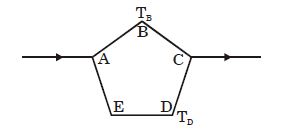
- 1$ABCDE$ is a regular pentagon of uniform wire. The rate of heat entering at $A$ and leaving at $C$ is equal. $T_B$ and $T_D$ are temperature of $B$ and $D$ . Find the temperature $T_C$View Solution
- 2View SolutionWoollen clothes are used in winter season because woolen clothes
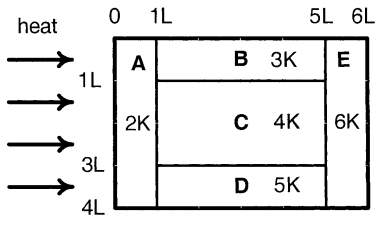
- 3A composite block is made of slabs $A, B, C, D$ and $E$ of different thermal conductivities (given in terms of a constant $K$ ) and sizes (given in terms of length, $L$ ) as shown in the figure. All slabs are of same width. Heat $'Q'$ flows only from left to right through the blocks. Then in steady state $Image$View Solution
$(A)$ heat flow through $A$ and $E$ slabs are same.
$(B)$ heat flow through slab $E$ is maximum.
$(C)$ temperature difference across slab $E$ is smallest.
$(D)$ heat flow through $C =$ heat flow through $B +$ heat flow through $D$.
- 4Two cylinders $P$ and $Q$ have the same length and diameter and are made of different materials having thermal conductivities in the ratio $2 : 3$ . These two cylinders are combined to make a cylinder. One end of $P$ is kept at $100°C$ and another end of $Q$ at $0°C$ . The temperature at the interface of $P$ and $Q$ is ...... $^oC$View Solution
- 5The total radiant energy per unit area, normal to the direction of incidence, received at a distance $R$ from the centre of a star of radius $r$, whose outer surface radiates as a black body at a temperature $T\ K$ is given byView Solution
- 6There is formation of layer of snow $x\,cm$ thick on water, when the temperature of air is $ - {\theta ^o}C$ (less than freezing point). The thickness of layer increases from $x$ to $y$ in the time $t$, then the value of $t$is given byView Solution
- 7View SolutionIn steady state graph between temp and distance from hot end is
- 8View SolutionAbsorption co-efficient of an open window is...
- 9A body cools from $60^{\circ} C$ to $40^{\circ} C$ in $6$ minutes. If, temperature of surroundings is $10^{\circ} C$. Then, after the next 6 minutes, its temperature will be $.........{ }^{\circ} C$.View Solution
- 10A body takes $T$ minutes to cool from ${62^o}C$ to ${61^o}C$ when the surrounding temperature is ${30^o}C$. The time taken by the body to cool from ${70^o}$ to $({A_1}\,{\rm{and }}{A_{\rm{2}}})$ isView Solution