A body takes $T$ minutes to cool from ${62^o}C$ to ${61^o}C$ when the surrounding temperature is ${30^o}C$. The time taken by the body to cool from ${70^o}$ to $({A_1}\,{\rm{and }}{A_{\rm{2}}})$ is
Medium


Download our appand get started for free
Experience the future of education. Simply download our apps or reach out to us for more information. Let's shape the future of learning together!No signup needed.*
Similar Questions
- 1A metallic rod of cross-sectional area $9.0\,\,cm^2$ and length $0.54 \,\,m$, with the surface insulated to prevent heat loss, has one end immersed in boiling water and the other in ice-water mixture. The heat conducted through the rod melts the ice at the rate of $1 \,\,gm$ for every $33 \,\,sec$. The thermal conductivity of the rod is ....... $ Wm^{-1} K^{-1}$View Solution
- 2A metallic sphere cools from $50^{\circ} C$ to $40^{\circ} C$ in $300 \,s.$ If atmospheric temperature around is $20^{\circ} C ,$ then the sphere's temperature after the next $5$ minutes will be close to$.....C$View Solution
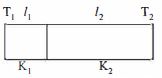
- 3One end of a thermally insulated rod is kept at a temperature $T_1$ and the other at $T_2$ . The rod is composed of two sections of length $l_1$ and $l_2$ and thermal conductivities $K_1$ and $K_2$ respectively. The temperature at the interface of the two section isView Solution
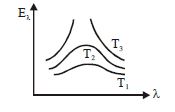
- 4View SolutionVariation of radiant energy emitted by sun, filament of tungsten lamp and welding arc as a function of its wavelength is shown in figure. Which of the following option is the correct match?
- 5Two walls of thicknesses $d_1$ and $d_2$ and thermal conductivities $k_1$ and $k_2$ are in contact. In the steady state, if the temperatures at the outer surfaces are ${T_1}$ and ${T_2}$, the temperature at the common wall isView Solution
- 6On observing light from three different stars $P, Q$ and $R$, it was found that intensity of violet colour is maximum in the spectrum of $P$, the intensity of green colour is maximum in the spectrum of $R$ and the intensity of red colour is maximum in the spectrum of $Q$. If $T_P, T_Q$ and $T_R$ are the respective absolute temperatures of $P, Q$ and $R$, then it can be concluded from the above observations thatView Solution
- 7The top of a lake gets frozen at a place where the surrounding air is at a temperature of $-20\,^oC$. ThenView Solution
- 8A heated body maintained at $T\,K$ emits thermal radiation of total energy $E$ with a maximum intensity at frequency $v$ . The emissivity of the material is $0.5$ . If the temperature of the body be increased and maintained at temperature $3T\,K$ , thenView Solution
$(i)$ The maximum intensity of the emitted radiation will occur at frequency $v /3$
$(ii)$ The maximum intensity of the emitted radiation will occur at frequency $3v $
$(iii)$ The total energy of emitted radiation will become $81\,E$
$(iv)$ The total energy of emitted radiation will become $27\,E$
- 9View SolutionWhich of the following statement is correct
- 10A black body at $227^o C$ radiates heat at the rate of $7\; cals/cm^2 s$. At a temperature of $727^o C$, the rate of heat radiated in the same units will beView Solution