A body cools from ${60^o}C$ to ${50^o}C$ in $10$ minutes when kept in air at ${30^o}C$. In the next $10$ minutes its temperature will be
Medium


Download our appand get started for free
Experience the future of education. Simply download our apps or reach out to us for more information. Let's shape the future of learning together!No signup needed.*
Similar Questions
- 1Two bottles $A$ and $B$ have radii $R_{A}$ and $R_{B}$ and heights $h_{A}$ and $h_{B}$ respectively, with $R_{B}=2 R_{A}$ and $h_{B}=2 h_{A}$. These are filled with hot water at $60^{\circ} C$. Consider that heat loss for the bottles takes place only from side surfaces. If the time, the water takes to cool down to $50^{\circ} C$ is $t_{A}$ and $t_{B}$ for bottles $A$ and $B$, respectively. Then, $t_{A}$ and $t_{B}$ are best related asView Solution
- 2If the radius of a star is $R$ and it acts as a black body, what would be the temperature of the star, in which the rate of energy production is $Q$?View Solution
($\sigma$ stands for Stefan's constant)
- 3Two spheres $P$ and $Q$, of same colour having radii $8\;cm$ and $2\;cm$ are maintained at temperatures ${127^o}C$ and ${527^o}C$ respectively. The ratio of energy radiated by $P$ and $Q$ isView Solution
- 4The end $A$ of a rod $AB$ of length $1\,m$ is maintained at $80\,^oC$ and the end $B$ at $0\,^oC.$ The temperature at a distance of $60\,\,c.m.$ from the end $A$ is......... $^oC$View Solution
- 5When $p$ calories of heat is given to a body, it absorbs $q$ calories; then the absorbtion power of body will beView Solution
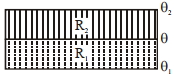
- 6The temperature $\theta$ at the junction of two insulating sheets, having thermal resistances $R _{1}$ and $R _{2}$ as well as top and bottom temperatures $\theta_{1}$ and $\theta_{2}$ (as shown in figure) is given byView Solution
- 7A black body at $1227^o C$ emits radiations with maximum intensity at a wavelength of $5000\;\mathring A$ . If the temperature of the body is increased by $1000^o C$, the maximum intensity will be observed at ...... $\mathring A$View Solution
- 8View SolutionAccording to ‘Newton’s Law of cooling’, the rate of cooling of a body is proportional to the
- 9View SolutionAbsorption co-efficient of an open window is...
- 10View SolutionNewton’s law of cooling, holds good only if the temperature difference between the body and the surroundings is