A body cools in $7$ minutes from $60^{\circ}\,C$ to $40^{\circ}\,C$. The temperature of the surrounding is $10^{\circ}\,C$. The temperature of the body after the next $7$ minutes will be
JEE MAIN 2023, Medium
Download our app for free and get started
using average rate of Newton's law of cooling
$\frac{T_1-T_2}{t}=K\left(\frac{T_1+T_2}{2}-T_s\right)$
Given $\frac{60-40}{7}=K(50-10) \ldots$ (i)
$\frac{40-T}{7}=K\left(\frac{40+T}{2}-10\right) \ldots$ (ii)
From $(i)$ and $(ii)$
$T =28^{\circ}\,C$

Download our appand get started for free
Experience the future of education. Simply download our apps or reach out to us for more information. Let's shape the future of learning together!No signup needed.*
Similar Questions
- 1Consider two rods of same length and different specific heats $\left(S_{1}, S_{2}\right)$, conductivities $\left(K_{1}, K_{2}\right)$ and area of cross-sections $\left(A_{1}, A_{2}\right)$ and both having temperatures $T_{1}$ and $T_{2}$ at their ends. If rate of loss of heat due to conduction is equal, thenView Solution
- 2View SolutionMode of transmission of heat, in which heat is carried by the moving particles, is
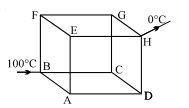
- 3Twelve conducting rods form the riders of a uniform cube of side $'l'.$ If in steady state, $B$ and $H$ ends of the rod are at $100^o C$ and $0^o C$. Find the temperature of the junction $'A'$ ....... $^oC$View Solution
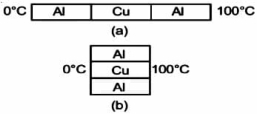
- 4The three rods shown in figure have identical dimensions. Heat flows from the hot end at a rate of $40 \,W$ in the arrangement $(a)$. Find the rates of heat flow when the rods are joined as in arrangement $(b)$ is ......... $W$ (Assume $K_al=200 \,W / m ^{\circ} C$ and $\left.K_{c u}=400 \,W / m ^{\circ} C \right)$View Solution
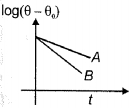
- 5Two bodies $A$ and $B$ of equal masses, area and emissivity cooling under Newton's law of cooling from same temperature are represented by the graph. If $\theta$ is the instantaneous temperature of the body and $\theta_0$ is the temperature of surroundings, then relationship between their specific heats is ..........View Solution
- 6A body takes $4$ minutes to cool from ${100^o}C$ to ${70^o}C$. To cool from ${70^o}C$ to ${40^o}C$ it will take ........ $\min.$ (room temperature is ${15^o}C$)View Solution
- 7View SolutionA block of metal is heated to a temperature much higher than the room temperature and allowed to cool in a room free from air currents. Which of the following curves correctly represents the rate of cooling
- 8In $MKS$ system, Stefan's constant is denoted by $\sigma $. In $CGS$ system multiplying factor of $\sigma $ will beView Solution
- 9Three stars $A, B, C$ have surface temperatures $T _{A} ,T _{B}, T _{C}$ respectively. Star $A$ appears bluish, star $B$ appears reddish and star $C$ yellowish. Hence,View Solution
- 10A body cools from ${60^o}C$ to ${50^o}C$ in $10$ minutes when kept in air at ${30^o}C$. In the next $10$ minutes its temperature will beView Solution