A block of metal is heated to a temperature much higher than the room temperature and allowed to cool in a room free from air currents. Which of the following curves correctly represents the rate of cooling
Diffcult
Download our app for free and get started
(b) According to Newton's law of cooling
Rate of cooling $\propto$ Temperature difference
Rate of cooling $\propto$ Temperature difference
==> $ - \frac{{d\theta }}{{dt}} \propto (\theta - {\theta _0})$
==>$ - \frac{{d\theta }}{{dt}}$=$\alpha \;(\theta - {\theta _0})$ ($\alpha$= constant)
==> $\int\limits_{{\theta _i}}^\theta {\frac{{d\theta }}{{(\theta - {\theta _0})}} = - \alpha \int\limits_0^t {dt} } $
==> $\theta = {\theta _0} + ({\theta _i} - {\theta _0}){e^{ - \alpha \,t}}$
This relation tells us that, temperature of the body varies exponentially with time from ${\theta _i}$ to ${\theta _0}$
Hence graph $(b)$ is correct.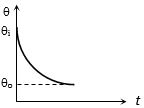

Download our appand get started for free
Experience the future of education. Simply download our apps or reach out to us for more information. Let's shape the future of learning together!No signup needed.*
Similar Questions
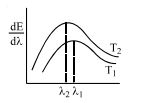
- 1Shown below are the black body radiation curves at temperatures $T1$ and $T2$ (T2>T1). Which of the following plots is correctView Solution
- 2A black body at $227^o C$ radiates heat at the rate of $7\; cals/cm^2 s$. At a temperature of $727^o C$, the rate of heat radiated in the same units will beView Solution
- 3An incandescent bulb has a thin filament of tungsten that is heated to high temperature by passing an electric current. The hot filament emits black-body radiation. The filament is observed to break up at random locations after a sufficiently long time of operation due to non-uniform evaporation of tungsten from the filament. If the bulb is powered at constant voltage, which of the following statement($s$) is(are) true?View Solution
($A$) The temperature distribution over the filament is uniform
($B$) The resistance over small sections of the filament decreases with time
($C$) The filament emits more light at higher band of frequencies before it breaks up
($D$) The filament consumes less electrical power towards the end of the life of the bulb
- 4The spectral emissive power $E_\lambda $ for a body at temperature $T_1$ is plotted against the wavelength and area under the curve is found to be $A$. At a different temperature $T_2$ the area is found to be $9A$. Then $\lambda _1/\lambda _2 =$View Solution
- 5Many exoplanets have been discovered by the transit method, where in one monitors, a dip in the intensity of the parent star as the exoplanet moves in front of it. The exoplanet has a radius $R$ and the parent star has radius $100 \,R$. If $I_0$ is the intensity observed on earth due to the parent star, then as the exoplanet transitsView Solution
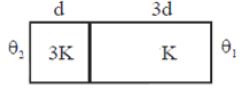
- 6Two materials having coefficients of thermal conductivity $3K$ and $K$ and thickness $d$ and $3d$, respectively, are joined to form a slab as shown in the figure. The temperatures of the outer surfaces are $\theta_2$ and $\theta_1$ respectively $\left( {\theta _2} > {\theta _1} \right)$ . The temperature at the interface isView Solution
- 7View SolutionThe earth radiates in the infra-red region of the spectrum. The spectrum is correctly given by
- 8A metallic sphere cools from $50^{\circ} C$ to $40^{\circ} C$ in $300 \,s.$ If atmospheric temperature around is $20^{\circ} C ,$ then the sphere's temperature after the next $5$ minutes will be close to$.....C$View Solution
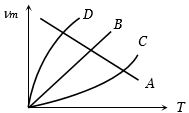
- 9Which of the following is the $\nu_m = T$ graph for a perfectly black body ($\nu_m$ =maximum frequency of radiation)View Solution
- 10In the figure, the distribution of energy density of the radiation emitted by a black body at a given temperature is shown. The possible temperature of the black body is ....... $K$View Solution