A body cools in $7$ minutes from ${60^o}C$ to ${40^o}C$ What time (in minutes) does it take to cool from ${40^o}C$ to ${28^o}C$ if the surrounding temperature is ${10^o}C$? Assume Newton’s Law of cooling holds
Medium


Download our appand get started for free
Experience the future of education. Simply download our apps or reach out to us for more information. Let's shape the future of learning together!No signup needed.*
Similar Questions
- 1The two ends of a metal rod are maintained at temperatures $100 ^o C$ and $110^o C$. The rate of heat flow in the rod is found to be $4.0\ J/s$. If the ends are maintained at temperatures $200^o\ C$ and $210^o\ C$, the rate of heat flow will be.... $J/s$View Solution
- 2A human body has a surface area of approximately $1 \mathrm{~m}^2$. The normal body temperature is $10 \mathrm{~K}$ above the surrounding room temperature $T_0$. Take the room temperature to be $T_0=300 \mathrm{~K}$. For $T_0=300 \mathrm{~K}$, and the value of $\sigma \mathrm{T}_0^4=460 \mathrm{Wm}^{-2}$ (where $\sigma$ is the Stefan-Boltzmann constant). Which of the following option is/are correct?View Solution
[$A$] The amount of energy radiated by the body in $1$ second is close to $60$ Joules.
[$B$] If the surrounding temperature reduces by a small amount $\Delta \mathrm{T}_0<<\mathrm{T}_0$, then to maintain the same body temperature the same (living) human being needs to radiate $\Delta \mathrm{W}=4 \sigma \mathrm{T}_0^3 \Delta \mathrm{T}_0$ more energy per unit time.
[$C$] Reducing the exposed surface area of the body ($e.g$ by curling up) allows humans to maintain the same body temperature while reducing the energy lost by radiation.
[$D$] If the body temperature rises significantly then the peak in the spectrum of electromagnetic radiation emitted by the body would shift to longer wavelengths.
- 3Calculate radiation power for sphere whose temperature is $227^{\circ} C$ and radius $2\, m$ and emissivity $0.8$ (in $W$)View Solution
- 4A cup of coffee cools from $90^{\circ} \mathrm{C}$ to $80^{\circ} \mathrm{C}$ in $\mathrm{t}$ minutes, when the room temperature is $20^{\circ} \mathrm{C}$. The time taken by a similar cup of coffee to cool from $80^{\circ} \mathrm{C}$ to $60^{\circ} \mathrm{C}$ at a room temperature same at $20^{\circ} \mathrm{C}$ is :View Solution
- 5Heat is flowing through two cylindrical rods of the same material. The diameters of the rods are in the ratio $1 : 2$ and their lengths are in the ratio $2 : 1$. If the temperature difference between their ends is the same, then the ratio of the amounts of heat conducted through per unit time will beView Solution
- 6A body takes $5$ minute to cool from $80°C$ to $50°C$ . ...... $\min.$ it will take to cool from $60°C$ to $30°C$ , if room temperature is $20°C$ .View Solution
- 7The outer faces of a rectangular slab made of equal thickness of iron and brass are maintained at $100^{\circ} C$ and $0^{\circ} C$ respectively. The temperature at the interface is ........... $^{\circ} C$ (Thermal conductivity of iron and brass are $0.2$ and $0.3$ respectively.)View Solution
- 8The power radiated by a black body is $P$ and it radiates maximum energy at wavelength,$\lambda_0.$ If the temperature of the black body is now changed so that it radiates maximum energy at wavelength $\frac{3}{4}\lambda_0$, the power radiated by it becomes $nP$. The value of $n$ isView Solution
- 9Two vessels of different materials are similar in size in every respect. The same quantity of ice filled in them gets melted in $20$ minutes and $40$ minutes respectively. The ratio of thermal conductivities of the materials isView Solution
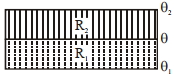
- 10The temperature $\theta$ at the junction of two insulating sheets, having thermal resistances $R _{1}$ and $R _{2}$ as well as top and bottom temperatures $\theta_{1}$ and $\theta_{2}$ (as shown in figure) is given byView Solution