A body cools in a surrounding which is at a constant temperature of ${\theta _0}$. Assume that it obeys Newton's law of cooling. Its temperature $\theta $ is plotted against time $t$ . Tangents are drawn to the curve at the points $P(\theta = {\theta _1})$ and $Q(\theta = {\theta _2})$. These tangents meet the time axis at angles of ${\varphi _2}$and ${\varphi _1}$, as shown

Medium
Download our app for free and get started
(b) For ?-t plot, rate of cooling $ = \frac{{d\theta }}{{dt}} = $slope of the curve.
At P,$\frac{{d\theta }}{{dt}} = \tan {\varphi _2} = k({\theta _2} - {\theta _0})$, where k = constant.
At P,$\frac{{d\theta }}{{dt}} = \tan {\varphi _2} = k({\theta _2} - {\theta _0})$, where k = constant.
At Q$\frac{{d\theta }}{{dt}} = \tan {\varphi _1} = k({\theta _1} - {\theta _0})$
$ \Rightarrow \,\,\,\frac{{\tan {\varphi _2}}}{{\tan {\varphi _1}}} = \frac{{{\theta _2} - {\theta _0}}}{{{\theta _1} - {\theta _0}}}$

Download our appand get started for free
Experience the future of education. Simply download our apps or reach out to us for more information. Let's shape the future of learning together!No signup needed.*
Similar Questions
- 1The temperature of a body falls from ${50^o}C$to ${40^o}C$ in $10$ minutes. If the temperature of the surroundings is ${20^o}C$ Then temperature of the body after another $10$ minutes will be ........ $^oC$View Solution
- 2View SolutionThe velocity of heat radiation in vacuum is
- 3View SolutionHow is the temperature of stars determined by
- 4View SolutionWhen red glass is heated in dark room it will seem
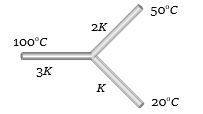
- 5Three rods of the same dimension have thermal conductivities $3K$ , $2K$ and $K$ . They are arranged as shown in fig. Given below, with their ends at $100^oC, 50^oC $and $20^oC$. The temperature of their junction is ......... $^oC$View Solution
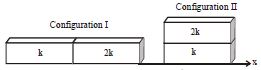
- 6Two rectangular blocks, having identical dimensions, can be arranged either in configuration $I$ or in configuration $II$ as shown in the figure. One of the blocks has thermal conductivity $k$ and the other $2k$. The temperature difference between the ends along the $x-$ axis is the same in both the configurations. It takes $9s$ to transport a certain amount of heat from the hot end to the cold end in the configuration $I$. The time to transport the same amount of heat in the configuration $II$ is .......... $\sec$View Solution
- 7View SolutionIce formed over lakes has
- 8Two rods of same material have same length and area. The heat $\Delta Q$ flows through them for $12\,minutes$ when they are jointed in series. If now both the rods are joined in parallel, then the same amount of heat $\Delta Q$ will flow in ........ $\min$View Solution
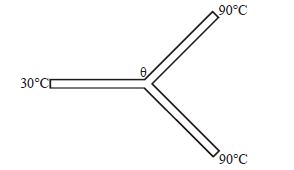
- 9Three identical rods have been joined at a junction to make it a $Y$ shape structure. If two free ends are maintained at $90\,^oC$ and the third end is at $30\,^oC$ , then what is the junction temperature $\theta $ ?......... $^oC$View Solution
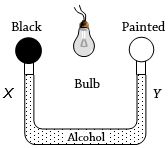
- 10The following figure shows two air-filled bulbs connected by a $ U-$ tube partly filled with alcohol. What happens to the levels of alcohol in the limbs $X$ and $Y$ when an electric bulb placed midway between the bulbs is lightedView Solution