The temperature of a body falls from ${50^o}C$to ${40^o}C$ in $10$ minutes. If the temperature of the surroundings is ${20^o}C$ Then temperature of the body after another $10$ minutes will be ........ $^oC$
Diffcult


Download our appand get started for free
Experience the future of education. Simply download our apps or reach out to us for more information. Let's shape the future of learning together!No signup needed.*
Similar Questions
- 1Three rods of identical area of cross-section and made from the same metal form the sides of an isosceles triangle $ABC$, right angled at $B$. The points $A$ and $B$ are maintained at temperatures $T$ and $\sqrt 2 T$ respectively. In the steady state the temperature of the point C is ${T_C}$. Assuming that only heat conduction takes place, $\frac{{{T_C}}}{T}$ is equal toView Solution
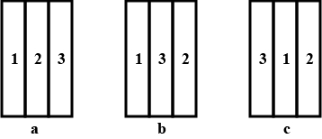
- 2Figure shows three different arrangements of materials $1, 2$ and $3$ to form a wall. Thermal conductivities are $k_1 > k_2 > k_3$ . The left side of the wall is $20\,^oC$ higher than the right side. Temperature difference $\Delta T$ across the material $1$ has following relation in three casesView Solution
- 3A liquid cools down from ${70^o}C$ to ${60^o}C$ in $5$ minutes. The time taken to cool it from ${60^o}C$ to ${50^o}C$ will beView Solution
- 4A body of length 1m having cross sectional area $0.75\;m^2$ has heat flow through it at the rate of $ 6000\; Joule/sec$ . Then find the temperature difference if $K = 200\;J{m^{ - 1}}{K^{ - 1}}$ ...... $^oC$View Solution
- 5Steel wire of length ' $L$ ' at $40^{\circ} C$ is suspended from the ceiling and then a mass ' $m$ ' is hung from its free end. The wire is cooled down from $40^{\circ} C$ to $30^{\circ} C$ to regain its original length ' $L$ '. The coefficient of linear thermal expansion of the steel is $10^{-5} /{ }^{\circ} C$, Young's modulus of steel is $10^{11} N / m ^2$ and radius of the wire is $1 \ mm$. Assume that $L \gg$ diameter of the wire. Then the value of ' $m$ ' in $kg$ is nearlyView Solution
- 6A cylinder of radius $R$ is surrounded by a cylindrical shell of inner radius $R$ and outer radius $2R$. The thermal conductivity of the material of the inner cylinder is $K_1$ and that of the outer cylinder is $K_2$. Assuming no loss of heat, the effective thermal conductivity of the system for heat flowing along the length of the cylinder isView Solution
- 7The ends of a metal bas of constant cross-sectional area are maintained at temperatures $T_1$ and $T_2$ which are both higher than the temperature of the surroundings. If the bar is unlagged, which one of the following sketches best represents the variation of temperature with distance along the bar?View Solution
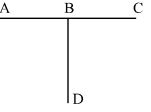
- 8Three conducting rods of same material and cross-section are shown in figure. Temperatures of$ A, D$ and $C$ are maintained at $20^o C, 90^o C$ and $0^o C$. The ratio of lengths of $BD$ and $BC$ if there is no heat flow in $AB$ is:View Solution
- 9View SolutionIn which of the following process, convection does not take place primarily
- 10Two metal rods $1$ and $2$ of same lengths have same temperature difference between their ends. Their thermal conductivities are $K_1$ and $K_2$ and cross sectional areas $A_1$ and $A_2$ , respectively. If the rate of heat conduction in $1$ is four times that in $2$, thenView Solution