A body executing $S.H.M.$ along a straightline has a velocity of $3 \,ms ^{-1}$ when it is at a distance of $4 \,m$ from its mean position and $4 \,ms ^{-1}$ when it is at a distance of $3 \,m$ from its mean position. Its angular frequency and amplitude are
Medium


Download our appand get started for free
Experience the future of education. Simply download our apps or reach out to us for more information. Let's shape the future of learning together!No signup needed.*
Similar Questions
- 1The maximum velocity of a particle, executing simple harmonic motion with an amplitude $7\ mm$, is $4.4\ m/s$. The period of oscillation is .... $sec$View Solution
- 2Two $SHM$ are represented by equations, $y_1 = 6\cos \left( {6\pi t + \frac{\pi }{6}} \right)\,,{y_2} = 3\left( {\sqrt 3 \sin 3\pi t + \cos 3\pi t} \right)$View Solution
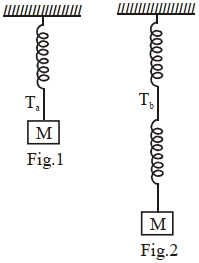
- 3Consider two identical springs each of spring constant $k$ and negligible mass compared to the mass $M$ as shown. Fig. $1$ shows one of them and Fig. $2$ shows their series combination. The ratios of time period of oscillation of the two $SHM$ is $\frac{ T _{ b }}{ T _{ a }}=\sqrt{ x },$ where value of $x$ isView Solution
(Round off to the Nearest Integer)
- 4A particle performs $SHM$ about $x = 0$ such that at $t = 0$ it is at $x = 0$ and moving towards positive extreme. The time taken by it to go from $x = 0$ to $x = \frac{A}{2}$ is ..... times the time taken to go from $x = \frac{A}{2}$ to $A$. The most suitable option for the blank space isView Solution
- 5A uniform thin ring of radius $R$ and mass $m$ suspended in a vertical plane from a point in its circumference. Its time period of oscillation is ........View Solution
- 6Column $I$ gives a list of possible set of parameters measured in some experiments. The variations of the parameters in the form of graphs are shown in Column $II$. Match the set of parameters given in Column $I$ with the graph given in Column $II$. Indicate your answer by darkening the appropriate bubbles of the $4 \times 4$ matrix given in the $ORS$.View Solution
Column $I$ Column $II$ $(A)$ Potential energy of a simple pendulum (y axis) as a function of displacement ( $\mathrm{x}$ axis) $Image$ $(B)$ Displacement (y axis) as a function of time (x axis) for a one dimensional motion at zero or constant acceleration when the body is moving along the positive $\mathrm{x}$-direction $Image$ $(C)$ Range of a projectile (y axis) as a function of its velocity ( $\mathrm{x}$ axis) when projected at a fixed angle $Image$ $(D)$ The square of the time period (y axis) of a simple pendulum as a function of its length ( $\mathrm{x}$ axis) $Image$ 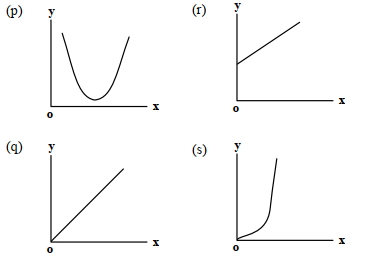
- 7For a body executing $S.H.M. :$View Solution
$(a)$ Potential energy is always equal to its $K.E.$
$(b)$ Average potential and kinetic energy over any given time interval are always equal.
$(c)$ Sum of the kinetic and potential energy at any point of time is constant.
$(d)$ Average $K.E.$ in one time period is equal to average potential energy in one time period.
Choose the most appropriate option from the options given below:
- 8A particle executes $S.H.M.$ and its position varies with time as $x=A$ sin $\omega t$. Its average speed during its motion from mean position to mid-point of mean and extreme position isView Solution
- 9The bob of a simple pendulum executes simple harmonic motion in water with a period $t$, while the period of oscillation of the bob is ${t_0}$ in air. Neglecting frictional force of water and given that the density of the bob is $(4/3) ×1000 kg/m^3$. What relationship between $t$ and ${t_0}$ is trueView Solution
- 10In $SHM,$ acceleration versus displacement (from mean position) graph :View Solution