MCQ
A body executing simple harmonic motion has a maximum acceleration equal to $ 24\,metres/se{c^2} $ and maximum velocity equal to $ 16\;metres/sec $. The amplitude of the simple harmonic motion is
  • $\frac{{32}}{3}\,metres$
  • B
    $\frac{3}{{32}}\,metres$
  • C
    $\frac{{1024}}{9}\,metres$
  • D
    $\frac{{64}}{9}\,metres$

Answer

Correct option: A.
$\frac{{32}}{3}\,metres$
a
(a) Maximum velocity $ = a\omega = 16$ 

Maximum acceleration $ = {\omega ^2}a = 24$ 

$ \Rightarrow a = \frac{{{{(a\omega )}^2}}}{{{\omega ^2}a}} = \frac{{16 \times 16}}{{24}} = \frac{{32}}{3}m$

Need a full question paper?

Generate a complete, print-ready paper with questions like this in minutes — across 16+ boards, with answer keys.

Start Generating Free

Similar questions

According to law of equipartition of energy the molar specific heat of a diatomic gas at constant volume where the molecule has one additional vibrational mode is :-
A ball is thrown at an angle $\theta $ and another ball is thrown at an angle $(90^o -\theta )$ with the horizontal from the same point with same speed $40\,ms^{-1}$. The second ball reaches $50\,m$ higher than the first ball. Find their individual heights?
Two metal spheres of capacitances C1 and C2 carry some charges. They are put in contact and then separated. The final charges Q1 and Q2 on them will satisfy:

  1. $\frac{\text{Q}_1}{\text{Q}_2}<\frac{\text{C}_1}{\text{C}_2}$

  2. $\frac{\text{Q}_1}{\text{Q}_2}=\frac{\text{C}_1}{\text{C}_2}$

  3. $\frac{\text{Q}_1}{\text{Q}_2}>\frac{\text{C}_1}{\text{C}_2}$

  4. $\frac{\text{Q}_1}{\text{Q}_2}=\frac{\text{C}_2}{\text{C}_1}$

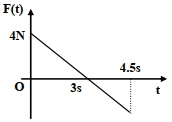
A block of mass $2 \mathrm{~kg}$ is free to move along the $\mathrm{x}$-axis. It is at rest and from $\mathrm{t}=0$ onwards it is subjected to a time-dependent force $\mathrm{F}(\mathrm{t})$ in the $\mathrm{x}$ direction. The force $\mathrm{F}(\mathrm{t})$ varies with $\mathrm{t}$ as shown in the figure. The kinetic energy of the block after $4.5$ seconds is
A liquid is kept in a cylindrical vessel which rotated along its axis. The liquid rises at the sides. If the radius of the vessel is $0.05\,m$ and the speed of rotation is $2\,rev/s$ , The difference in the height of the liquid at the centre of the vessel and its sides will be .............. $\mathrm{cm}$ $(\pi ^2 = 10)$
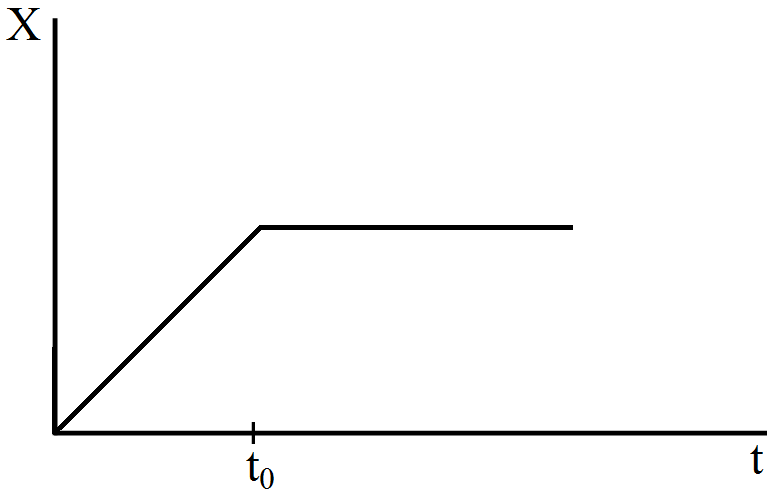
Figure shows the displacement-time graph of a particle moving on the X-axis.

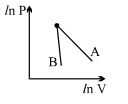
The figure, shows the graph of logarithmic reading of pressure and volume for two ideal gases $A$ and $B$ undergoing adiabatic process. From figure it can be concluded that
The angular velocity of seconds hand of a watch will be 
The volume of a gas at $20°C$ is $100 \,cm^3$ at normal pressure. If it is heated to $100°C$, its volume becomes $125\, cm^3$ at the same pressure, then volume coefficient of the gas at normal pressure is
When a capillary is dipped in water, water rises to a height $h$. If the length of the capillary is made less than $h$, then