MCQ 11 Mark
If $x=5 \sin \left(\pi t+\frac{\pi}{3}\right) \mathrm{m}$ represents the motion of a particle executing simple harmonic motion, the amplitude and time period of motion, respectively, are
- ✓
$5 \mathrm{~m}, 2 \mathrm{~s}$
- B
$5 \mathrm{~cm}, 1 \mathrm{~s}$
- C
$5 \mathrm{~m}, 1 \mathrm{~s}$
- D
$5 \mathrm{~cm}, 2 \mathrm{~s}$
AnswerCorrect option: A. $5 \mathrm{~m}, 2 \mathrm{~s}$
a
$x=5 \sin \left(\pi t+\frac{\pi}{3}\right) \mathrm{m}$
Amplitude $=5 \mathrm{~m}$
$\omega=\pi=\frac{2 \pi}{T}$
$T=\frac{2 \pi}{\pi}=2 \mathrm{~s}$
View full question & answer→MCQ 21 Mark
If the mass of the bob in a simple pendulum is increased to thrice its original mass and its length is made half its original length, then the new time period of oscillation is $\frac{x}{2}$ times its original time period. Then the value of $x$ is:
- ✓
$\sqrt{2}$
- B
$2 \sqrt{3}$
- C
$4$
- D
$\sqrt{3}$
AnswerCorrect option: A. $\sqrt{2}$
a
$T^{\prime}=2 \pi \sqrt{\frac{\ell^{\prime}}{g}} \text { where } \ell^{\prime}=\frac{\ell}{2}$
$T=2 \pi \sqrt{\frac{\ell}{g}}$
$T^{\prime}=\frac{x}{2} T$
$2 \pi \sqrt{\frac{\ell}{2 g}}=\frac{x}{2} 2 \pi \sqrt{\frac{\ell}{g}}$
$\frac{1}{\sqrt{2}}=\frac{x}{2} \Rightarrow x=\sqrt{2}$
View full question & answer→MCQ 31 Mark
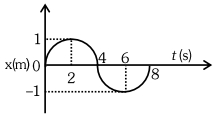
The $x-t$ graph of a particle performing simple harmonic motion is shown in the figure. The acceleration of the particle at $t=2 s$ is :
- ✓
$-\frac{\pi^2}{16}\,ms ^{-2}$
- B
$\frac{\pi^2}{8}\,ms ^{-2}$
- C
$-\frac{\pi^2}{8}\,ms ^{-2}$
- D
$\frac{\pi^2}{16}\,ms ^{-2}$
AnswerCorrect option: A. $-\frac{\pi^2}{16}\,ms ^{-2}$
a
$x = A \sin (\omega t )$
$\frac{ dx }{ dt }= v = A \omega \cos (\omega t )$
$\frac{ dv }{ dt }= a =-\omega^2 A \sin (\omega t )$
$a =-\left(\frac{2 \pi}{8}\right)^2 \times 1 \sin \left(\frac{2 \pi}{8} \times 2\right)$
$\Rightarrow a =-\frac{\pi^2}{16} \times \sin \left(\frac{\pi}{2}\right)$
$\therefore a =\frac{-\pi^2}{16}\,m / s ^2$
View full question & answer→MCQ 41 Mark
Two pendulums of length $121\,cm$ and $100\,cm$ start vibrating in phase. At some instant, the two are at their mean position in the same phase. The minimum number of vibrations of the shorter pendulum after which the two are again in phase at the mean position is :
Answerd
$( n ) T _{\ell}=( n +1) T _{ s }$
$( n ) 2 \pi \sqrt{\frac{1.21}{ g }}=( n +1) 2 \pi \sqrt{\frac{1}{ g }}$
$( n )(1.1)=( n +1)$
$0.1( n )=1$
$n =10$
No. of oscillation of smaller one
$= n +1$
$=10+1$
$=11$
View full question & answer→MCQ 51 Mark
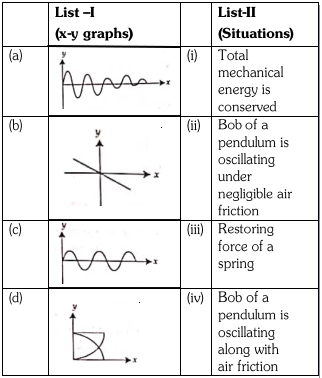
Match $List - I$ with $List - II$
Choose the correct answer from the options given below
- A
$(a) - (iv), (b) - (ii), (c) - (iii), (d) - (i)$
- ✓
$(a) - (iv), (b) - (iii), (c) - (ii), (d) - (i)$
- C
$(a) - (i), (b) - (iv), (c) - (iii), (d) - (ii)$
- D
$(a) - (iii), (b) - (ii), (c) - (i), (d) - (iv)$
AnswerCorrect option: B. $(a) - (iv), (b) - (iii), (c) - (ii), (d) - (i)$
b
$(a) \rightarrow (iv)$ Amplitude is continuously decreasing
$(b) \rightarrow (iii)$ $\quad F \propto- x$
$(c) \rightarrow (ii)$ Amplitude is constant
$(d) \rightarrow (i)$ $\quad$ K.E. $+$ P.E. $=$ M.E. $=$ constant
View full question & answer→MCQ 61 Mark
Identify the function which represents a nonperiodic motion.
AnswerCorrect option: A. $e^{-\omega t}$
a
$e^{-\omega t}$ represents non-periodic motion.
View full question & answer→MCQ 71 Mark
A body is executing simple harmonic motion with frequency $'n',$ the frequency of its potential energy is :
- A
$\mathrm{n}$
- B
$3 \mathrm{n}$
- ✓
$2 \mathrm{n}$
- D
$4 \mathrm{n}$
AnswerCorrect option: C. $2 \mathrm{n}$
c
Displacement equation of $SHM$ of frequency $'n'$
$\mathrm{x}=\mathrm{A} \sin (\omega \mathrm{t})=\mathrm{A} \sin (2 \pi \mathrm{nt})$
Now,
Potential energy
$U=\frac{1}{2} k x^{2}=\frac{1}{2} K A^{2} \,\sin ^{2}(2 \pi n t)$
$=\frac{1}{2} k A^{2}\left[\frac{1-\cos (2 \pi(2 n) t)}{2}\right]$
So frequency of potential energy $=2 \mathrm{n}$
View full question & answer→MCQ 81 Mark
A spring is stretched by $5 \,\mathrm{~cm}$ by a force $10 \,\mathrm{~N}$. The time period of the oscillations when a mass of $2 \,\mathrm{~kg}$ is suspended by it is :(in $s$)
- A
$0.0628$
- B
$6.28$
- C
$3.14$
- ✓
$0.628$
AnswerCorrect option: D. $0.628$
d
$\mathrm{F}=\mathrm{K} \mathrm{x}$
$10=\mathrm{K} \times 0.05$
$\mathrm{~K}=\frac{1000}{5}=200$
$\mathrm{~T}=2 \pi \sqrt{\frac{\mathrm{m}}{\mathrm{k}}}=2 \pi \sqrt{\frac{2}{200}}$
$=\frac{2 \pi}{10}=\frac{6.28}{10}$
$=.628\, \mathrm{~s}$
View full question & answer→MCQ 91 Mark
Identify the function which represents a periodic motion.
AnswerCorrect option: D. $\sin \omega t+\cos \omega t$
d
For periodic function
$f(t)=f(t+T)$
where $T$ is time period of function
$\sin (\omega t+2 \pi)+\cos (\omega t+2 \pi)$
$=\sin \omega t+\cos \omega t$
View full question & answer→MCQ 101 Mark
The phase difference between displacement and acceleration of a particle in a simple harmonic motlon is
- A
- ✓
$\pi\; rad$
- C
$\frac{3 \pi}{2}\; rad$
- D
$\frac{\pi}{2}\; rad$
AnswerCorrect option: B. $\pi\; rad$
b
Displacement $(x)$ equation of $SHM$
$x = A \sin (\omega t +\phi)$ $....(1)$
$\frac{ dx }{ dt }= A \omega \cos (\omega t +\phi)$
acceleration $(a)=\frac{d^{2} x}{d t^{2}}$
$a=-\omega^{2} A \sin (\omega t+\phi)$
$a =\omega^{2} A \sin (\omega t +\phi+\pi)$$.....(2)$
from $(1) \;and\;(2),$ phase difference between displacement and acceleration is $\pi .$
View full question & answer→MCQ 111 Mark
The displacement of a particle executing simple harmonic motion is given by
$\mathrm{y}=\mathrm{A}_{0}+\mathrm{A} \sin \omega \mathrm{t}+\mathrm{B} \cos \omega \mathrm{t}$
Then the amplitude of its oscillation is given by
- A
$\mathrm{A}_{0}+\sqrt{\mathrm{A}^{2}+\mathrm{B}^{2}}$
- ✓
$\sqrt{\mathrm{A}^{2}+\mathrm{B}^{2}}$
- C
$\sqrt{\mathrm{A}_{0}^{2}+(\mathrm{A}+\mathrm{B})^{2}}$
- D
$\mathrm{A}+\mathrm{B}$
AnswerCorrect option: B. $\sqrt{\mathrm{A}^{2}+\mathrm{B}^{2}}$
b
$y=A_{0}+A \sin \omega t+B \cos \omega t$
$y=A_{0}+\sqrt{A^{2}+B^{2}} \sin (\omega t+\phi)$
$\mathrm{A}_{0}$ is mean position, and $\sqrt{\mathrm{A}^{2}+\mathrm{B}^{2}}$ is amplitude
View full question & answer→MCQ 121 Mark
The distance covered by a particle undergoing $SHM$ in one time period is (amplitude $= A$)
Answerd
Distance in one oscillation $= 4A$
View full question & answer→MCQ 131 Mark
Average velocity of a particle executing $SHM$ in one complete vibration is
Answerd
Displacement $=$ zero in one complete oscillation
$\Rightarrow$ Average velocity $=\frac{\text { Dtsplacement }}{\mathrm{T}}=0$
View full question & answer→MCQ 141 Mark
A pendulum is hung from the roof of a sufficiently high building and is moving freely to and fro like a simple harmonic oscillator. The acceleration of the bob of the pendulum is $20\; m/s^2$ at a distance of $5\; m$ from the mean position. The time period of oscillation is
- A
$2\pi\;s$
- ✓
$\pi\;s$
- C
$1\;s$
- D
$2\;s$
AnswerCorrect option: B. $\pi\;s$
b
Magnitude of acceleration of a particle moving in a $SHM$ is, $|a|=\omega^{2} y ;$ where $y$ is amplitude.
$\Rightarrow \quad 20=\omega^{2}(5) \Rightarrow \omega=2 \mathrm{rad} \mathrm{s}^{-1}$
$\therefore \quad$ Time period of oscillation, $T=\frac{2 \pi}{\omega}=\frac{2 \pi}{2}=\pi \mathrm{s}$
View full question & answer→MCQ 151 Mark
A spring of force constant $k$ is cut into lengths of ratio $1:2:3$ . They are connected in series and the new force constant is $k'$ . Then they are connected in parallel and force constant is $k''$ . Then $k':k''$ is
- ✓
$1:11$
- B
$1:14$
- C
$1:16$
- D
$1:9$
AnswerCorrect option: A. $1:11$
a
Let us assume, the length of spring be $l$.
When we cut the spring into ratio of length $1: 2: 3,$ we
get three springs of lengths $\frac{l}{6}, \frac{2 l}{6}$ and $\frac{3 l}{6}$ with force
constant,
$\therefore k_{1}=\frac{k l}{l_{1}}=\frac{k l}{l / 6}=6 k$
${k_{2}=\frac{k l}{l_{2}}=\frac{k l}{2 l / 6}=3 k}$
${k_{3}=\frac{k l}{l_{3}}=\frac{k l}{3 l / 6}=2 k}$
When connected in series,
$\frac{1}{k^{\prime}}=\frac{1}{6 k}+\frac{1}{3 k}+\frac{1}{2 k}=\frac{1+2+3}{6 k}=\frac{1}{k}$
$\therefore \quad \overline{k^{\prime}}=k$
When connected in parallel,
${k^{\prime \prime}=6 k+3 k+2 k=11 k}$
${\frac{k^{\prime}}{k^{\prime \prime}}=\frac{k}{11 k}=\frac{1}{11}}$
View full question & answer→MCQ 161 Mark
A particle executes linear simple harmonic motion with an ampilitude of $3\,cm$ . When the particle is at $2\,cm$ from the mean position , the magnitude of its velocity is equal to that of its acceleration. Then its time period in seconds is
- ✓
$\frac{{4\pi }}{{\sqrt 5 }}$
- B
$\frac{{2\pi }}{{\sqrt 5 }}$
- C
$\;\frac{{\sqrt 5 }}{\pi }$
- D
$\frac{{\sqrt 5 }}{{2\pi }}$
AnswerCorrect option: A. $\frac{{4\pi }}{{\sqrt 5 }}$
a
$\text { Given, } A=3 \mathrm{cm}, x=2 \mathrm{cm}$
The velocity of a particle in simple harmonic motion is given as
$v=\omega \sqrt{A^{2}-x^{2}}$
and magnitude of its acceleration is
$a=\omega^{2} x$
Given $|v|=|a|$
$\therefore \omega \sqrt{A^{2}-x^{2}}-\omega^{2} x$
${\omega x=\sqrt{A^{2}-x^{2}} \text { or } \omega^{2} x^{2}=A^{2}-x^{2}}$
${\omega^{2}=\frac{A^{2}-x^{2}}{x^{2}}=\frac{9-4}{4}=\frac{5}{4}}$
${\omega=\frac{\sqrt{5}}{2}}$
Time period, $T=\frac{2 \pi}{\omega}=2 \pi \cdot \frac{2}{\sqrt{5}}=\frac{4 \pi}{\sqrt{5}} \mathrm{s}$
View full question & answer→MCQ 171 Mark
A body of mass $m $ is attached to the lower end of a spring whose upper end is fixed. The spring has negligible mass. When the mass $m$ is slightly pulled down and released , it oscillates with a time period of $3\,s$ . When the mass $m$ is increased by $1\,kg$ , the time period of oscillations becomes $5\,s$ . The value of $m$ in $kg$ is
- A
$\frac{16}{9}$
- ✓
$\frac{9}{16}$
- C
$\frac{3}{4}$
- D
$\frac{4}{3}$
AnswerCorrect option: B. $\frac{9}{16}$
b
$Time\, period\, of\, spring - block \,system,$
$T=2 \pi \sqrt{\frac{m}{k}}$
For given spring, $T \propto \sqrt{m}$
$\frac{T_{1}}{T_{2}} =\sqrt{\frac{m_{1}}{m_{2}}}$
$\text { Here, } T_{1} =3 \mathrm{s}, m_{1}=m, T_{2}=5 \mathrm{s}, m_{2}=m+1, m=?$
$ \frac{3}{5}=\sqrt{\frac{m}{m+1}} \text { or } \frac{9}{25}=\frac{m}{m+1}$
$25 m=9 m+9 \Rightarrow 16 m=9$
$\therefore m=\frac{9}{16} \mathrm{kg}$
View full question & answer→MCQ 181 Mark
The displacement of a particle from its mean position (in metre) is given by $y = 0.2\sin (10\pi t + 1.5\pi )\cos (10\pi t + 1.5\pi )$. The motion of particle is
- A
Periodic but not $S.H.M.$
- B
- ✓
Simple harmonic motion with period $0.1 s$
- D
Simple harmonic motion with period $0.2 s$
AnswerCorrect option: C. Simple harmonic motion with period $0.1 s$
c
(c) $y = 0.2\sin (10\pi t + 1.5\pi )$$\cos (10\pi t + 1.5\pi )$
$ = 0.1\sin 2(10\pi \,t + 1.5\pi )$
$ = 0.1\sin (20\pi t + 3.0\pi )$
$\therefore$ Time period, $T = \frac{{2\pi }}{\omega } = \frac{{2\pi }}{{20\pi }} = \frac{1}{{10}} = 0.1sec$
View full question & answer→MCQ 191 Mark
The angular frequency of motion whose equation is $4\frac{{{d^2}y}}{{d{t^2}}} + 9y = 0$ is ($y =$ displacement and $t =$ time)
- A
$2.25$
- B
$0.44$
- ✓
$1.5$
- D
$0.67$
Answerc
$4 \frac{d^{2} y}{d t^{2}}+9 y=0$
or $\frac{d^{2} y}{d t^{2}}=\frac{-9}{4} y$
Comparing with $SHM$ equation
$\frac{\mathrm{d}^{2} \mathrm{y}}{\mathrm{dt}^{2}}=-\omega^{2} \mathrm{y}$
$\therefore \omega^{2}=\frac{9}{4}$
$\therefore \omega=\frac{3}{2}$
View full question & answer→MCQ 201 Mark
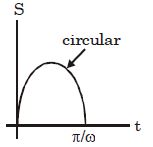
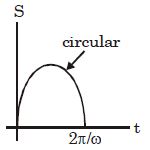
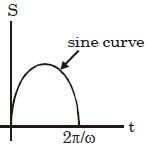
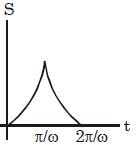
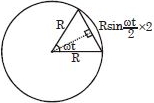
A particle moves along a circle with a constant angular speed $\omega$ Its displacement,with respect to this position of the particle at time $t = 0$ is plotted against time. The graph would look like
Answerc
$S = 2Rsin (\frac{\omega t}{2})$
View full question & answer→MCQ 211 Mark
The equation of motion of a particle is $x = a\,cos (\alpha\, t)$ . The motion is
- A
Periodic but not oscillatory
- ✓
- C
Oscillatory but not periodic
- D
Neither periodic nor oscillatory
View full question & answer→MCQ 221 Mark
The displacement of a particle is represented by the equation $y = sin^3\,\,\,\omega t$ . The motion is
AnswerCorrect option: B. periodic but not simple harmonic
b
Given, $y=\sin ^{3} \omega t=\frac{1}{4}[3 \sin \omega t-\sin 3 \omega t]$
As this motion is not represented by single harmonic function, hence it is not $SHM.$ As this motion involves sine and cosine functions, hence it is periodic motion.
View full question & answer→MCQ 231 Mark
A particle moves on $x-$ axis according to the equation $x = x_0\,\,sin^2\,\omega t,$ the motion is simple harmonic
AnswerCorrect option: D. With time period $(\pi /\omega )$
d
$\mathrm{x}=\mathrm{x}_{0} \sin ^{2} \omega \mathrm{t}$
$x=x_{0}\left[\frac{1-\cos 2 \omega t}{2}\right]=\frac{x_{0}}{2}-\frac{x_{0} \cos 2 \omega t}{2}$
Angular Frequency $=2 \omega$
$\frac{2 \pi}{\mathrm{T}}=2 \omega$
$\mathrm{T}=\frac{\pi}{\omega}$
View full question & answer→MCQ 241 Mark
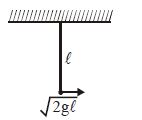
A simple pendulum having length $\ell $ is having speed $\sqrt {2g\ell }$ at bottom most point of its trajectory. Its motion will be
AnswerCorrect option: A. Periodic but not $SHM$
a
Particle will just complete half of the circle, so periodic but not $S.H.M.$
View full question & answer→MCQ 251 Mark
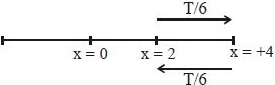
A particle is performing simple harmonic motion along $x$ -axis with amplitude $4\, cm$ and time period $1.2\, sec$. The minimum time taken by the particle to move from $x = 2\, cm$ to $x =+ 4 \,cm$ and back again is given by .... $s$
Answerb
minimum time taken by particle $=\frac{T}{6}+\frac{T}{6}$
$=\frac{T}{3}$
$=0.4 \mathrm{s}$
View full question & answer→MCQ 261 Mark
A particle is performing $SHM$ according to the equation $x = (3\, cm)$ $\sin \,\left( {\frac{{2\pi t}}{{18}} + \frac{\pi }{6}} \right)$ where $t$ is in seconds. The distance travelled by the particle in $36\, s$ is ..... $cm$
Answera
$\omega t=\frac{2 \pi}{18} t \Rightarrow \omega=\frac{2 \pi}{18} \quad$ also $\quad \omega=\frac{2 \pi}{\mathrm{T}}$
$\because T=18 s$
So distance travelled in $36 \mathrm{sec}=8 \mathrm{A}$
$=8 \times 3=24 \mathrm{cm}$
View full question & answer→MCQ 271 Mark
The equation of motion of a particle of mass $1\,g$ is $\frac{{{d^2}x}}{{d{t^2}}} + {\pi ^2}x = 0$ where $x$ is displacement (in $m$ ) from mean position. The frequency of oscillation is .... $s$ (in $Hz$ )
- ✓
$0.5$
- B
$2$
- C
$5\sqrt {10}$
- D
$\frac {1}{5\sqrt {10}}$
Answera
${\omega ^2} = {\pi ^2} \Rightarrow \omega = \pi \Rightarrow f = \frac{\omega }{{2\pi }} = \frac{\pi }{{2\pi }} = \frac{1}{2}Hz$
View full question & answer→MCQ 281 Mark
The function $(sin\,\omega t -cos\,\omega t)$ represents
- A
a simple harmonic motion with a period $\frac{\pi }{\omega }$
- ✓
a simple harmonic motion with a period $\frac{2\pi }{\omega }$
- C
a periodic but not simple harmonic motion with a period $\frac{\pi }{\omega }$
- D
a periodic but not simple harmonic motion with a periodic $\frac{2\pi }{\omega }$
AnswerCorrect option: B. a simple harmonic motion with a period $\frac{2\pi }{\omega }$
b
$x=\sin \omega t-\cos \omega t$
$\Longrightarrow x=2 \cos \omega t=2 \sin \left(\omega t+\frac{\pi}{2}\right) \quad\left[\sin C-\sin D=2 \cos \left(\frac{C+D}{2}\right) \sin \left(\frac{C-D}{2}\right)\right]$
On comparing this with equation of $S H M: x=A \sin (\omega t+\phi)$
$\Longrightarrow A=2$ $\omega(\text { Angular frequency })$
$\Longrightarrow T=\frac{2 \pi}{\omega}$
View full question & answer→MCQ 291 Mark
A particle executing $S.H.M.$ of amplitude 4 cm and $T = 4 \,sec.$ The time taken by it to move from positive extreme position to half the amplitude is ..... $\sec$
- A
$1$
- B
$0.33$
- ✓
$0.67$
- D
$1.22$
AnswerCorrect option: C. $0.67$
c
(c) Equation of motion $y = a\cos \omega t$
$\frac{a}{2} = a\cos \omega t$
$\Rightarrow \cos \omega t = \frac{1}{2}$
$\Rightarrow \omega t = \frac{\pi }{3}$
$ \Rightarrow \frac{{2\pi t}}{T} = \frac{\pi }{3}$
$\Rightarrow t = \frac{{\frac{\pi }{3} \times T}}{{2\pi }} = \frac{4}{{3 \times 2}} = \frac{2}{3}\sec $
View full question & answer→MCQ 301 Mark
The periodic time of a body executing simple harmonic motion is $3\, sec$. After how much interval from time $t = 0$, its displacement will be half of its amplitude ..... $\sec$
- A
$0.13$
- B
$0.17$
- ✓
$0.25$
- D
$0.33$
AnswerCorrect option: C. $0.25$
c
(c) $y = a\sin \frac{{2\pi }}{T}t$
==> $\frac{a}{2} = a\sin \frac{{2\pi t}}{3}$
==> $\frac{1}{2} = \sin \frac{{2\pi t}}{3}$
==> sin$\frac{{2\pi t}}{3} = \sin \frac{\pi }{6}$
==> $\frac{{2\pi t}}{3} = \frac{\pi }{6}$
==> $t = \frac{1}{4}\sec $
View full question & answer→MCQ 311 Mark
If $x = a\sin \left( {\omega t + \frac{\pi }{6}} \right)$ and $x' = a\cos \omega t$, then what is the phase difference between the two waves
- ✓
$ \pi/ 3$
- B
$ \pi/ 6$
- C
$ \pi/ 2$
- D
$ \pi$
AnswerCorrect option: A. $ \pi/ 3$
a
(a) $x = a\sin \left( {\omega t + \frac{\pi }{6}} \right)$ and $x' = a\cos \omega t = a\sin \,\left( {\omega \,t + \frac{\pi }{2}} \right)$
$\therefore \Delta \phi = \left( {\omega t + \frac{\pi }{2}} \right) - \left( {\omega t + \frac{\pi }{6}} \right) = \frac{\pi }{3}$
View full question & answer→MCQ 321 Mark
A particle doing simple harmonic motion, amplitude $= 4\, cm$, time period $= 12\, sec$. The ratio between time taken by it in going from its mean position to $2 \,cm$ and from $2\, cm$ to extreme position is
Answerd
(d) $\omega = \frac{{2\pi }}{T} = \frac{{2\pi }}{{12}} = \frac{\pi }{6}\frac{{rad}}{{sec}}$ (For $y = 2 \,cm$) $2 = 4\left( {\sin \frac{\pi }{6}{t_1}} \right)$
By solving ${t_1} = 1$sec (For $y = 4 \,cm$) ${t_2} = 3sec$
So time taken by particle in going from 2 cm to extreme position is ${t_2} - {t_1} = 2sec$.
Hence required ratio will be $\frac{1}{2}$.
View full question & answer→MCQ 331 Mark
A simple harmonic motion having an amplitude $A$ and time period $T$ is represented by the equation : $y = 5 \sin \pi (t + 4) m$
Then the values of $A$ (in $m$) and $T$ (in $sec$) are :
- ✓
$A = 5; T = 2$
- B
$A = 10 ; T = 1$
- C
$A = 5 ; T = 1$
- D
$A = 10 ; T = 2$
AnswerCorrect option: A. $A = 5; T = 2$
a
Standard equation S.H.M: $y=a \sin 2 \pi(t+T)$
Given equation of SHM: $y=a \sin \pi(t+4)$
We will the above equations$:$
hence it will be written as after multiplying by $2$ at $R.H.S$
$y=a \sin 2 \pi\left(\frac{t}{2}+\frac{4}{2}\right)$
$T=2 ; A=5$
View full question & answer→MCQ 341 Mark
The graphs in figure show that a quantity $y$ varies with displacement $d$ in a system undergoing simple harmonic motion. Which graphs best represents the relationship obtained when $y$ is The time

Answerd
Distance versus time curve is like the rotated curve $IV$ for an $SHM$ since distance follows a $wave-lke$ path about the mean position. Thus $time-displacement$ curve will be it's rotated version, or curve $IV$
View full question & answer→MCQ 351 Mark
A small mass executes linear $SHM$ about $O$ with amplitude $a$ and period $T.$ Its displacement from $O$ at time $T/8$ after passing through $O$ is :
- A
$a/8$
- B
$a/2\sqrt{2}$
- C
$a/2$
- ✓
$a / \sqrt{2}$
AnswerCorrect option: D. $a / \sqrt{2}$
d
This SHM can be represented by
$\boldsymbol{x}=\boldsymbol{a} \sin \omega t$
$\Rightarrow x=a \sin \frac{2 \pi t}{T}$
$\Rightarrow x\left(t=\frac{T}{8}\right)=a \sin \left(\frac{2 \pi}{T} \times \frac{T}{8}\right)=a \sin \left(\frac{\pi}{4}\right)=\frac{a}{\sqrt{2}}$
View full question & answer→MCQ 361 Mark
A particle executes $SHM$ of period $1.2\, sec$ and amplitude $8\, cm.$ Find the time it takes to travel $3\,cm$ from the positive extremity of its oscillation. ..... $\sec$
- A
$0.28$
- B
$0.32$
- ✓
$0.17$
- D
$0.42$
AnswerCorrect option: C. $0.17$
c
$x=A \cos \omega t$
$\Rightarrow \quad 5 \mathrm{cm}=8 \cos \omega t$
$\Rightarrow \quad \omega t=0.9$
$\frac{2 \pi}{1.2} t=0.9$
$\Rightarrow \quad t=\frac{1.08}{2 \pi} \mathrm{s}=0.17 \mathrm{s}$
View full question & answer→MCQ 371 Mark
Astone is swinging in a horizontal circle $0.8\, m$ in diameter at $30 \,rev / min.$ Adistant horizontal light beam causes a shadow of the stone to be formed on a nearly vertical wall. The amplitude and period of the simple harmonic motion for the shadow of the stone are
- A
$0.4\ m, 4\ s$
- B
$0.2\ m. 2\ s$
- ✓
$0.4\ m, 2\ s$
- D
$0.8\ m, 2\ s$
AnswerCorrect option: C. $0.4\ m, 2\ s$
c
$A=\frac{d}{2}=\frac{0.8}{2}=0.4 \mathrm{m}$
$\omega=\frac{30 \times 2 \pi}{60}=\pi$
or $\frac{2 \pi}{\mathrm{T}}=\pi$
$\therefore \mathrm{T}=2 \mathrm{sec}$
View full question & answer→MCQ 381 Mark
A particle moves in $xy$ plane according to the law $x = a \sin \omega t$ and $y = a(1-\cos \omega t)$ where $a$ and $\omega$ are constants. The particle traces
AnswerCorrect option: D. $(A)$ and $(C)$ both
d
A particle moves in $x y$ plane according to the law
$x=a \sin (\omega t)$ and $y=a(1-\cos (\omega t))$ where $a$ and $\omega$ are constants.
$\Rightarrow \sin ^2(\omega t)=\frac{x^2}{a^2}$
$\Rightarrow \cos ^2(\omega t)=\left(1-\frac{y}{a}\right)^2$
$\Rightarrow \frac{x^2}{a^2}+\left(1-\frac{y}{a}\right)^2=1$
$\Rightarrow x^2+(y-a)^2=a^2$
The given equation is the equation of circle with centre $(0, a)$, the radius a also the angular velocity is $\omega$ so distance covered $=a c o t$
View full question & answer→MCQ 391 Mark
A particle executes $S.H.M.$ according to equation $x=10( cm ) \cos \left[2 \pi t+\frac{\pi}{2}\right]$, where $t$ is in second. The magnitude of the velocity of the particle at $t=\frac{1}{6} \,s$ will be .............. $cm / s$
- A
$24.7$
- B
$20.5$
- C
$28.3$
- ✓
$31.4$
AnswerCorrect option: D. $31.4$
d
(D)
$x=10 \cos \left[2 \pi t+\frac{\pi}{2}\right]$
At $t=\frac{1}{6} s$
$x=10 \cos \left[\frac{\pi}{2}+\frac{\pi}{3}\right]$
$x=-10 \sin \frac{\pi}{3}$
$x=-5 \sqrt{3}$
$v=\omega \sqrt{A^2-x^2}$
$v=2 \pi \sqrt{100-75}$
$v=10 \pi$
$v=31.4 \,cm / s$
View full question & answer→MCQ 401 Mark
The phase of a particle executing simple harmonic motion is $\frac{\pi }{2}$ when it has
Answerd
(d) For $S.H.M.$ displacement $y = a\sin \omega \,t$ and acceleration $A = \, - {\omega ^2}y\sin \omega \,t$ these are maximum at $\omega \,t = \frac{\pi }{2}.$
View full question & answer→MCQ 411 Mark
The amplitude of a particle executing $S.H.M.$ with frequency of $60 \,Hz$ is $0.01 \,m$. The maximum value of the acceleration of the particle is
AnswerCorrect option: A. $144{\pi ^2}\,m/se{c^2}$
a
(a) Maximum acceleration $ = a{\omega ^2} = a \times 4{\pi ^2}{n^2}$
$ = 0.01 \times 4 \times {(\pi )^2} \times {(60)^2} = 144{\pi ^2}\,m/\sec $
View full question & answer→MCQ 421 Mark
A small body of mass $0.10\, kg$ is executing $S.H.M.$ of amplitude $1.0 \,m$ and period $0.20\, sec$. The maximum force acting on it is.... $N$
- ✓
$98.596$
- B
$985.96$
- C
$100.2$
- D
$76.23$
AnswerCorrect option: A. $98.596$
a
(a) Maximum acceleration
${A_{\max }} = a{\omega ^2}$
$= \frac{{a \times 4{\pi ^2}}}{{{T^2}}}$
$ = \frac{{1 \times 4 \times {{(3.14)}^2}}}{{0.2 \times 0.2}}$
${F_{\max }} = m \times {A_{\max }}$
$= \frac{{0.1 \times 4 \times {{(3.14)}^2}}}{{0.2 \times 0.2}}$
$= 98.596\;N$
View full question & answer→MCQ 431 Mark
A body executing simple harmonic motion has a maximum acceleration equal to $ 24\,metres/se{c^2} $ and maximum velocity equal to $ 16\;metres/sec $. The amplitude of the simple harmonic motion is
AnswerCorrect option: A. $\frac{{32}}{3}\,metres$
a
(a) Maximum velocity $ = a\omega = 16$
Maximum acceleration $ = {\omega ^2}a = 24$
$ \Rightarrow a = \frac{{{{(a\omega )}^2}}}{{{\omega ^2}a}} = \frac{{16 \times 16}}{{24}} = \frac{{32}}{3}m$
View full question & answer→MCQ 441 Mark
A particle of mass $10$ grams is executing simple harmonic motion with an amplitude of $0.5\, m$ and periodic time of $(\pi /5)$ seconds. The maximum value of the force acting on the particle is ... $N$
Answerd
(d) Maximum force $ = m(a{\omega ^2}) = ma\left( {\frac{{4{\pi ^2}}}{{{T^2}}}} \right)$
$ = 0.5\,\left( {\frac{{4{\pi ^2}}}{{{\pi ^2}/25}}} \right) \times 0.01 = 0.5N$
View full question & answer→MCQ 451 Mark
A body is vibrating in simple harmonic motion with an amplitude of $0.06\, m$ and frequency of $15\, Hz$. The velocity and acceleration of body is
- ✓
$5.65\,m/s$ and $5.32 \times {10^2}m/{s^2}$
- B
$6.82\,m/s$ and $7.62 \times {10^2}\,m/{s^2}$
- C
$8.91\,m/s$ and $8.21 \times {10^2}\,m/{s^2}$
- D
$9.82\,m/s$ and $9.03 \times {10^2}\,m/{s^2}$
AnswerCorrect option: A. $5.65\,m/s$ and $5.32 \times {10^2}m/{s^2}$
a
(a)Velocity $v = a\omega = a \times 2\pi \;n$
$ = 0.06 \times 2\pi \times 15 = 5.65\;m/s$
Acceleration $A = {\omega ^2}a = 4{\pi ^2}{n^2}a = 5.32 \times {10^2}m/{s^2}$
View full question & answer→MCQ 461 Mark
A particle executes linear simple harmonic motion with an amplitude of $2\, cm$. When the particle is at $1\, cm$ from the mean position the magnitude of its velocity is equal to that of its acceleration. Then its time period in seconds is
- A
$\frac{1}{{2\pi \sqrt 3 }}$
- B
$2\pi \sqrt 3 $
- ✓
$\frac{{2\pi }}{{\sqrt 3 }}$
- D
$\frac{{\sqrt 3 }}{{2\pi }}$
AnswerCorrect option: C. $\frac{{2\pi }}{{\sqrt 3 }}$
c
(c) Velocity $v = \omega \sqrt {{A^2} - {x^2}} $ and acceleration $ = {\omega ^2}x$
Now given, ${\omega ^2}x = \omega \sqrt {{A^2} - {x^2}} $
==> ${\omega ^2}.1 = \omega \sqrt {{2^2} - {1^2}} $
==> $\omega = \sqrt 3 $
$T = \frac{{2\pi }}{\omega } = \frac{{2\pi }}{{\sqrt 3 }}$
View full question & answer→MCQ 471 Mark
Values of the acceleration $A$ of a particle moving in simple harmonic motion as a function of its displacement $x$ are given in the table below. The period of the motion is
| $A (mm \,\,s^{-2}$) |
$16$
|
$8$
|
$0$
|
$- 8$
|
$- 16$
|
|
$x\;(mm)$
|
$- 4$
|
$- 2$
|
$0$
|
$2$
|
$4$
|
- A
$\frac{1}{\pi }s$
- B
$\frac{2}{\pi }s$
- C
$\frac{\pi }{2}s$
- ✓
$\pi \,s$
AnswerCorrect option: D. $\pi \,s$
d
(d) $|A| = \omega^2x$ ==> $\frac{{|A|}}{x} = {\omega ^2}$
From the given value $\frac{{|A|}}{x} = {\omega ^2} = 4$ ==> $\omega = 2.$
Also $\omega = \frac{{2\pi }}{T} \Rightarrow 2 = \frac{{2\pi }}{T}\, \Rightarrow T = \pi \,sec$
View full question & answer→MCQ 481 Mark
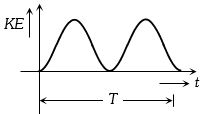
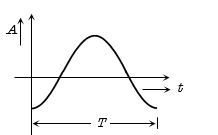
Acceleration $A$ and time period $T$ of a body in $S.H.M.$ is given by a curve shown below. Then corresponding graph, between kinetic energy $(K.E.)$ and time $t$ is correctly represented by
Answera
(a) In $S.H.M.$ when acceleration is negative maximum or positive maximum, the velocity is zero so kinetic energy is also zero.
Similarly for zero acceleration, velocity is maximum so kinetic energy is also maximum.
View full question & answer→MCQ 491 Mark
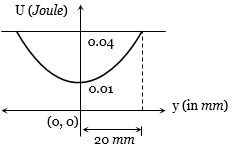
The variation of potential energy of harmonic oscillator is as shown in figure. The spring constant is
- A
$1 \times 10^2 N/m$
- ✓
$150 N/m$
- C
$0.667 \times 10^2 N/m$
- D
$3 \times 10^2 N/m$
AnswerCorrect option: B. $150 N/m$
b
(b)Total potential energy $= 0.04 J$
Resting potential energy $=0.01 J$
Maximum kinetic energy $=(0.04-0.01)$
$ = 0.03J = \frac{1}{2}m\;{\omega ^2}{a^2} = \frac{1}{2}k{a^2}$
$0.03 = \frac{1}{2} \times k \times {\left( {\frac{{20}}{{1000}}} \right)^2}$
$k = 0.06 \times 2500\;N/m = 150\;N/m$.
View full question & answer→MCQ 501 Mark
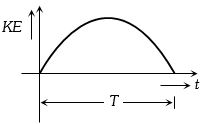
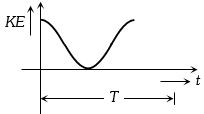
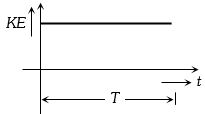
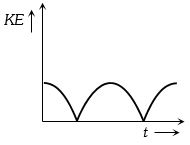
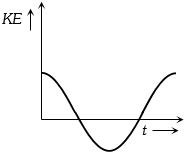
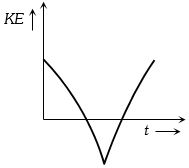
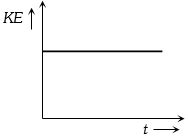
A body performs $S.H.M.$ Its kinetic energy $K$ varies with time $t$ as indicated by graph
Answera
(a) Kinetic energy varies with time but is never negative.
View full question & answer→