Question
A body falls towards earth in air. Will its total mechanical energy be conserved during the fall? Justify

Answer

For a body falling freely under gravity. The mechanical energy is not conserved because some part of mechanical energy utilized against force of friction of air molecules which is non conservative force. But if a body is falling freely under gravity in vacuum, the total mechanical energy remain conserved.

Need a full question paper?

Generate a complete, print-ready paper with questions like this in minutes — across 16+ boards, with answer keys.
Start Generating Free

Similar questions

Calculate the ratio of the angular momentum of the earth about its axis due to its spinning motion to that about the sun due to its orbital motion. Radius of the earth = 6400km and radius of the orbit of the earth about the sun = $1.5 \times 10^8km$.
Why is a heavy wheel attached to the shaft of engines?
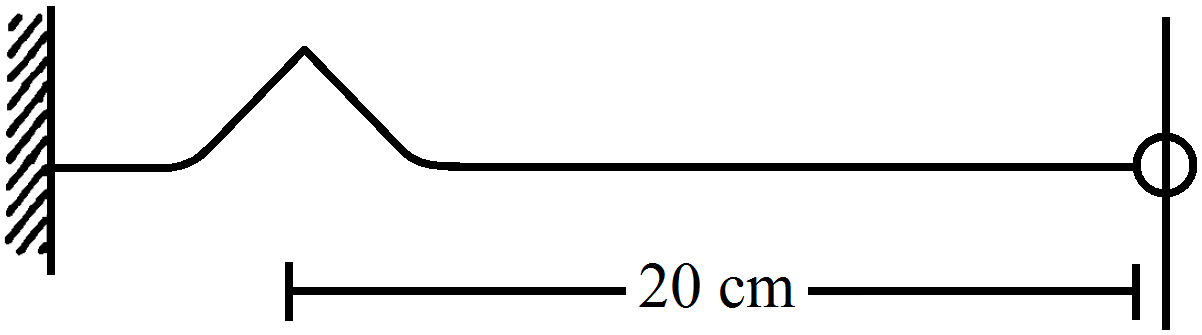
A string of linear mass density $0.5g/cm$ and a total length $30\ cm$ is tied to a fixed wall at one end and to a frictionless ring at the other end figure, The ring can move on a vertical rod. A wave pulse is produced on the string which moves towards the ring at a speed of $20\ cm/s.$ The pulse is symmetric about its maximum which is located at a distance of $20\ cm$ from the end joined to the ring.
  1. Assuming that the wave is reflected from the ends without loss of energy, find the time taken by the string to regain its shape.
  2. The shape of the string changes periodically with time. Find this time period.
  3. What is the tension in the string?
Two strips of metal are riveted together at their ends by four rivets, each of diameter $6.0mm$. What is the maximum tension that can be exerted by the riveted strip if the shearing stress on the rivet is not to exceed $6.9 \times 10^7 Pa$? Assume that each rivet is to carry one quarter of the load.
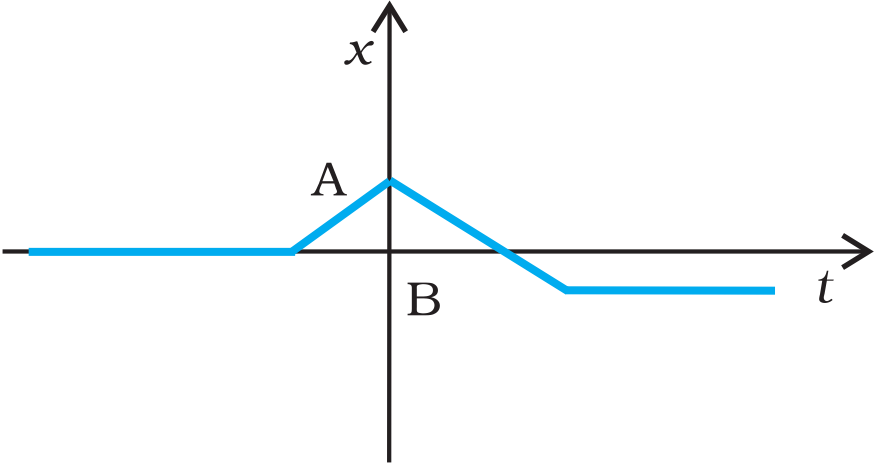
Suggest a suitable physical situation for of the following graphs.
A steel wire of $2.0 \mathrm{~mm}^2$ cross-section is held straight (but under no tension) by attaching it firmly to two points a distance 1.50 m apart at $30^{\circ} \mathrm{C}$. If the temperature now decreases to $5^{\circ} \mathrm{C}$ and if the two points remain fixed, what will be the tension in the wire? Given that Young's modulus of steel $=2 \times 10^{11} \mathrm{Nm}^{-2}$ and coefficient of thermal expansion of steel $\mathrm{a}=1.1 \times 10^{-5{ }^{\circ} \mathrm{C}} \mathrm{C}$.
What is the effect of pressure on melting point of a substance? What is the relegation. Give its one practical application.
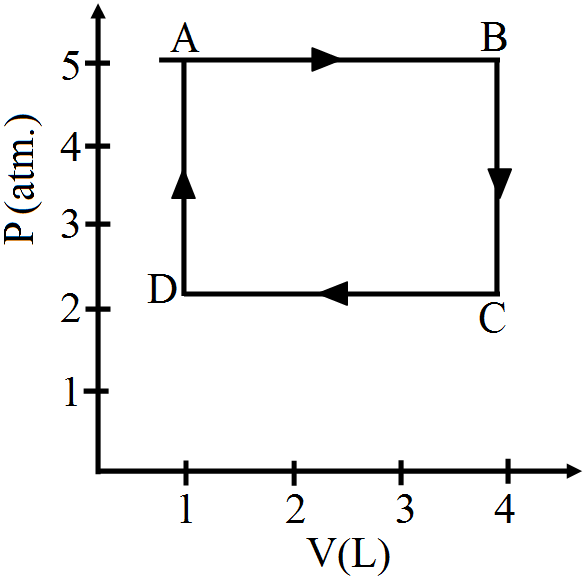
One mole of an ideal gas undergoes a cyclic change ABCD. From the given diagram, calculate the net work done in the process. $1$ atmosphere = $10^\circ dyne\ cm^{-2}$.
A 40cm wire having a mass of 3.2g is stretched between two fixed supports 40.05cm apart. In its fundamental mode, the wire vibrates at 220Hz. If the area of cross-section of the wire is $1.0mm^2$, find its Young's modulus.
A cylindrical piece of cork of density of base area A and height h floats in a liquid of density $\rho_{\text{l}}.$ The cork is depressed slightly and then released. Show that the cork oscillates up and down simple harmonically with a period.$\text{T}=2\pi\sqrt{\frac{\text{h}\rho}{\rho_{\text{l}}\text{g}}}$
where $\rho$ is the density of cork. (Ignore damping due to viscosity of the liquid).