Question
What is the effect of pressure on melting point of a substance? What is the relegation. Give its one practical application.

Answer

The melting point of those substances which expands on melting, increases with increase in pressure while the melting point of those substances which contact on melting, decreases with increase in pressure. The phenomenon ‘a' in which ice melts when pressure is increased and again freezes when pressure is removed is called relegation. It is due to the above fact that the skating is possible on snow.

Need a full question paper?

Generate a complete, print-ready paper with questions like this in minutes — across 16+ boards, with answer keys.
Start Generating Free

Similar questions

A constant force of 2.50N accelerates a stationary particle of mass 15g through a displacement of 2.50m. Find the work done and the average power delivered.
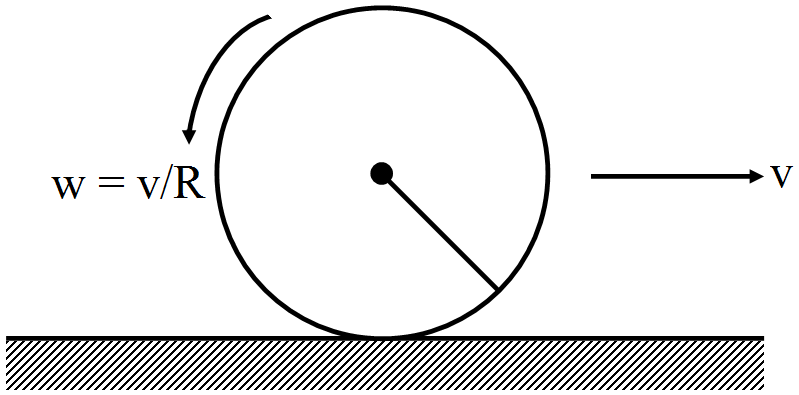
A solid sphere is set into motion on a rough horizontal surface with a linear speed v in the forward direction and an angular speed $\frac{\text{v}}{\text{R}}$ in the anticlockwise direction as shown in figure. Find the linear speed of the sphere:
  1. When it stops rotating.
  2. When slipping finally ceases and pure rolling starts.
Suppose the bob of the previous problem has a speed of 1.4m/ s when the string makes an angle of 0.20 radian with the vertical. Find the tension at this instant. You can use $\cos\theta\approx1-\frac{\theta^2}{2}$ and $\sin\theta\approx\theta$ for small $\theta.$
A spring stores 5J of energy when stretched by 25cm. It is kept vertical with the lower end fixed. A block fastened to its other end is made to undergo small oscillations. If the block makes 5 oscillations each second, what is the mass of the block?
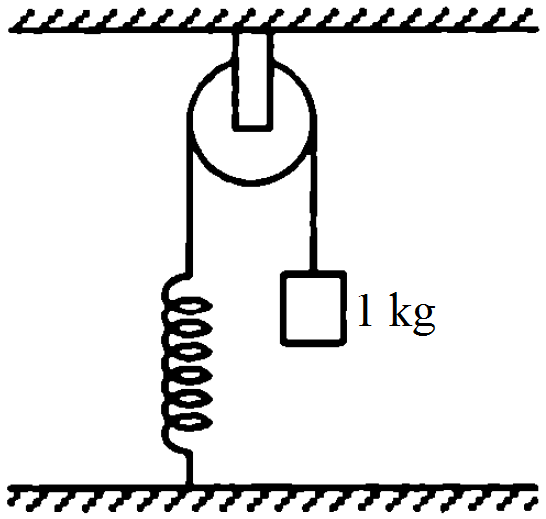
The pulley shown in figure has a radius of 20cm and moment of inertia $0.2kg-m^2$. The string going over it is attached at one end to a vertical spring of spring constant 50N/m fixed from below, and supports a 1kg mass at the other end. The system is released from rest with the spring at its natural length. Find the speed of the block when it has descended through 10cm. Take g $= 10m/s_2$.
Two blocks of masses $10kg$ and $30kg$ are placed along a vertical line. The first block is raised through a height of $7cm$. By what distance should the second mass be moved to raise the centre of mass by $1cm$?
An amount Q of heat is added to a monatomic ideal gas in a process in which the gas performs a work $\frac{\text{Q}}{2}$ on its surrounding. Find the molar heat capacity for the process.
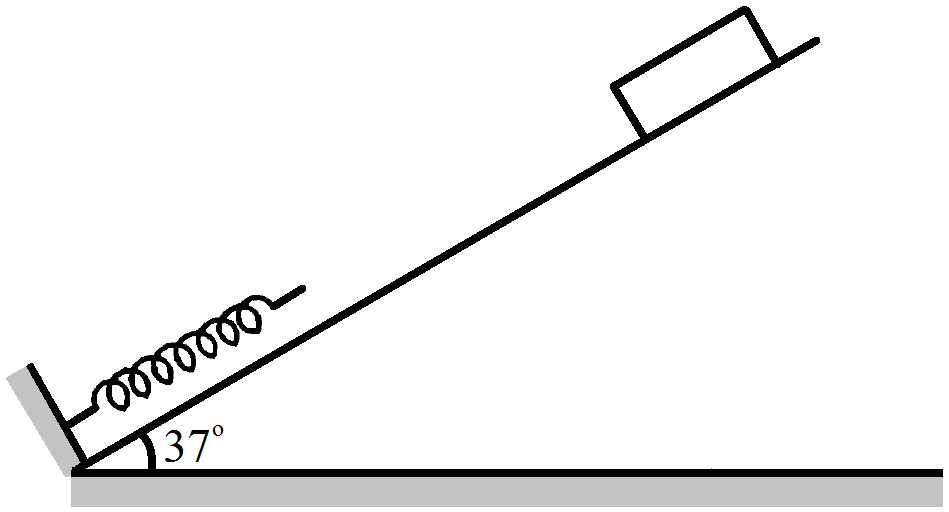
Figure shows a spring fixed at the bottom end of an incline of inclination $37^\circ$. A small block of mass 2kg starts slipping down the incline from a point 4.8m away from the spring. The block compresses the spring by 20cm, stops momentarily and then rebounds through a distance of 1m up the incline. Find.
  1. The friction coefficient between the plane and the block.
  2. The spring constant of the spring. Take $g = 10m/s^2.$
If the time of flight of a projectile projected with a velocity u at an angle $\theta$ is $\frac{2\text{u}\sin\theta}{\text{g}},$ find the condition for maximum range and its value?