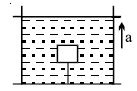
A body having volume $V$ and density $\rho$ is attached to the bottom of a container as shown. Density of the liquid is $d( > \rho )$. Container has a constant upward acceleration $a.$ Tension in the string is
Diffcult
Download our app for free and get started
Note that the acceleration has an effect on both upthrust and weight
Weight experienced by the mass $=\rho V(g+a)$
Upthrust experienced by the mass $=d V(g+a)$
Tension experienced by the string $=U{p t h r u s t}-Weight$
$=V(g+a)(d-\rho)$

Download our appand get started for free
Experience the future of education. Simply download our apps or reach out to us for more information. Let's shape the future of learning together!No signup needed.*
Similar Questions
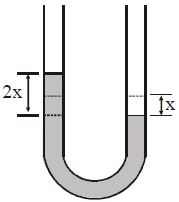
- 1$9\ kg$ of mercury is poured into a glass $U-tube$ with inner diameter of $1.2 \ cm$. The mercury can flow without friction within the tube. the oscillation period ......... $\sec$. Density of mercury = $13.6 × 10^3\ kg/m^3$.View Solution
- 2Alaminar stream is flowing vertically down from a tap of cross-section area $1$ $cm^2$. At a distance $10 $ $cm$ below the tap, the cross-section area of the stream has reduced to $1/2$ $cm^2$. The volumetric flow rate of water from the tap must be about ........ $litre/\min$View Solution
- 3A rectangular block is $5 cm × 5 cm × 10cm$ in size. The block is floating in water with $ 5 cm $ side vertical. If it floats with $10 cm $ side vertical, what change will occur in the level of water?View Solution
- 4A plane is in level flight at constant speed and each of its two wings has an area of $40 \mathrm{~m}^2$. If the speed of the air is $180 \mathrm{~km} / \mathrm{h}$ over the lower wing surface and $252 \mathrm{~km} / \mathrm{h}$ over the upper wing surface, the mass of the plane is______ $\mathrm{kg}$. (Take air density to be $1 \mathrm{~kg} \mathrm{~m}^{-3}$ and $\mathrm{g}=10 \mathrm{~ms}^{-2}$ )View Solution
- 5A spherical solid ball of volume $V$ is made of a material of density $\rho_1$ . It is falling through a liquid of density $\rho_2 (\rho_2 < \rho_1 )$. Assume that the liquid applies a viscous force on the ball that is proportional to the square of its speed $v$, i.e., $F_{viscous}= -kv^2 (k >0 )$,The terminal speed of the ball isView Solution
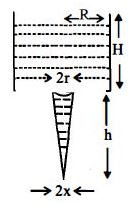
- 6Consider a water jar of radius $R$ that has water filled up to height $H$ and is kept on a stand of height $h$ (see figure) . Through a hole of radius $r$ $(r << R)$ at its bottom, the water leaks out and the stream of water coming down towards the ground has a shape like a funnel as shown in the figure. If the radius of the cross-section of water stream when it hits the ground is $x.$ ThenView Solution
- 7There is a hole in the bottom of tank having water. If total pressure at bottom is $ 3 atm$ ($1 atm = 10^5N/m^2$) then the velocity of water flowing from hole isView Solution
- 8The approximate depth of an ocean is $2700\,\, m.$ The compressibility of water is $45.4 \times 10^{-11} Pa^{-1}$ and density of water is $10^3 \,kg/m^3 $. What fractional compression of water will be obtained at the bottom of the ocean?View Solution
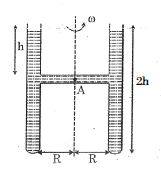
- 9The shown $H$ shaped apparatus contains an ideal incompressible liquid and has dimension as shown in figure . The diameters of the Tubes are small as compared to $h$ and $R$. The apparatus is rotated with a constant angular velocity $\omega$ about a symmetric vertical axis as shown in figure. The pressure at point $A$ isView Solution
- 10A train with cross-sectional area $S _{ t }$ is moving with speed $v_t$ inside a long tunnel of cross-sectional area $S _0\left( S _0=4 S _{ t }\right)$. Assume that almost all the air (density $\rho$ ) in front of the train flows back between its sides and the walls of the tunnel. Also, the air flow with respect to the train is steady and laminar. Take the ambient pressure and that inside the train to be $p _0$. If the pressure in the region between the sides of the train and the tunnel walls is $p$, then $p _0- p =\frac{7}{2 N } \rho v_{ t }^2$. The value of $N$ is. . . . .View Solution