MCQ
A body is moving along a rough horizontal surface with an initial velocity $6 \mathrm{~m} / \mathrm{s}$. If the body comes to rest after travelling $9 \mathrm{~m}$, then the coefficient of sliding friction will be
  • A
    $0.4$
  • $0.2$
  • C
    $0.6$
  • D
    $0.8$

Answer

Correct option: B.
$0.2$
(b) We know $s=\frac{u^2}{2 \mu g} $
$ \therefore \mu=\frac{u^2}{2 g s}=\frac{(6)^2}{2 \times 10 \times 9}=0.2$

Need a full question paper?

Generate a complete, print-ready paper with questions like this in minutes — across 16+ boards, with answer keys.

Start Generating Free

Similar questions

If two liquids of same masses but densities $\rho_1$ and $\rho_2$ respectively are mixed, then density of mixture is given by
A thief stole a box full of valuable articles of weight $W$ and while carrying it on his back, he jumped down a wall of height ' $h$ ' from the ground. Before he reached the ground he experienced a load of
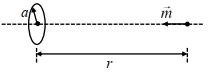
A special metal $S$ conducts electricity without any resistance. A closed wire loop, made of $S$, does not allow any change in flux through itself by inducing a suitable current to generate a compensating flux. The induced current in the loop cannot decay due to its zero resistance. This current gives rise to a magnetic moment which in turn repels the source of magnetic field or flux. Consider such a loop, of radius $a$, with its center at the origin. A magnetic dipole of moment $m$ is brought along the axis of this loop from infinity to a point at distance $r \gg a)$ from the center of the loop with its north pole always facing the loop, as shown in the figure below.

The magnitude of magnetic field of a dipole $m$, at a point on its axis at distance $r$, is $\frac{\mu_0}{2 \pi} \frac{m}{r^3}$, where $\mu_0$ is the permeability of free space. The magnitude of the force between two magnetic dipoles with moments, $m_1$ and $m_2$, separated by a distance $r$ on the common axis, with their north poles facing each other, is $\frac{k m_1 m_2}{r^4}$, where $k$ is a constant of appropriate dimensions. The direction of this force is along the line joining the two dipoles.

($1$) When the dipole $m$ is placed at a distance $r$ from the center of the loop (as shown in the figure), the current induced in the loop will be proportional to

$(A)$ $\frac{m}{r^3}$ $(B)$ $\frac{m^2}{r^2}$ $(C)$ $\frac{m}{r^2}$ $(D)$ $\frac{m^2}{r}$

($2$) The work done in bringing the dipole from infinity to a distance $r$ from the center of the loop by the given process is proportional to

$(A)$ $\frac{m}{r^5}$ $(B)$ $\frac{m^2}{r^5}$ $(C)$ $\frac{m^2}{r^6}$ $(D)$ $\frac{m^2}{r^7}$

Give the answer or qution ($1$) and ($2$)
What is the angular velocity of earth
The minimum frequency $v$ of continuous $X$-rays is related to the applied potential difference $V$ as
A lamp is hanging at a height of $4\ m$ above a table. The lamp is lowered by $1 \mathrm{~m}$. The percentage increase in illuminace will be
A S.H.M. is represented by $x=5 \sqrt{2}(\sin 2 \pi t+\cos 2 \pi t)$. The amplitude of the S.H.M. is
The beats are produced by two sound sources of same amplitude and of nearly equal frequencies. The maximum intensity of beats will be that of one source
The line on the earth's surface joining the points where the field is horizontal is
A particle of mass $m$ is attached to a spring (of spring constant $k$ ) and has a natural angular frequency $\omega_0$-An external force $F(t)$ proportional to $\cos \omega t\left(\left(\omega \neq \omega_0\right)\right.$ is applied to the oscillator. The time displacement of the oscillator will be proportional to