MCQ 11 Mark
A $500 \mathrm{~kg}$ horse pulls a cart of mass $1500\ \mathrm{~kg}$ along a level road with an acceleration of $1 \mathrm{~ms}^{-2}$. If the coefficient of sliding friction is $0.2$ , then the force exerted by the horse in forward direction is
- A
$3000\ \mathrm{~N}$
- B
$4000\ \mathrm{~N}$
- C
$5000\ \mathrm{~N}$
- ✓
$6000 \ \mathrm{~N}$
AnswerCorrect option: D. $6000 \ \mathrm{~N}$
(d) Net force in forward direction $=$ Accelerating force + Friction
$ =m a+\mu m g=m(a+\mu g)=(1500+500)(1+0.2 \times 10) $
$ =2000 \times 3=6000\ N$
View full question & answer→MCQ 21 Mark
A force of $750 \mathrm{~N}$ is applied to a block of mass $102 \mathrm{~kg}$ to prevent it from sliding on a plane with an inclination angle $30^{\circ}$ with the horizontal. If the coefficients of static friction and kinetic friction between the block and the plane are 0.4 and 0.3 respectively, then the frictional force acting on the block is
- A
$750 \mathrm{~N}$
- B
$500 \mathrm{~N}$
- C
$345 \mathrm{~N}$
- ✓
$250 \mathrm{~N}$
AnswerCorrect option: D. $250 \mathrm{~N}$
View full question & answer→MCQ 31 Mark
A given object takes $n$ times as much time to slide down a $45^{\circ}$ rough incline as it takes to slide down a perfectly smooth $45^{\circ}$ incline. The coefficient of kinetic friction between the object and the incline is given by
AnswerCorrect option: A. $\left(1-\frac{1}{n^2}\right)$
(a) $\mu=\tan \theta\left(1-\frac{1}{n^2}\right)=1-\frac{1}{n^2} \quad\left[\right.$ As $\left.\theta=45^{\circ}\right]$
View full question & answer→MCQ 41 Mark
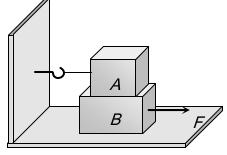
A block $A$ with mass $100 \mathrm{~kg}$ is resting on another block $B$ of mass $200 \mathrm{~kg}$. As shown in figure a horizontal rope tied to a wall holds it. The coefficient of friction between $A$ and $B$ is $0.2$ while coefficient of friction between $B$ and the ground is $0.3.$ The minimum required force $F$ to start moving $B$ will be
- A
$900 \mathrm{~N}$
- B
$100 \mathrm{~N}$
- ✓
$1100 \mathrm{~N}$
- D
$1200 \mathrm{~N}$
AnswerCorrect option: C. $1100 \mathrm{~N}$
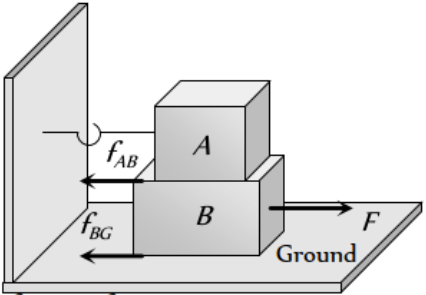
$F=f_{A B}+f_{B G}$
$ =\mu_{A B} m_a g+\mu_{B G}\left(m_A+m_B\right) g$
$=0.2 \times 100 \times10 +0.3(300) \times 10$
$=200+900=1100 N$ View full question & answer→MCQ 51 Mark
A block is lying on an inclined plane which makes $60^{\circ}$ with the horizontal. If coefficient of friction between block and plane is $0.25$ and $g=10 \mathrm{~m} / \mathrm{s}^2$, then acceleration of the block when it moves along the plane will be
- A
$2.50 \mathrm{~m} / \mathrm{s}^2$
- B
$5.00 \mathrm{~m} / \mathrm{s}^2$
- ✓
$7.4 \mathrm{~m} / \mathrm{s}^2$
- D
$8.66 \mathrm{~m} / \mathrm{s}^2$
AnswerCorrect option: C. $7.4 \mathrm{~m} / \mathrm{s}^2$
$ a=g(\sin \theta-\mu \cos \theta)=10\left(\sin 60^{\circ}-0.25 \cos 60^{\circ})\right.$
$ a=7.4 m / s ^2$
View full question & answer→MCQ 61 Mark
A cylinder of $10 \mathrm{~kg}$ is sliding in a plane with an initial velocity of $10 \mathrm{~m} / \mathrm{s}$. If the coefficient of friction between the surface and cylinder is 0.5 then before stopping, it will cover. $\left(g=10 \mathrm{~m} / \mathrm{s}^2\right)$
- A
$2.5 \mathrm{~m}$
- B
$5 \mathrm{~m}$
- C
$7.5 \mathrm{~m}$
- ✓
$10 \mathrm{~m}$
AnswerCorrect option: D. $10 \mathrm{~m}$
(d) Kinetic energy of the cylinder will go against friction$\therefore \frac{1}{2} m v^2=\mu m g s \Rightarrow s=\frac{u^2}{2 \mu g}=\frac{(10)^2}{2 \times(0.5) \times 10}=10 m$
View full question & answer→MCQ 71 Mark
A fireman of mass $60 \mathrm{~kg}$ slides down a pole. He is pressing the pole with a force of $600 \mathrm{~N}$. The coefficient of friction between the hands and the pole is 0.5 , with what acceleration will the fireman slide down $\left(g=10 \mathrm{~m} / \mathrm{s}^2\right)$
- A
$1 \mathrm{~m} / \mathrm{s}^2$
- B
$2.5 \mathrm{~m} / \mathrm{s}^2$
- C
$10 \mathrm{~m} / \mathrm{s}^2$
- ✓
$5 \mathrm{~m} / \mathrm{s}^2$
AnswerCorrect option: D. $5 \mathrm{~m} / \mathrm{s}^2$
View full question & answer→MCQ 81 Mark
The upper half of an inclined plane of inclination $\theta$ is perfectly smooth while the lower half is rough. A body starting from the rest at top comes back to rest at the bottom if the coefficient of friction for the lower half is given by
- A
$\mu=\sin \theta$
- B
$\mu=\cot \theta$
- C
$\mu=2 \cos \theta$
- ✓
$\mu=2 \tan \theta$
AnswerCorrect option: D. $\mu=2 \tan \theta$
View full question & answer→MCQ 91 Mark
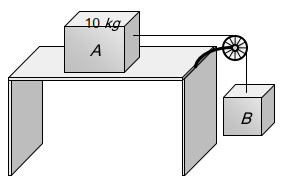
If mass of $A=10 \mathrm{~kg}$, coefficient of static friction $=0.2$, coefficient of kinetic friction $=0.2$. Then mass of $B$ to start motion is
- ✓
$2 \mathrm{~kg}$
- B
$2.2 \mathrm{~kg}$
- C
$4.8 \mathrm{~kg}$
- D
$200\ \mathrm{gm}$
AnswerCorrect option: A. $2 \mathrm{~kg}$
(a) $\mu_s=\frac{m_B}{m_A} \Rightarrow 0.2=\frac{m_B}{10} \Rightarrow m_B=2\ kg$
View full question & answer→MCQ 101 Mark
A body of mass $2 \mathrm{~kg}$ is kept by pressing to a vertical wall by a force of $100 \mathrm{~N}$. The coefficient of friction between wall and body is 0.3 . Then the frictional force is equal to
- A
$6 \mathrm{~N}$
- ✓
$20 \mathrm{~N}$
- C
$600 \mathrm{~N}$
- D
$700 \mathrm{~N}$
AnswerCorrect option: B. $20 \mathrm{~N}$
(b) For the given condition, Static friction $=$ Applied force $=$ Weight of body $=2 \times 10=20 N$
View full question & answer→MCQ 111 Mark
The maximum speed that can be achieved without skidding by a car on a circular unbanked road of radius $R$ and coefficient of static friction $\mu$, is
AnswerCorrect option: D. $\sqrt{\mu R g}$
(d) In the given condition the required centripetal force is provided by frictional force between the road and tyre.
$\frac{m v^2}{R}=\mu m g $
$\therefore v=\sqrt{\mu R g}$
View full question & answer→MCQ 121 Mark
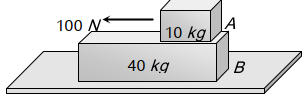
A $40 \mathrm{~kg}$ slab rests on a frictionless floor as shown in the figure. A $10 \mathrm{~kg}$ block rests on the top of the slab. The static coefficient of friction between the block and slab is 0.60 while the kinetic friction is $0.40.$ The $10 \mathrm{~kg}$ block is acted upon by a horizontal force $100 \mathrm{~N}$. If $g=9.8 \mathrm{~m} / \mathrm{s}^2$, the resulting acceleration of the slab will be
- ✓
$0.98 \mathrm{~m} / \mathrm{s}^2$
- B
$1.47 \mathrm{~m} / \mathrm{s}^2$
- C
$1.52 \mathrm{~m} / \mathrm{s}^2$
- D
$6.1 \mathrm{~m} / \mathrm{s}^2$
AnswerCorrect option: A. $0.98 \mathrm{~m} / \mathrm{s}^2$
Limiting friction between block and slab $=\mu_s m_A g$
$=0.6 \times 10 \times 9.8=58.8 N$
But applied force on block $A$ is $100 N$.
So the block will slip over a slab.Now kinetic friction works between block and slab
$F_k=\mu_k m_A g=0.4 \times 10 \times 9.8=39.2 N$
This kinetic friction helps to move the slab
$\therefore \text { Acceleration of slab }=\frac{39.2}{m_B}=\frac{39.2}{40}=0.98 m / s ^2$
View full question & answer→MCQ 131 Mark
A block of mass $M=5 \mathrm{~kg}$ is resting on a rough horizontal surface for which the coefficient of friction is $0.2.$ When a force $F=40 \mathrm{~N}$ is applied, the acceleration of the block will be $\left(g=10 \mathrm{~m} / \mathrm{s}^2\right)$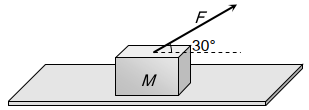
- ✓
$5.73 \mathrm{~m} / \mathrm{sec}^2$
- B
$8.0 \mathrm{~m} / \mathrm{sec}^2$
- C
$3.17 \mathrm{~m} / \mathrm{sec}^2$
- D
$10.0 \mathrm{~m} / \mathrm{sec}^2$
AnswerCorrect option: A. $5.73 \mathrm{~m} / \mathrm{sec}^2$
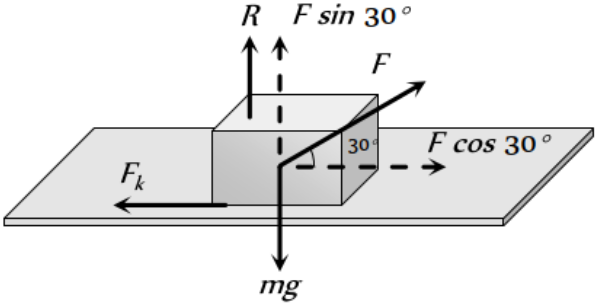
$\text { Kinetic friction }=\mu_k R=0.2\left(m g-F \sin 30^{\circ}\right) $
$ =0.2\left(5 \times 10-40 \times \frac{1}{2}\right)=0.2(50-20)=6 N$
$\text { Acceleration of the block }=\frac{F \cos 30^{\circ}-\text { Kineticfriction }}{\text { Mass }}$
$ =\frac{40 \times \frac{\sqrt{3}}{2}-6}{5}=5.73 m / s ^2$ View full question & answer→MCQ 141 Mark
A block of $1 \mathrm{~kg}$ is stopped against a wall by applying a force $F$ perpendicular to the wall. If $\mu=0.2$ then minimum value of $F$ will be
- A
$980 \mathrm{~N}$
- ✓
$49 \mathrm{~N}$
- C
$98 \mathrm{~N}$
- D
$490 \mathrm{~N}$
AnswerCorrect option: B. $49 \mathrm{~N}$
(b) $F=\frac{W}{\mu}=\frac{1 \times 9.8}{0.2}=49 N$
View full question & answer→MCQ 151 Mark
300 Joule of work is done in sliding up a $2 \mathrm{~kg}$ block on an inclined plane to a height of 10 metres. Taking value of acceleration due to gravity ' $g$ ' to be $10 \mathrm{~m} / \mathrm{s}^2$, work done against friction is
- ✓
$100 \mathrm{~J}$
- B
$200 \mathrm{~J}$
- C
$300 \mathrm{~J}$
- D
AnswerCorrect option: A. $100 \mathrm{~J}$
(a) Work done against gravity $=m g h \quad=2 \times 10 \times 10=200 J$ Work done against friction $=($ Total work done - work done against gravity) $=300-200=100 J$
View full question & answer→MCQ 161 Mark
On a rough horizontal surface, a body of mass $2 \mathrm{~kg}$ is given a velocity of $10 \mathrm{~m} / \mathrm{s}$. If the coefficient of friction is 0.2 and $g=10 \mathrm{~m} / \mathrm{s}^2$, the body will stop after covering a distance of
- A
$10 \mathrm{~m}$
- ✓
$25 \mathrm{~m}$
- C
$50 \mathrm{~m}$
- D
$250 \mathrm{~m}$
AnswerCorrect option: B. $25 \mathrm{~m}$
(b) $S=\frac{u^2}{2 \mu g}=\frac{(10)^2}{2 \times 0.2 \times 10}=25 m$
View full question & answer→MCQ 171 Mark
A car having a mass of $1000\ \mathrm{~kg}$ is moving at a speed of $30$ metres/sec. Brakes are applied to bring the car to rest. If the frictional force between the tyres and the road surface is $5000$ newtons, the car will come to rest in
- A
$5$ seconds
- B
$10$ seconds
- C
$12$ seconds
- ✓
$6$ seconds
AnswerCorrect option: D. $6$ seconds
$ v=u-a t \Rightarrow t=\frac{u}{a} \quad[\text { As } v=0] $
$ t=\frac{u \times m}{F}=\frac{30 \times 1000}{5000}=6\ sec$ $[As \ v=0]$
View full question & answer→MCQ 181 Mark
A block weighs $W$ is held against a vertical wall by applying a horizontal force $F$. The minimum value of $F$ needed to hold the block is
- A
Less than $W$
- B
Equal to $W$
- ✓
Greater than $W$
- D
AnswerCorrect option: C. Greater than $W$
View full question & answer→MCQ 191 Mark
When a body is moving on a surface, the force of friction is called
MCQ 201 Mark
A block of mass $2 \mathrm{~kg}$ is kept on the floor. The coefficient of static friction is $0.4$. If a force $F$ of $2.5$ Newtons is applied on the block as shown in the figure, the frictional force between the block and the floor will be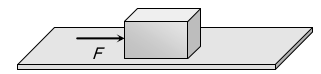
- ✓
$2.5 \mathrm{~N}$
- B
$5 \mathrm{~N}$
- C
$7.84 \mathrm{~N}$
- D
$10 \mathrm{~N}$
AnswerCorrect option: A. $2.5 \mathrm{~N}$
(a) Applied force $=2.5 N$Limiting friction $=\mu m g=0.4 \times 2 \times 9.8=7.84\ N$
For the given condition applied force is very smaller than limiting friction.
$\therefore$ Static friction on a body $=$ Applied force $=2.5 N$
View full question & answer→MCQ 211 Mark
A body of mass $M$ is kept on a rough horizontal surface (friction coefficient $\mu$ ). A person is trying to pull the body by applying a horizontal force but the body is not moving. The force by the surface on the body is $F$, where
AnswerCorrect option: C. $M g \leq F \leq M g \sqrt{1+\mu^2}$
Maximum force by surface when friction works
$F=\sqrt{f^2+R^2}=\sqrt{(\mu R)^2+R^2}=R \sqrt{\mu^2+1}$
Minimum force $=R$ when there is no frictionHence ranging from $R$ to $R \sqrt{\mu^2+1}$
We get, $M g \leq F \leq M g \sqrt{\mu^2+1}$
View full question & answer→MCQ 221 Mark
A $60 \mathrm{~kg}$ weight is dragged on a horizontal surface by a rope upto $2$ metres. If coefficient of friction is $\mu=0.5$, the angle of rope with the surface is $60^{\circ}$ and $g=9.8 \mathrm{~m} / \mathrm{sec}^2$, then work done is
- A
$294$ joules
- ✓
$315$ joules
- C
$588$ joules
- D
$197$ joules
AnswerCorrect option: B. $315$ joules
Let body is dragged with force $P$, making an angle $60^{\circ}$ with the horizontal.
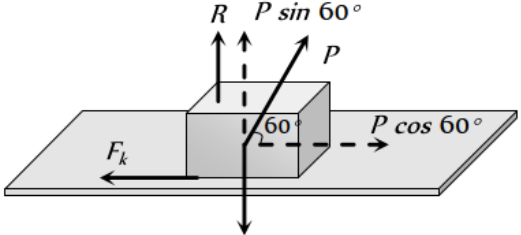
$F_k=$ Kinetic friction in the motion $=\mu_k R$
From the figure $F_k=P \cos 60^{\circ}$ and $R=m g-P \sin 60^{\circ}$
$\therefore P \cos 60^{\circ}=\mu_k\left(m g-P \sin 60^{\circ}\right) $
$\Rightarrow \frac{P}{2}=0.5\left(60 \times 10-\frac{P \sqrt{3}}{2}\right) \Rightarrow P=315.1 N $
$\therefore F_k=P \cos 60^{\circ}=\frac{315.1}{2} N$
Work done $=F_k \times s=\frac{315.1}{2} \times 2=315$ Joule View full question & answer→MCQ 231 Mark
The blocks $A$ and $B$ are arranged as shown in the figure. The pulley is frictionless. The mass of $A$ is $10 \mathrm{~kg}$. The coefficient of friction of $A$ with the horizontal surface is 0.20 . The minimum mass of $B$ to start the motion will be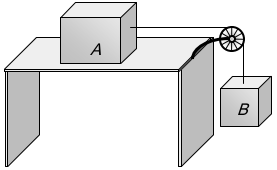
- ✓
$2 \mathrm{~kg}$
- B
$0.2 \mathrm{~kg}$
- C
$5 \mathrm{~kg}$
- D
$10 \mathrm{~kg}$
AnswerCorrect option: A. $2 \mathrm{~kg}$
(a) $\quad \mu=\frac{m_B}{m_A} \Rightarrow 0.2=\frac{m_B}{10} \Rightarrow m_B=2 kg$
View full question & answer→MCQ 241 Mark
A car is moving along a straight horizontal road with a speed $v_0$. If the coefficient of friction between the tyres and the road is $\mu$, the shortest distance in which the car can be stopped is
AnswerCorrect option: A. $\frac{v_0^2}{2 \mu g}$
(a) Retarding force $F=m a=\mu R=\mu m g \quad \therefore a=\mu g$Now from equation of motion $v^2=u^2-2 a s$$\Rightarrow 0=u^2-2 a s \Rightarrow s=\frac{u^2}{2 a}=\frac{u^2}{2 \mu g} \quad \therefore=\frac{v_0^2}{2 \mu g}$
View full question & answer→MCQ 251 Mark
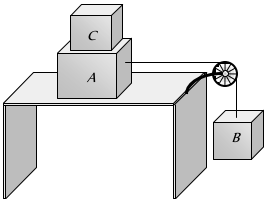
Two masses A and B of $10 \mathrm{~kg}$ and $5 \mathrm{~kg}$ respectively are connected with a string passing over a frictionless pulley fixed at the corner of a table as shown. The coefficient of static friction of $A$ with table is $0.2.$ The minimum mass of $C$ that may be placed on $A$ to prevent it from moving is
- ✓
$15 \mathrm{~kg}$
- B
$10 \mathrm{~kg}$
- C
$5 \mathrm{~kg}$
- D
$12 \mathrm{~kg}$
AnswerCorrect option: A. $15 \mathrm{~kg}$
$ \text { For limiting condition }$
$\mu=\frac{m_B}{m_A+m_C} \Rightarrow 0.2=\frac{5}{10+m_C} $
$ \Rightarrow 2+0.2 m_C=5$
$ \Rightarrow m_C=15\ kg$
View full question & answer→MCQ 261 Mark
A motorcycle is travelling on a curved track of radius $500 \mathrm{~m}$. If the coefficient of friction between road and tyres is $0.5 ,$ the speed avoiding skidding will be
- ✓
$50 \mathrm{~m} / \mathrm{s}$
- B
$75 \mathrm{~m} / \mathrm{s}$
- C
$25 \mathrm{~m} / \mathrm{s}$
- D
$35 \mathrm{~m} / \mathrm{s}$
AnswerCorrect option: A. $50 \mathrm{~m} / \mathrm{s}$
(a) $v=\sqrt{\mu r g}=\sqrt{0.5 \times 500 \times 10}=50 m / s$
View full question & answer→MCQ 271 Mark
A body of mass $2 \mathrm{~kg}$ is being dragged with uniform velocity of $2 \mathrm{~m} / \mathrm{s}$ on a rough horizontal plane. The coefficient of friction between the body and the surface is $0.20.$ The amount of heat generated in $5 \mathrm{sec}$ is $\left(J=4.2 \text { joule } / \mathrm{cal} \text { and } g=9.8 \mathrm{~m} / \mathrm{s^2}\right)$
- ✓
$9.33 \mathrm{cal}$
- B
$10.21 \mathrm{cal}$
- C
$12.67 \mathrm{cal}$
- D
$13.34 \mathrm{cal}$
AnswerCorrect option: A. $9.33 \mathrm{cal}$
(a) Work done $=$ Force $\times$ Displacement
$=\mu m g \times(v \times t)$
$W=(0.2) \times 2 \times 9.8 \times 2 \times 5 \text { joule }$
Heat generated $Q=\frac{W}{J}=\frac{0.2 \times 2 \times 9.8 \times 2 \times 5}{4.2}=9.33 cal$
View full question & answer→MCQ 281 Mark
The maximum speed of a car on a road turn of radius $30 \mathrm{~m}$, if the coefficient of friction between the tyres and the road is 0.4 ; will be
- A
$9.84 \mathrm{~m} / \mathrm{s}$
- B
$10.84 \mathrm{~m} / \mathrm{s}$
- ✓
$7.84 \mathrm{~m} / \mathrm{s}$
- D
$5.84 \mathrm{~m} / \mathrm{s}$
AnswerCorrect option: C. $7.84 \mathrm{~m} / \mathrm{s}$
(b) $v=\sqrt{\mu rg }=\sqrt{0.4 \times 30 \times 9.8}=10.84 m / s$
View full question & answer→MCQ 291 Mark
A uniform metal chain is placed on a rough table such that one end of chain hangs down over the edge of the table. When one-third of its length hangs over the edge, the chain starts sliding. Then, the coefficient of static friction is
- A
$\frac{3}{4}$
- B
$\frac{1}{4}$
- C
$\frac{2}{3}$
- ✓
$\frac{1}{2}$
AnswerCorrect option: D. $\frac{1}{2}$
$ \mu_s=\frac{\text { Lenght ofthe chain hanging from the table }}{\text { Lengthof the chain lyingon the table }} $
$ =\frac{l / 3}{l-l / 3}=\frac{l / 3}{2 l / 3}=\frac{1}{2}$
View full question & answer→MCQ 301 Mark
Which one of the following is not used to reduce friction
Answer(c) Sand is used to increase the friction.
View full question & answer→MCQ 311 Mark
A block of mass $10 \mathrm{~kg}$ is placed on an inclined plane. When the angle of inclination is $30^{\circ}$, the block just begins to slide down the plane. The force of static friction is
- A
$10 \mathrm{~kg} w t$
- B
$89 \mathrm{~kg} w$
- C
$49 \mathrm{~kg} w$
- ✓
$5 \mathrm{~kg} w t$
AnswerCorrect option: D. $5 \mathrm{~kg} w t$
(d) $F=m g \sin 30^{\circ}=50 N =5 kg -w t$.
View full question & answer→MCQ 321 Mark
A box is lying on an inclined plane what is the coefficient of static friction if the box starts sliding when an angle of inclination is $60^{\circ}$
- A
$1.173$
- ✓
$1.732$
- C
$2.732$
- D
$1.677$
AnswerCorrect option: B. $1.732$
(b) $\mu=\tan \left(\right.$ Angle of repose) $=\tan 60^{\circ}=1.732$
View full question & answer→MCQ 331 Mark
A body of $5 \mathrm{~kg}$ weight kept on a rough inclined plane of angle $30^{\circ}$ starts sliding with a constant velocity. Then the coefficient of friction is (assume $g=10 \mathrm{~m} / \mathrm{s}^2$ )
- ✓
$1 / \sqrt{3}$
- B
$2 / \sqrt{3}$
- C
$\sqrt{3}$
- D
$2 \sqrt{3}$
AnswerCorrect option: A. $1 / \sqrt{3}$
(a) $\mu=\tan 30^{\circ}=\frac{1}{\sqrt{3}}$.
View full question & answer→MCQ 341 Mark
A body of mass $10 \mathrm{~kg}$ is lying on a rough plane inclined at an angle of $30^{\circ}$ to the horizontal and the coefficient of friction is $0.5.$ the minimum force required to pull the body up the plane is
- A
$914 \mathrm{~N}$
- ✓
$91.4 \mathrm{~N}$
- C
$9.14 \mathrm{~N}$
- D
$0.914 \mathrm{~N}$
AnswerCorrect option: B. $91.4 \mathrm{~N}$
$F =m g(\sin \theta+\mu \cos \theta)$
$ =10 \times 9.8\left(\sin 30^{\circ}+0.5 \cos 30^{\circ}\right)=91.4 N .$
View full question & answer→MCQ 351 Mark
A body takes just twice the time as long to slide down a plane inclined at $30^{\circ}$ to the horizontal as if the plane were frictionless. The coefficient of friction between the body and the plane is
- ✓
$\frac{\sqrt{3}}{4}$
- B
$\sqrt{3}$
- C
$\frac{4}{3}$
- D
$\frac{3}{4}$
AnswerCorrect option: A. $\frac{\sqrt{3}}{4}$
(a) $\quad \mu=\tan \theta\left(1-\frac{1}{n^2}\right)=\tan 30\left(1-\frac{1}{2^2}\right)=\frac{\sqrt{3}}{4}$
View full question & answer→MCQ 361 Mark
A block of mass $50 \mathrm{~kg}$ can slide on a rough horizontal surface. The coefficient of friction between the block and the surface is 0.6. The least force of pull acting at an angle of $30^{\circ}$ to the upward drawn vertical which causes the block to just slide is
- A
$29.43 \mathrm{~N}$
- B
$219.6 \mathrm{~N}$
- C
$21.96 \mathrm{~N}$
- ✓
$294.3 \mathrm{~N}$
AnswerCorrect option: D. $294.3 \mathrm{~N}$
View full question & answer→MCQ 371 Mark
A block $P$ of mass $m$ is placed on a frictionless horizontal surface. Another block $Q$ of same mass is kept on $P$ and connected to the wall with the help of a spring of spring constant $k$ as shown in the figure. $\mu_s$ is the coefficient of friction between $P$ and $Q$. The blocks move together performing $S H M$ of amplitude $A$. The maximum value of the friction force between $P$ and $Q$ is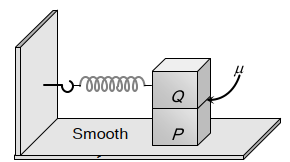
- A
$k A$
- ✓
$\frac{k A}{2}$
- C
- D
$\mu_s m g$
AnswerCorrect option: B. $\frac{k A}{2}$
(b) When two blocks performs simple harmonic motion together then at the extreme position ( at amplitude $=A$ )Restoring force $F=K A=2 m a \Rightarrow a=\frac{K A}{2 m}$There will be no relative motion between $P$ and $Q$ if pseudo force on block $P$ is less than or just equal to limiting friction between $P$ and $Q$.i.e. $m\left(\frac{K A}{2 m}\right)=$ Limiting friction$\therefore \text { Maximum friction }=\frac{K A}{2}$
View full question & answer→MCQ 381 Mark
What is the maximum value of the force $F$ such that the block shown in the arrangement, does not move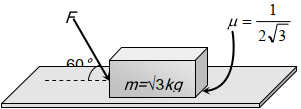
- ✓
$20 \mathrm{~N}$
- B
$10 \mathrm{~N}$
- C
$12 \mathrm{~N}$
- D
$15 \mathrm{~N}$
AnswerCorrect option: A. $20 \mathrm{~N}$
View full question & answer→MCQ 391 Mark
An insect crawls up a hemispherical surface very slowly (see the figure). The coefficient of friction between the insect and the surface is $1 / 3$. If the line joining the centre of the hemispherical surface to the insect makes an angle $\alpha$ with the vertical, the maximum possible value of $\alpha$ is given by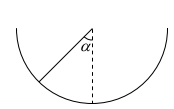
AnswerCorrect option: A. $\cot \alpha=3$
View full question & answer→MCQ 401 Mark
A block of mass $0.1 \mathrm{~kg}$ is held against a wall by applying a horizontal force of $5 \mathrm{~N}$ on the block. If the coefficient of friction between the block and the wall is $0.5,$ the magnitude of the frictional force acting on the block is
- A
$2.5 \mathrm{~N}$
- ✓
$0.98 \mathrm{~N}$
- C
$4.9 \mathrm{~N}$
- D
$0.49 \mathrm{~N}$
AnswerCorrect option: B. $0.98 \mathrm{~N}$
View full question & answer→MCQ 411 Mark
When a bicycle is in motion, the force of friction exerted by the ground on the two wheels is such that it acts
- A
In the backward direction on the front wheel and in the forward direction on the rear wheel
- B
In the forward direction on the front wheel and in the backward direction on the rear wheel
- C
In the backward direction on both front and the rear wheels
- ✓
AnswerIn cycling, the rear wheel moves by the force communicated to it by pedalling while front wheel moves by it self.
So, while pedalling a bicycle, the force exerted by rear wheel on ground makes force of friction act on it in the forward direction (like walking).
Front wheel moving by itself experience force of friction in backward direction (like rolling of a ball).
[However, if pedalling is stopped both wheels move by themselves and so experience force of friction in backward direction].
View full question & answer→MCQ 421 Mark
Which of the following is correct, when a person walks on a rough surface
- A
The frictional force exerted by the surface keeps him moving
- B
The force which the man exerts on the floor keeps him moving
- ✓
The reaction of the force which the man exerts on floor keeps him moving
- D
AnswerCorrect option: C. The reaction of the force which the man exerts on floor keeps him moving
View full question & answer→MCQ 431 Mark
A block of mass $2 \mathrm{~kg}$ rests on a rough inclined plane making an angle of $30^{\circ}$ with the horizontal. The coefficient of static friction between the block and the plane is $0.7.$ The frictional force on the block is
- ✓
$9.8 \mathrm{~N}$
- B
$0.7 \times 9.8 \times \sqrt{3} \mathrm{~N}$
- C
$9.8 \times \sqrt{3} \mathrm{~N}$
- D
$0.8 \times 9.8 \mathrm{~N}$
AnswerCorrect option: A. $9.8 \mathrm{~N}$
Limiting friction $F_l=\mu m g \cos \theta$
$F_l=0.7 \times 2 \times 10 \times \cos 30^{\circ}=12 N \text { (approximately) }$
But when the block is lying on the inclined plane then component of weight down the plane
$=m g \sin \theta$
$=2 \times 9.8 \times \sin 30^{\circ}=9.8 N$
It means the body is stationary, so static friction will work on it
$\therefore$ Static friction $=$ Applied force $=9.8 N$
View full question & answer→MCQ 441 Mark
A motorcyclist of mass $m$ is to negotiate a curve of radius $r$ with a speed $v$. The minimum value of the coefficient of friction so that this negotiation may take place safely, is
- A
$v^2 r g$
- ✓
$\frac{v^2}{g r}$
- C
$\frac{g r}{v^2}$
- D
$\frac{g}{v^2 r}$
AnswerCorrect option: B. $\frac{v^2}{g r}$
View full question & answer→MCQ 451 Mark
A block of mass $m$ lying on a rough horizontal plane is acted upon by a horizontal force $P$ and another force $Q$ inclined at an angle $\theta$ to the vertical. The block will remain in equilibrium, if the coefficient of friction between it and the surface is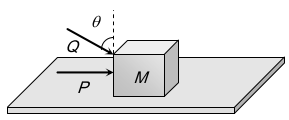
- ✓
$\frac{(P+Q \sin \theta)}{(m g+Q \cos \theta)}$
- B
$\frac{(P \cos \theta+Q)}{(m g-Q \sin \theta)}$
- C
$\frac{(P+Q \cos \theta)}{(m g+Q \sin \theta)}$
- D
$\frac{(P \sin \theta-Q)}{(m g-Q \cos \theta)}$
AnswerCorrect option: A. $\frac{(P+Q \sin \theta)}{(m g+Q \cos \theta)}$
View full question & answer→MCQ 461 Mark
A body of mass $5 \mathrm{~kg}$ rests on a rough horizontal surface of coefficient of friction 0.2 . The body is pulled through a distance of $10 \mathrm{~m}$ by a horizontal force of $25 \mathrm{~N}$. The kinetic energy acquired by it is $\left(g=10 m s^2\right)$
- A
$330 \mathrm{~J}$
- ✓
$150 \mathrm{~J}$
- C
$100 \mathrm{~J}$
- D
$50 \mathrm{~J}$
AnswerCorrect option: B. $150 \mathrm{~J}$
(b) Kinetic energy acquired by body$=($ Total work done on the body $)-($ work against friction $)$$\begin{aligned}& =F \times S-\mu m g S=25 \times 10-0.2 \times 5 \times 10 \times 10 \\& =250-100=150 \text { Joule }\end{aligned}$
View full question & answer→MCQ 471 Mark
A body is sliding down an inclined plane having coefficient of friction $0.5$. If the normal reaction is twice that of the resultant downward force along the incline, the angle between the inclined plane and the horizontal is
- A
$15^{\circ}$
- B
$30^{\circ}$
- ✓
$45^{\circ}$
- D
$60^{\circ}$
AnswerCorrect option: C. $45^{\circ}$
(c) Resultant downward force along the incline$=m g(\sin \theta-\mu \cos \theta)$Normal reaction $=m g \cos \theta$
Given : $m g \cos \theta=2 m g(\sin \theta-\mu \cos \theta)$By solving $\theta=45^{\circ}$.
View full question & answer→MCQ 481 Mark
A uniform chain of length $L$ changes partly from a table which is kept in equilibrium by friction. The maximum length that can withstand without slipping is $/$, then coefficient of friction between the table and the chain is
- A
$\frac{l}{L}$
- B
$\frac{l}{L+l}$
- ✓
$\frac{l}{L-l}$
- D
$\frac{L}{L+l}$
AnswerCorrect option: C. $\frac{l}{L-l}$
(c) $\quad \mu=\frac{\text { Lenght of chain hanging from the table }}{\text { Lenght of chain lyingon the table }}=\frac{l}{L-l}$
View full question & answer→MCQ 491 Mark
If $\mu_s, \mu_k$ and $\mu_r$ are coefficients of static friction, sliding friction and rolling friction, then
- A
$\mu_s<\mu_k<\mu_r$
- B
$\mu_k<\mu_r<\mu_s$
- ✓
$\mu_r<\mu_k<\mu_s$
- D
$\mu_r=\mu_k=\mu_s$
AnswerCorrect option: C. $\mu_r<\mu_k<\mu_s$
View full question & answer→MCQ 501 Mark
A body of weight $64 N$ is pushed with just enough force to start it moving across a horizontal floor and the same force continues to act afterwards. If the coefficients of static and dynamic friction are 0.6 and 0.4 respectively, the acceleration of the body will be (Acceleration due to gravity $=g)$
- A
$\frac{g}{6.4}$
- B
$0.64 \mathrm{~g}$
- C
$\frac{g}{32}$
- ✓
$0.2 \mathrm{~g}$
AnswerCorrect option: D. $0.2 \mathrm{~g}$
View full question & answer→