Question
A body is projected with some initial velocity making an angle $\theta$ with the horizontal. Show that its path is a parabola. Find the maximum height attained, time for maximum height, horizontal range, maximum horizontal range and the time of flight.
Answer

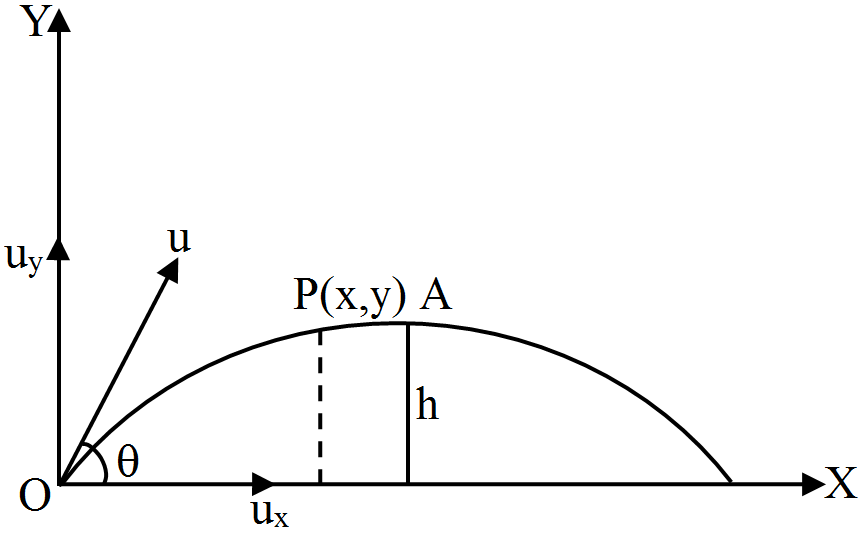
Let the body be projected with velocity u inclined at angle with the horizontal. The horizontal and vertical components of velocity and acceleration are

ux, ax and uy, ay

where $\text{u}_\text{x}=\text{u}\cos\theta,\text{ u}_\text{y}=\text{u}\sin\theta,$

ax = 0, ay = -g

g is the acceleration due to gravity.

The coordinates of O are (0, 0) considering horizontal motion.

The position of the body after time t has coordinate (x, y);

where $\text{x}(\text{t})=\text{x}_0+\text{u}_\text{x}\text{t}+\frac{1}{2}\text{a}_\text{x}\text{t}^2$

Substituting for various factors

$\text{x (t)}=0+\text{u}\cos\theta.\text{t}+\frac{1}{2}\times0\times\text{t}^2$

or $\text{x (t)}=\text{u}\cos\theta.\text{t}$

$\text{t}=\frac{\text{x (t)}}{\text{u}\cos\theta}\dots(\text{i})$

Considering the vertical motion

$\text{y (t)}=\text{y}(0)+\text{u}_\text{y}+\frac{1}{2}\text{a}_\text{y}\text{t}^2$

or $\text{y (t)}=0+\text{u}\sin\theta.\text{t}-\frac{1}{2}\text{gt}^2$

or $\text{y (t)}=\text{u}\sin\theta.\text{t}-\frac{1}{2}\text{gt}^2\dots(\text{ii})$

Substituting for t from equation (i) in equation (ii), we get

$\text{y (t)}=\text{u}\sin\theta\Big(\frac{\text{x (t)}}{\text{u}\cos\theta}\Big)-\frac{1}{2}\text{g}\Big(\frac{\text{x (t)}}{\text{u}\cos\theta}\Big)^2\text{s}$

$\Rightarrow\ \text{y (t)}=\text{x (t)}\tan\theta-\frac{1}{2}\text{g}\Big(\frac{\text{x}^2(\text{t})}{\text{u}^2\cos^2\theta}\Big)\dots(\text{iii})$

This is an equation of parabola. Thus, the path of a projectile is a parabola.

Maximum height attained: At the maximum height, the vertical component of velocity becomes zero. Now using the equation of motion.

$\text{h}=\frac{\text{v}^2_\text{y}-\text{u}^2_\text{y}}{2\text{a}_\text{y}}$

We have maximum height

$\therefore\ \text{h}_\text{max}=\frac{0^2-(\text{u}\sin\theta)^2}{2(-\text{g})}$

or $\text{H}=\frac{\text{u}^2\sin^2\theta}{2\text{g}}\dots(\text{iv})$

Time for maximum height: Using equation of motion v = u + at

or vx = ux + ayt

we have $0=\text{u}\sin\theta-\text{gt}$

or $\text{t}=\frac{\text{u}\sin\theta}{\text{g}}\dots(\text{v})$

Horizontal range: Let the horizontal range be x. Since there is no acceleration in the horizontal direction so

$\text{x}=\text{x}(0)+\text{u}_\text{x}\text{t}+\frac{1}{2}\text{a}_\text{x}\text{t}^2$

As x(0) = 0, $\text{u}_\text{x}=\text{u}\cos\theta,$ ax = 0 and it is the total time of the flight which is twice the time for maximum height because body takes same time in rising to and falling from the highest point.

Hence, $\text{t}=\frac{2\text{u}\sin\theta}{\text{g}}$

$\therefore \ \text{x}=0+\text{u}\cos\theta.\text{t}$

$=\text{u}\cos\theta\Big(\frac{2\text{u}\sin\theta}{\text{g}}\Big)$

or $\text{x}=\frac{\text{u}^2}{\text{g}}(2\sin\theta\cos\theta)$

$\Rightarrow\ \text{x}=\frac{\text{u}^2}{\text{g}}\sin2\theta\dots(\text{vi})$

Maximum horizontal range: From equation (vi) for x to be maximum, the value of $\sin2\theta$ should be maximum which is 1,

Hence, $\text{x}_\text{max}=\frac{\text{u}^2}{\text{g}}\dots(\text{vii})$

For this xmax$\sin2\theta=1\Rightarrow\ \theta=45^\circ$

Therefore, the horizontal range will be maximum if the angle of projection is 45° or $\frac{\pi}{4}$ radians.

Time of flight of the projectiles: The projectile after completing its flight returns back to the same horizontal level from which it was projected. Therefore, the vertical displacement in the whole flight is zero. Considering vertical motion.

$\text{y (t)}=\text{y}(0)+\text{u}_\text{y}\text{t}+\frac{1}{2}\text{a}_\text{y}\text{t}^2$

Now, y(t) = 0, y(0) = 0, $\text{u}_\text{y}=\text{u}\sin\theta,$ ay = -g

Then $0=0+\text{u}\sin\theta.\text{T}-\frac{1}{2}\text{gT}^2$

$\Rightarrow\ \text{T}\Big(\text{u}\sin\theta-\frac{1}{2}\text{gT}\Big)\text{s}=0$

Therefore T = 0

and $\text{u}\sin\theta-\frac{1}{2}\text{gT}=0$

$\Rightarrow\ \text{u}\sin\theta=\frac{1}{2}\text{gT}$

or $\text{gT}=2\text{u}\sin\theta$

$\text{T}=\frac{2\text{u}\sin\theta}{\text{g}}\dots(\text{viii})$

Equation (viii) gives the total time of flight. This is twice the time for maximum height.

Need a full question paper?

Generate a complete, print-ready paper with questions like this in minutes — across 16+ boards, with answer keys.

Start Generating Free

Similar questions

Liquid is flowing steadily through a pipe. Assume that the volume of the liquid flowing out per second depends on (a) the coefficient of viscosity of the liquid $(\eta)$(b) the radius of the pipe (r) and (c) the pressure gradient along the pipe (pressure gradient is drop in pressure per unit length of the pipe, and is equal to P/ l, where P is the difference between the ends of the pipe and I is the length of the pipe). The dimensions of viscosity is [ML-1T-1). Deduce by the method of dimensions, the formula for the volume of the liquid flowing out per second.
Two parallel wires seprated by a distance of 10cm carry currents of 10A and 40A along-the same direction. Where should a third current be placed so that it experiences no magnetic force?
Figure. shows two vessels A and B with rigid walls containing ideal gases. The pressure, temperature and the volume are pA, TA, V in the vessel A and pB, TB, V in the vessel B. The vessels are now connected through a small tube. Show that the pressure p and the temperature T satisfy $\frac{\text{p}}{\text{T}}=\frac{1}{2}\Big(\frac{\text{P}_\text{A}}{\text{T}_\text{A}}+\frac{\text{p}_\text{B}}{\text{T}_\text{B}}\Big)$ when equilibrium is achieved.

If a body moving with uniform acceleration in straight line describes successive equal distance in time interval t1, t2 and t3, then show that
$\frac{1}{\text{t}_1}-\frac{1}{\text{t}_2}+\frac{1}{\text{t}_3}=\frac{3}{\text{t}_1+\text{t}_2+\text{t}_3}$
A uniform magnetic field B exists in a cylindrical region, shown dotted in figure. The magnetic field increases at a constant rate $\frac{\text{dB}}{\text{dt}}.$ Consider a circle of radius r coaxial with the cylindrical region.

  1. Find the magnitude of the electric field E at a point on the circumference of the circle.
  2. Consider a point P on the side of the square circumscribing the circle. Show that the component of the induced electric field at P along ba is the same as the magnitude found in part (a).


A particle executes simple harmonic motion of amplitude A.
i. At what distance from the mean position is its kinetic energy equal to its potential energy?
ii. At what points is its speed half the maximum speed?
The motor in a refrigerator has power output 250 watt. The freezing compartment is at 270K and outside air at 300K. Assuming ideal efficiency, what is the amount of heat that can be extracted from the freezing compartment in 10 minutes? What is the shortest time in which 10kg of water at 273K can be converted into ice? J = 4.2 × 10³ kcal-1.
A 16cm3 volume of water flows per second through a capillary tube of radius r сm and of length 1cm when connected to a pressure head of h cm of water. If a tube of the same length and radius $\frac{\text{r}}{2}$ is connected to the same pressure head, find the mass of water flowing per minute through the tube.
State Newton's Second law of motion. Prove that second law is the real law of motion.
A $20\mu\text{F}$ capacitor is joined to a battery of emf 6.0V through a resistance of $100\Omega.$ Find the charge on the capacitor 2.0ms after the connections are made.