$|\lambda\text{A}|=\lambda|\text{A}|,\ \text{if}$
- A$\lambda>0$
- B$\lambda<0$
- C$\lambda=0$
- D$\lambda\neq0$
379 questions across 8 question groups — pick any mix to generate a Physics paper with step-by-step answer keys.
M.C.Q (1 Marks)
57 Q→02Fill In The Blanks[1 Marks ]
13 Q→03True False[1 Marks ]
17 Q→041 Marks Question
23 Q→052 Marks Questions
64 Q→063 Marks Question
120 Q→074 Marks Question
9 Q→085 Marks Questions
76 Q→One sample from each question group in this chapter. Select any group above to see the full set with answer keys.
A scalar quantity is one that
Does not vary from one point to another in space.
A scalar quantity is one that
Has the same value for observers with different orientations of axes.
A scalar quantity is one that
Has the same value for observers with different orientations of axes.
A scalar quantity is one that
Does not vary from one point to another in space.
b + c must lie in the plane of a and d if a and d are not collinear, and in the line of a and d, if they are collinear?
Following are properties of vectors
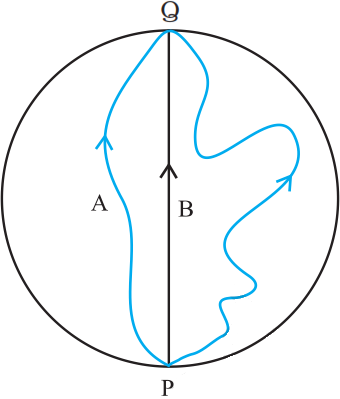
a) Two vectors A and B are said to be equal if, and only if, they have the same magnitude and the same direction.
b) Multiplying a vector A with a positive number λ gives a vector whose magnitude is changed by the factor λ but the direction is the same as that of A:
$|\ \lambda\text{ A }|=\lambda\text{ A }|$
c) The null vector also results when we multiply a vector A by the number zero. Properties of 0 are
A + 0 = A
λ 0 = 0
0 A = 0
d) Subtraction of vectors can be defined in terms of addition of vectors. We define the difference of two vectors A and B as the sum of two vectors A and –B :
A – B = A + (–B).
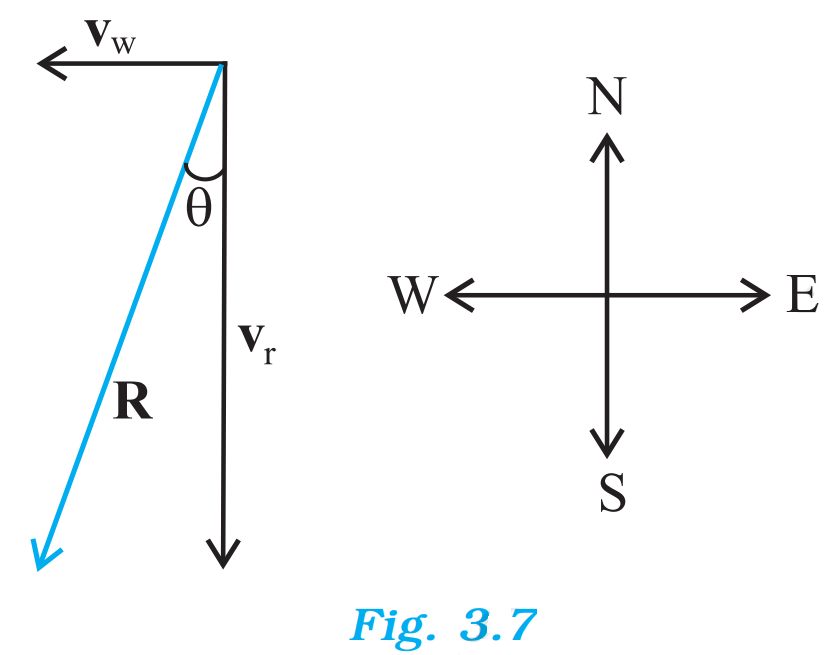
In physics, we can classify quantities as scalars or vectors. Basically, the difference is that a direction is associated with a vector but not with a scalar. A scalar quantity is a quantity with magnitude only. It is specified completely by a single number, along with the proper unit. Examples are: the distance between two points, mass of an object, the temperature of a body and the time at which a certain event happened. The rules for combining scalars are the rules of ordinary algebra. Scalars can be added, subtracted, multiplied and divided just as the ordinary numbers. A vector quantity is a quantity that has both a magnitude and a direction and obeys the triangle law of addition or equivalently the parallelogram law of addition. So, a vector is specified by giving its magnitude by a number and its direction. Some physical quantities that are represented by vectors are displacement, velocity, acceleration and force. Answer the following
Pick question groups from the list above, set marks and difficulty, and export a branded PDF with step-by-step answer keys. First 3 chapters free — no signup.