Question
A body is projected with velocity u at an angle $\theta_0$ upward from horizontal. Deduce the expression for:
  1. Horizontal range.
  2. Maximum height attained.

Answer

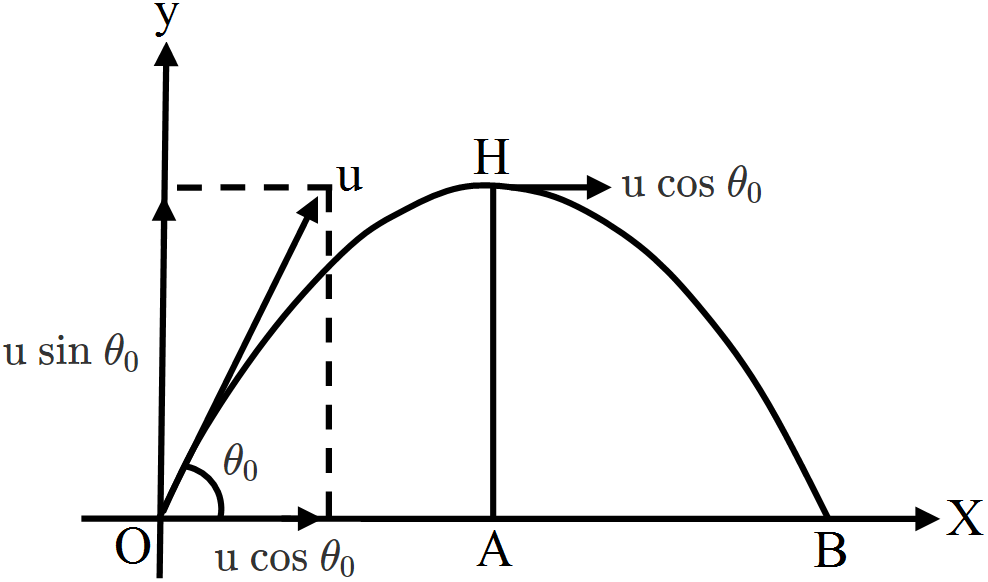
Consider a body is projected with velocity u at an angle $\theta_0.$ The horizontal and vertical components initially with velocity are $\text{u}\cos\theta_0$ and $\text{u}\sin\theta_0$ respectively.

  1. Horizontal range: It is the horizontal distance covered by the body between its point of projection and the point of hitting the ground, when both points are on same horizontal plane. It is denoted by R.

$\therefore\ \text{R}=\text{u}\cos\theta_0\times$ Total time of flight (T)

$=\text{u}\cos\theta_0\times\frac{2\text{u}\sin\theta_0}{\text{g}}$

$=\frac{\text{u}^2}{\text{g}}2\sin\theta_0\cos\theta_0$

$=\frac{\text{u}^2}{\text{g}}\sin2\theta_0$

$\text{R}=\frac{\text{u}^2\sin2\theta_0}{\text{g}}$

  1. Maximum height: Maximum height (hmax) is the maximum vertical height attained by the body above the point of projection during its flight.

Here, AH is referred as the maximum height attained against gravity. At highest point vertical component of velocity become zero.

Using, v2 = u2 + 2as, we have

$0=\text{u}^2\sin^2\theta_0-2\text{gh}_\text{max}$

$\Rightarrow\ \text{h}_\text{max}=\frac{\text{u}^2\sin^2\theta_0}{2\text{g}}$

Need a full question paper?

Generate a complete, print-ready paper with questions like this in minutes — across 16+ boards, with answer keys.

Start Generating Free

Similar questions

When an apple falls from a tree what happens to its gravitational potential energy just as it reaches the ground? After it strikes the ground?
At what temperature the mean speed of the molecules of hydrogen gas equals the escape epeed from the earth?
A child sits stationary at one end of a long trolley moving uniformly with a speed V on a smooth horizontal floor. If the child gets up and runs about on the trolley in any manner, what is the speed of the CM of the (trolley + child) system?
A solid sphere of mass 2kg is rolling down an inclined plane of angle of inclination 30°. What is the agent which supplies the external torque for the rotational motion of the sphere? Calculate its value. Also find the value of the torque if radius of sphere is 40cm.
Earth also moves in circular orbit around sun once every year with on orbital radius of 1.5 × 10¹¹m. What is the acceleration of earth (or any object on the surface of the earth) towards the centre of the sun? How does this acceleration compare with g = 9.8m/ s2?

$\Big(\text{Hint: acceleration}\frac{\text{V}^2}{\text{R}}=\frac{4\pi^2\text{R}}{\text{T}^2}\Big)$

A train start moving from rest and its speed increases with uniform acceleration for 10 sec . At the end of 5 sec . its speed become $54 km /$ hour.
(a) Find the acceleration of the train.
(b) What will be its speed after 10 sec ?
(c) How much distance will the train travel in 10 sec?
(d) How much distance did the train cover in the seventh and tenth second respectively?
Two masses, one 'n' times as heavy as the other, have equal kinetic energy. What is the ratio of their momenta?
A body, starts from rest and accelerates uniformly, find the ratio of the displacement in:
  1. One, two and three seconds.
  2. First, second and third second.
Estimate the moment of inertia for a disc of radius R and mass M about an axis passing through its centre and perpendicular to its plane.
Suppose we have 12 protons and 12 neutrons. We can assemble them to form either a :uMg nucleus or two 12C nuclei. In which of the two cases more energy will be liberated?