MCQ
A body is projected with velocity $u$ making an angle $\alpha$ with the horizontal. Its velocity when it is perpendicular to the initial velocity vector $u$ is
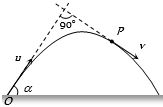
  • A
    $u \,tan\alpha$
  • $u\, cot\alpha$
  • C
    $u\, cosec\alpha$
  • D
    $u \,sec\alpha$

Answer

Correct option: B.
$u\, cot\alpha$
b
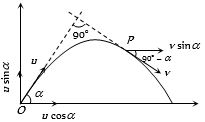
$'O' = u\cos \alpha $

$'P' = v\sin \alpha $

$v\sin \alpha = u\cos \alpha $

$\Rightarrow \,v = u\cot \alpha $
Need a full question paper?

Generate a complete, print-ready paper with questions like this in minutes — across 16+ boards, with answer keys.

Start Generating Free

Similar questions

At room temperature, the $r.m.s.$ speed of the molecules of certain diatomic gas is found to be $1920\, m/s$. The gas is
The length of second's hand in a watch is $1 \,cm.$ The change in velocity of its tip in $15\, seconds$ is
The unit of the coefficient of viscosity in $S.I.$ system is
Two waves represented by,

${y_1} = 10\,\sin \,200\pi t$,

${y_2} = 20\,\sin \,\left( {2000\pi t + \frac{\pi }{2}} \right)$

are superimposed at any point at a particular instant. The amplitude of the resultant wave is

A thin rod of length $L$ is bent to form a semicircle. The mass of rod is $M$. What will be the gravitational potential at the centre of the circle?
At time $t = 0$ , a $2\, kg$ particle has position vector $\vec r = \left( {4\hat i - 2\hat j} \right)\,m$ relative to the origin. Its velocity is given by $\vec v = 2{t^2}\hat i\,\left( {m/s} \right)$. The torque acting on the particle about the origin at $t = 2\,s$, is ........ $\hat k\,N - m$
The maximum and minimum distances of a comet from the Sun are $1.6 \times 10^{12}\, m$ and $8.0 \times 10^{10}\, m$ respectively. If the speed of the comet at the nearest point is $6 \times 10^{4}\, ms ^{-1},$ the speed at the farthest point is ......... $\times 10^{3}\, m / s$
Vessel $A$ is filled with hydrogen while vessel $B,$ whose volume is twice that of $A,$ is filled with the same mass of oxygen at the same temperature. The ratio of the mean kinetic energies of hydrogen and oxygen is
The efficiency of a frictionless engine can be 100% only when the heat sink is:
A particle executes a simple harmonic motion of time period $T$. Find the time taken by the particle to go directly from its mean position to half the amplitude