A box is placed on an inclined plane and has to be pushed down. The angle of inclination is
Easy


Download our appand get started for free
Experience the future of education. Simply download our apps or reach out to us for more information. Let's shape the future of learning together!No signup needed.*
Similar Questions
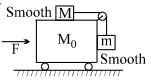
- 1Imagine $a$ situation in which the horizontal surface of block $M_0$ is smooth and its vertical surface is rough with $a$ coefficient of friction $\mu$ Consider a special situation in which both the faces of the block $M_0$ are smooth, as shown in adjoining figure. Mark out the correct statement $(s)$View Solution
- 2View SolutionA cube is resting on an inclined plane. What must be the value of coefficient of friction between cube and plane so that cube topples before sliding
- 3A body of mass $40\,kg$ resting on rough horizontal surface is subjected to a force $P$ which is just enough to start the motion of the body. If $\mu_{ s }=5, \mu_{ x }=0.4$, $g =10\,m / s ^2$ and the force $P$ is continuously applied on the body, then the acceleration of the body is $.........m/s^{2}$View Solution
- 4The coefficient of static friction between a wooden block of mass $0.5\, kg$ and a vertical rough wall is $0.2$ The magnitude of horizontal force that should be applied on the block to keep it adhere to the wall will be $N$ $\left[ g =10\, ms ^{-2}\right]$View Solution
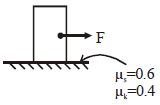
- 5$10\, kg$ block is placed as shown, if $F = 50$ newton find friction force ............ $N$View Solution
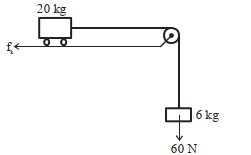
- 6Consider a block and trolley system as shown in figure. If the coefficient of kinetic friction between the trolley and the surface is $0.04$ , the acceleration of the system in $\mathrm{ms}^{-2}$ is :View Solution
(Consider that the string is massless and unstretchable and the pulley is also massless and frictionless):
- 7A block of mass $m$ is stationary on a rough plane of mass $M$ inclined at an angle $\theta$ to the horizontal, while the whole set up is accelerating upwards at an acceleration $\alpha$. If the coefficient of friction between the block and the plane is $\mu$, then the force that the plane exerts on the block isView Solution
- 8If the radius of curvature of the path of two particles of same mass are in the ratio $3:4,$ then in order to have constant centripetal force, their velocities will be in the ratio of:View Solution
- 9View SolutionA metal block is resting on a rough wooden surface. A horizontal force applied to the block is increased uniformly. Which of the following curves correctly represents velocity of the block ?
- 10Radius of the curved road on national highway is $R$. Width of the road is $b$. The outer edge of the road is raised by $h$ with respect to inner edge so that a car with velocity $v$ can pass safe over it. The value of $h$ isView Solution