A body is sliding down an inclined plane (angle of inclination $45^o$). If the coefficient of friction is $0.5$ and $g = 9.8\, m/s^2$. then the acceleration of the body downwards in $m/s^2$ is
Medium


Download our appand get started for free
Experience the future of education. Simply download our apps or reach out to us for more information. Let's shape the future of learning together!No signup needed.*
Similar Questions
- 1The force required just to move a body up an inclined plane is double the force required just to prevent the body sliding down. If the coefficient of friction is $0.25$, the angle of inclination of the plane is ...... $^o$View Solution
- 2The upper half of an inclined plane of inclination $\theta$ is perfectly smooth while lower half is rough. A block starting from rest at the top of the plane will again come to rest at the bottom, if the coefficient of friction between the block and lower half of the plane is given byView Solution
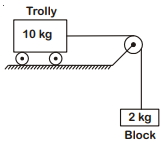
- 3Calculate the acceleration (In $m/s^{2}$) of the block and trolly system shown in the figure. The coefficient of kinetic friction between the trolly and the surface is $0.05 .\left( g =10\; m / s ^{2},\right.$ mass of the string is negligible and no other friction exists).View Solution
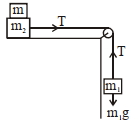
- 4Two masses $m_1 = 5\ kg$ and $m_2 = 10\ kg$, connected by an inextensible string over a frictionless pulley, are moving as shown in the figure. The coefficient of friction of horizontal surface is $0.15$. The minimum weight $m$ that should be put on top of $m_2$ to stop the motion is ........ $kg$View Solution
- 5A small block of mass $m$ is projected horizontally with speed $u$ where friction coefficient between block and plane is given by $\mu = cx$, where $x$ is displacement of the block on plane. Find maximum distance covered by the blockView Solution
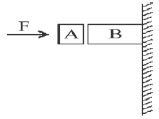
- 6Given in the figure are two blocks $A$ and $B$ of weight $20\ N$ and $100\ N,$ respectively. These are being pressed against a wall by a force $F$ as shown. If the coefficient of friction between the blocks is $0.1$ and between block $B$ and the wall is $0.15$, the frictional force applied by the wall on block $B$ is $......... N$View Solution
- 7$A$ block of mass $M$ is placed on $a$ horizontal surface and it is tied with an inextensible string to $a$ block of mass, as shown in figure. A block of mass $m_0$ is also placed on $M$ If friction force exists between the block $M$ and the block $m_0$ and not between the block $M$ and the horizontal surface, then the minimum value of $\mu$ for which the block m remains stationary isView Solution

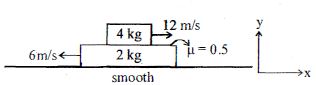
- 8The blocks are given velocity in the direction shown in figure. Co-efficient of friction between two blocks shown in figure is $μ = 0.5$. Take $g = 10\ m/s^2$View Solution
(considering $4\ kg$ block doesn't fall on ground)
Consider the following statements
$(i)$ Time when relative motion between them is stopped is $1.4\ second$.
$(ii)$ Time when relative motion between them is stopped in $1.2\ second$
$(iii)$ The common velocity of the two blocks is $8\ m/s$, towards right.
$(iv)$ The displacement of the $4\, kg$ block when relative motion stopped is$10.8\ m$.
Which of the fstatements is/are correct
- 9A block of mass $10\, kg$ starts sliding on a surface with an initial velocity of $9.8\, ms ^{-1}$. The coefficient of friction between the surface and bock is $0.5$. The distance covered by the block before coming to rest is: [use $g =9.8\, ms ^{-2}$ ].........$m$View Solution
- 10A block of mass $10\, kg$ is placed on a rough horizontal surface having coefficient of friction $\,\mu = 0.5$. If a horizontal force of $100\, N$ is acting on it, then acceleration of the block will be ....... $m/s^2$View Solution