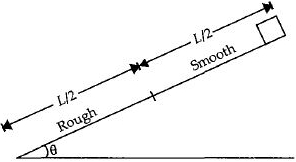
The upper half of an inclined plane of inclination $\theta$ is perfectly smooth while lower half is rough. A block starting from rest at the top of the plane will again come to rest at the bottom, if the coefficient of friction between the block and lower half of the plane is given by
AIPMT 2013, Medium
Download our app for free and get started
Let $m$ be mass of the block and $L$ be lenght of the inclined plane.
According to work - energy theorem $W=\Delta K=0 ($Initial and final speeds are zero$)$
$\therefore$ Wrok done by friction + Work done by gravity $=0$
$-\mu m g \cos \theta \frac{L}{2}+m g \sin \theta L=0$
$ \frac{\mu}{2} \cos \theta=\sin \theta$
$\mu=\frac{2 \sin \theta}{\cos \theta}=2 \tan \theta$
According to work - energy theorem $W=\Delta K=0 ($Initial and final speeds are zero$)$
$\therefore$ Wrok done by friction + Work done by gravity $=0$
$-\mu m g \cos \theta \frac{L}{2}+m g \sin \theta L=0$
$ \frac{\mu}{2} \cos \theta=\sin \theta$
$\mu=\frac{2 \sin \theta}{\cos \theta}=2 \tan \theta$

Download our appand get started for free
Experience the future of education. Simply download our apps or reach out to us for more information. Let's shape the future of learning together!No signup needed.*
Similar Questions
- 1A coin is placed on a disc. The coefficient of friction between the coin and the disc is $\mu$. If the distance of the coin from the center of the disc is $r$, the maximum angular velocity which can be given to the disc, so that the coin does not slip away, is:View Solution
- 2A coin placed on a rotating table just slips when it is placed at a distance of $1\,cm$ from the center. If the angular velocity of the table in halved, it will just slip when placed at a distance of from the centre $............\,cm$View Solution
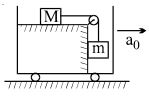
- 3Imagine the situation in which the given arrangement is placed inside a trolley that can move only in the horizontal direction, as shown in figure. If the trolley is accelerated horizontally along the positive $x$ -axis with $a_0$, then Identify the correct statement $(s)$ related to the tension $T$ in the stringView Solution
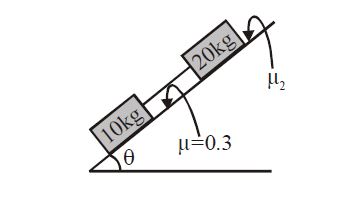
- 4Value of $\theta$ is increased gradually from $\theta = 0$ At $\theta=tan^{-1}(\frac{1}{2})$ both the block just start slipping. Then value of $\mu_2$ is : $(g = 10 m/s^2)$View Solution
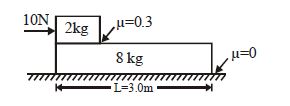
- 5Determine the time in which the smaller block reaches other end of bigger block in the figure. $(g = 10\ m s^{-2})$ .......... $\sec$View Solution
- 6A block of mass $70\,kg$ is kept on a rough horizontal surface $(\mu = 0.4)$. A person is trying to pull the block by applying a horizontal force, but the block is not moving. The net contact force exerted by the surface on the block is $F$, thenView Solution
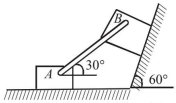
- 7In figure, two blocks are separated by a uniform strut attached to each block with frictionless pins. Block $A$ weighs $400\,N$, block $B$ weighs $300\,N$, and the strut $A B$ weigh $200\,N$. If $\mu=0.25$ under $B$, determine the minimum coefficient of friction under $A$ to prevent motion.View Solution
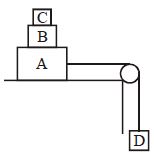
- 8Three blocks $A$, $B$ and $C$ of equal mass $m$ are placed on a smooth surface as shown. Coefficient of friction between any block $A, B$ and $C$ is $μ$. The maximum value of mass $D$ so the block $A, B$ & $C$ move without slipping over each other isView Solution
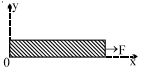
- 9A uniform rod of length $L$ and mass $M$ has been placed on a rough horizontal surface. The horizontal force $F$ applied on the rod is such that the rod is just in the state of rest. If the coefficient of friction varies according to the relation $\mu = Kx$ where $K$ is a $+$ ve constant. Then the tension at mid point of rod isView Solution
- 10View SolutionIt is easier to roll a barrel than pull it along the road. This statement is