A body of mass $1\, kg$ rests on a horizontal floor with which it has a coefficient of static friction $\frac{1}{\sqrt{3}}$. It is desired to make the body move by applying the minimum possible force $F\, N$. The value of $F$ will be the Nearest Integer) [Take $g =10 \,ms ^{-2}$ ]
JEE MAIN 2021, Difficult
Download our app for free and get started
$F \cos \theta=\mu N$
$F \sin \theta+ N = mg$
$\Rightarrow F =\frac{\mu mg }{\cos \theta+\mu \sin \theta}$
$F _{\min }=\frac{\mu mg }{\sqrt{1+\mu^{2}}}=\frac{\frac{1}{\sqrt{3}} \times 10}{\frac{2}{\sqrt{3}}}=5$

Download our appand get started for free
Experience the future of education. Simply download our apps or reach out to us for more information. Let's shape the future of learning together!No signup needed.*
Similar Questions
- 1View SolutionIf the overbridge is concave instead of being convex, the thrust on the road at the lowest position will be
- 2View SolutionIn a tonga, horse pulls a wagon. Which is the correct analysis of the situation?
- 3A block of mass $m$ rests on a rough inclined plane. The coefficient of friction between the surface and the block is $\mu$. At what angle of inclination $\theta$ of the plane to the horizontal will the block just start to slide down the plane?View Solution
- 4A block rests on a rough inclined plane making an angle of ${30^o}$ with the horizontal. The coefficient of static friction between the block and the plane is $0.8$. If the frictional force on the block is $10 \,N$, the mass of the block (in kg) is (take $g = 10\,\,m/{s^2})$View Solution
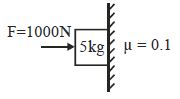
- 5For the given figure, if block remains in equilibrium position then find frictional force between block and wall ........ $N$View Solution
- 6A force of $750 \,N$ is applied to a block of mass $102\, kg$ to prevent it from sliding on a plane with an inclination angle $30°$ with the horizontal. If the coefficients of static friction and kinetic friction between the block and the plane are $0.4 $ and $0.3$ respectively, then the frictional force acting on the block is...... $N$View Solution
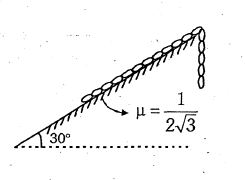
- 7A uniform chain is at rest partially on the incline and partially hanging vertically. Coefficient of friction between chain and incline is $\mu = \frac{1}{{2\sqrt 3 }}$. The ratio of $\frac{{{L_{\max }}}}{{{L_{\min }}}}$ is $(L_{max} =$ maximum length of chain kept on inclined so that chain remains at rest, $L_{min} =$ minimum length of chain kept on incline so that chain remains at rest)View Solution
- 8A block slides down on an inclined surface of inclination $30^o$ with the horizontal. Starting from rest it covers $8\, meter$ in the first two seconds. The coefficient of friction is $(g = 10\, ms^{-2})$View Solution
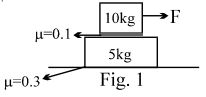
- 9The acceleration of $10\, kg$ block when $F = 30\,N$ ........ $m/s^2$View Solution
- 10A rod $(AB)$ is attached to a fixed point $(C)$ using a light rope $(AC)$. The other end of the rod $(B)$ is sitting on ice with negligible friction and the system is in stationary position. Which of the following can be the equilibrium configuration of this system?View Solution