A body of mass $100\, g$ is sliding from an inclined plane of inclination $30^°$. What is the frictional force experienced if $\mu = 1.7$
Easy


Download our appand get started for free
Experience the future of education. Simply download our apps or reach out to us for more information. Let's shape the future of learning together!No signup needed.*
Similar Questions
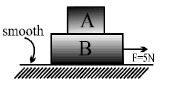
- 1In the shown arrangement mass of $A = 1\,\,kg$ mass of $B = 2\,\,kg.$ Coefficient of friction between $A $ and $B = 0.2.$ There is no friction between $B$ and ground. The frictional force exerted by $A$ on $B$ equals toView Solution
- 2A small mass $'m'$ rests at the edge of a horizontal disc of radius $'R'$ . The coefficient of static friction between mass and the disc is $\mu $ . The disc is rotated about its axis at an angular velocity such that the mass slides off the disc and lands on the floor $'h'$ meters below. What was its horizontal distance of travel from the point it left the disc?View Solution
- 3The magnitude of the centripetal force acting on a body of mass $m$ executing uniform motion in a circle of radius $r$ with speed $v$ isView Solution
- 4A car has to move on a level turn of radius $450\,m.$ If the coefficient of static friction between tyre and the road is $\mu = 0.2.$ Find the maximum speed the car can take without skidding is given by ........ $m/s$View Solution
- 5A conveyor belt is moving at a constant speed of $2\, ms^{-1}$. A box is gently dropped on it. The coefficient of friction between them is $\mu = 0.5$. The distance that the box will move relative to belt before coming to rest on it, (taking $g = 10\, ms^{-2}$) is ........ $m$.View Solution
- 6A block of mass $10\, kg$ starts sliding on a surface with an initial velocity of $9.8\, ms ^{-1}$. The coefficient of friction between the surface and bock is $0.5$. The distance covered by the block before coming to rest is: [use $g =9.8\, ms ^{-2}$ ].........$m$View Solution
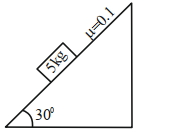
- 7A block of mass $5 \mathrm{~kg}$ is placed on a rough inclined surface as shown in the figure.If $\vec{F}_1$ is the force required to just move the block up the inclined plane and $\vec{F}_2$ is the force required to just prevent the block from sliding down, then the value of $\left|\vec{F}_1\right|-\left|\vec{F}_2\right|$ is : [Use $g=10 \mathrm{~m} / \mathrm{s}^2$ ]View Solution
- 8If a ladder weighing $250\,N$ is placed against a smooth vertical wall having coefficient of friction between it and floor is $0.3$, then what is the maximum force of friction available at the point of contact between the ladder and the floor ........ $N$View Solution
- 9View SolutionA hockey player is moving northward and suddenly turns westward with the same speed to avoid an oopponent. The force that acts on the player is
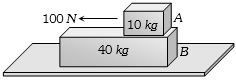
- 10A $40 \,kg$ slab rests on a frictionless floor as shown in the figure. A $10 \,kg$ block rests on the top of the slab. The static coefficient of friction between the block and slab is $0.60$ while the kinetic friction is $0.40$. The $10\, kg$ block is acted upon by a horizontal force $100 \,N$. If $g = 9.8\,m/{s^2}$, the resulting acceleration of the slab will be ........ $m/s^2$View Solution