A car has to move on a level turn of radius $450\,m.$ If the coefficient of static friction between tyre and the road is $\mu = 0.2.$ Find the maximum speed the car can take without skidding is given by ........ $m/s$
Medium


Download our appand get started for free
Experience the future of education. Simply download our apps or reach out to us for more information. Let's shape the future of learning together!No signup needed.*
Similar Questions
- 1The minimum force required to start pushing a body up a rough (frictional coefficient $\mu$) inclined plane is $F _{1}$ while the minimum force needed to prevent it from sliding down is $F _{2}$. If the inclined plane makes an angle $\theta$ from the horizontal such that $\tan \theta=2 \mu$, then the ratio $\frac{F_{1}}{F_{2}}$ isView Solution
- 2A horizontal force of $4\,N$ is needed to keep a block of mass $0.5\, kg$ sliding on a horizontal surface with a constant speed. The coefficient of sliding friction must be :- $[g = 10\, m/s^2]$View Solution
- 3A small mass $'m'$ rests at the edge of a horizontal disc of radius $'R'$ . The coefficient of static friction between mass and the disc is $\mu $ . The disc is rotated about its axis at an angular velocity such that the mass slides off the disc and lands on the floor $'h'$ meters below. What was its horizontal distance of travel from the point it left the disc?View Solution
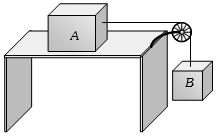
- 4The blocks $A$ and $B$ are arranged as shown in the figure. The pulley is frictionless. The mass of $A$ is $10 \,kg$. The coefficient of friction of $A$ with the horizontal surface is $0.20$. The minimum mass of $B $ to start the motion will be...... $kg$View Solution
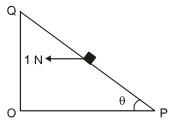
- 5A small block of mass of $0.1 \ kg$ lies on a fixed inclined plane $P Q$ which makes an angle $\theta$ with the horizontal. A horizontal force of $1 \ N$ on the block through its center of mass as shown in the figure. The block remains stationary if (take $g =10 \ m / s ^2$ ) $Image$View Solution
$(A)$ $\theta=45^{\circ}$
$(B)$ $\theta>45^{\circ}$ and a frictional force acts on the block towards $P$.
$(C)$ $\theta>45^{\circ}$ and a frictional force acts on the block towards $Q$.
$(D)$ $\theta<45^{\circ}$ and a frictional force acts on the block towards $Q$.
- 6A body of mass $4\, kg$ is at rest on a horizontal table. The coefficient of friction between the body and the table is $0.2$ . A horizontal force of $6N$ is applied on the body. The acceleration of the body is .......... $m/s^2$View Solution
- 7The coefficient of friction between a body and the surface of an inclined plane at $45^°$ is $0.5.$ If $g = 9.8\,m/{s^2}$, the acceleration of the body downwards in $m/{s^2}$ isView Solution
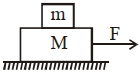
- 8Two blocks $( m =0.5\, kg$ and $M =4.5\, kg$ ) are arranged on a horizontal frictionless table as shown in figure. The coefficient of static friction between the two blocks is $\frac{3}{7} .$ Then the maximum horizontal force that can be applied on the larger block so that the blocks move together is ......... $N.$ (Round off to the Nearest Integer) [Take g as $9.8\, ms ^{-2}$ ]View Solution
- 9A circular road of radius $1000 \,m$ has banking angle ${45^o}$. The maximum safe speed of a car having mass $2000 \,kg$ will be, if the coefficient of friction between tyre and road is $0.5$ ....... $m/s$View Solution
- 10A block of mass $5\,kg$ is placed at rest on a table of rough surface. Now, if a force of $30\,N$ is applied in the direction parallel to surface of the table, the block slides through a distance of $50\,m$ in an interval of time $10\,s$. Coefficient of kinetic friction is (given, $g =10\,ms ^{-2}$)View Solution