A body of mass $1\,kg$ is executing simple harmonic motion. Its displacement $y(cm)$ at $t$ seconds is given by $y = 6\sin (100t + \pi /4)$. Its maximum kinetic energy is ..... $J$
Easy


Download our appand get started for free
Experience the future of education. Simply download our apps or reach out to us for more information. Let's shape the future of learning together!No signup needed.*
Similar Questions
- 1A simple pendulum of frequency $f$ has a metal bob. If bob is charged negatively and is allowed to oscillate with large positive charged plate under it, frequency will beView Solution
- 2Two particles execute $SHM$ of same amplitude of $20\, cm$ with same period along the same line about the same equilibrium position. The maximum distance between the two is $20\, cm.$ Their phase difference in radians isView Solution
- 3The equation of a particle executing simple harmonic motion is given by $x =\sin \pi\left( t +\frac{1}{3}\right) m$. At $t =1 \,s$, the speed of particle will be .......... $cm s ^{-1}$ (Given : $\pi=3.14$ )View Solution
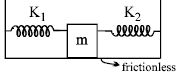
- 4Two springs with negligible masses and force constant of $K_1 = 200\, Nm^{-1}$ and $K_2 = 160\, Nm^{-1}$ are attached to the block of mass $m = 10\, kg$ as shown in the figure. Initially the block is at rest, at the equilibrium position in which both springs are neither stretched nor compressed. At time $t = 0,$ a sharp impulse of $50\, Ns$ is given to the block with a hammer.View Solution
- 5The displacement y of a particle executing periodic motion is given by $y = 4{\cos ^2}(t/2)\sin (1000t)$. This expression may be considered to be a result of the superposition of ........... independent harmonic motionsView Solution
- 6The displacement time equation of a particle executing $SHM$ is : $x = A \,sin\,(\omega t + \phi )$. At time $t = 0$ position of the particle is $x = A/2$ and it is moving along negative $x-$ direction. Then the angle $\phi $ can beView Solution
- 7A pendulum suspended from the ceiling of a train oscillates with a time period $2$ $second$ , when the train is accelerating at $10\,ms^{-2}$. What will be its time period when the train retards at $10\,ms^{-2}$ ? .... $s$View Solution
- 8For a particle showing motion under the force $F=-5(x-2)$, the motion is ...........View Solution
- 9A pendulum suspended from the ceiling of a train oscillates with a time period $2$ $second$ , when the train is accelerating at $10\,ms^{-2}$. What will be its time period when the train retards at $10\,ms^{-2}$ ? .... $s$View Solution
- 10If $x=5 \sin \left(\pi t+\frac{\pi}{3}\right) \mathrm{m}$ represents the motion of a particle executing simple harmonic motion, the amplitude and time period of motion, respectively, areView Solution