The displacement y of a particle executing periodic motion is given by $y = 4{\cos ^2}(t/2)\sin (1000t)$. This expression may be considered to be a result of the superposition of ........... independent harmonic motions
IIT 1992, Diffcult


Download our appand get started for free
Experience the future of education. Simply download our apps or reach out to us for more information. Let's shape the future of learning together!No signup needed.*
Similar Questions
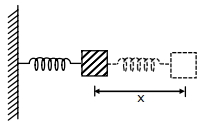
- 1The motion of a mass on a spring, with spring constant ${K}$ is as shown in figure. The equation of motion is given by $x(t)= A sin \omega t+ Bcos\omega t$ with $\omega=\sqrt{\frac{K}{m}}$ Suppose that at time $t=0$, the position of mass is $x(0)$ and velocity $v(0)$, then its displacement can also be represented as $x(t)=C \cos (\omega t-\phi)$, where $C$ and $\phi$ areView Solution
- 2View SolutionResonance is an example of
- 3When an oscillator completes $100$ oscillations its amplitude reduced to $\frac{1}{3}$ of initial value. What will be its amplitude, when it completes $200$ oscillations?View Solution
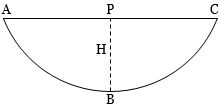
- 4A simple pendulum with a bob of mass $‘m’$ oscillates from $A$ to $ C$ and back to $A$ such that $PB$ is $H.$ If the acceleration due to gravity is $‘g’$, then the velocity of the bob as it passes through $B$ isView Solution
- 5View SolutionTo make the frequency double of an oscillator, we have to
- 6A simple pendulum oscillating in air has period $T.$ The bob of the pendulum is completely immersed in a non-viscous liquid. The density of the liquid is $\frac {1}{16}$ of the material of the bob. If the bob is inside liquid all the time, its period of oscillation in this liquid isView Solution
- 7A particle is executing $SHM$ about $y=0$ along $y$-axis. Its position at an instant is given by $y=(7 \,m )$ sin( $\pi f)$. Its average velocity for a time interval $0$ to $0.5 \,s$ is ........... $m / s$View Solution
- 8In a seconds pendulum, mass of bob is $30\, gm$. If it is replaced by $90\, gm$ mass. Then its time period will .... $\sec$View Solution
- 9A ball suspended by a thread swings in a vertical plane so that its magnitude of acceleration in the extreme position and lowest position are equal. The angle $(\theta)$ of thread deflection in the extreme position will be :View Solution
- 10The equation of a particle executing simple harmonic motion is given by $x =\sin \pi\left( t +\frac{1}{3}\right) m$. At $t =1 \,s$, the speed of particle will be .......... $cm s ^{-1}$ (Given : $\pi=3.14$ )View Solution