MCQ
A body of mass $2\, {kg}$ moving with a speed of $4\, {m} / {s}$. makes an elastic collision with another body at rest and continues to move in the original direction but with one fourth of its initial speed. The speed of the two body centre of mass is $\frac{x}{10} \,{m} / {s}$. Then the value of $x$ is ..... .
  • A
    $5$
  • B
    $75$
  • $25$
  • D
    $50$

Answer

Correct option: C.
$25$
c
$p_{i}=p_{f}$

$2 \times 4=2 \times 1+m_{2} \times v_{2}$

$m_{2} v_{2}=6$

by coefficient of restitution

$1=\frac{v_{2}-1}{4} \Rightarrow v_{2}=5 m / s$

$m _{2} \times 5=6$

$m _{2}=1.2 kg$

$v _{ cm }=\frac{ m _{1} v _{1}+ m _{2} v _{2}}{ m _{1}+ m _{2}}$

$v _{ cm }=\frac{2 \times 1+1.2 \times 5}{2+1.2}=\frac{8}{3.2}=\frac{25}{10}$

$x =25$

Need a full question paper?

Generate a complete, print-ready paper with questions like this in minutes — across 16+ boards, with answer keys.

Start Generating Free

Similar questions

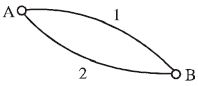
A small body slips, subject to the force of friction, from point $A$ to point $B$ along two curved surfaces of equal radius, first along route $1,$ then along route $2$. Friction does not depend on the speed and the coefficient of friction on both routes is the same. In which case will the body’s speed at $B$ be greater?
A pipe open at both ends produces a note of frequency $f‌‌‌_1$. When the pipe is kept with $\frac{3}{4}$th of its length it water, it produced a note of frequency $f_2$. The ratio $\frac{{{f_1}}}{{{f_2}}}$ is
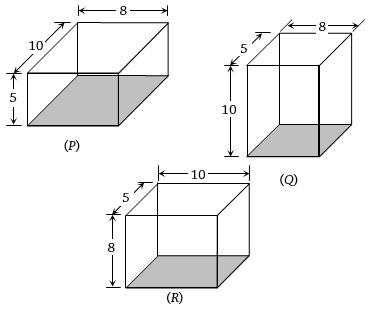
A rectangular block of size $10\,cm \times 8\,cm \times 5\,cm$ is kept in three different positions $P, Q$ and $R$ in turn as shown in the figure. In each case, the shaded area is rigidly fixed and a definite force $F$ is applied tangentially to the opposite face to deform the block. The displacement of the upper face will be
A cubical block of side $'a'$ and density $'\rho '$ slides over a fixed inclined plane with constant velocity $'v'$ . There is a thin film of viscous fluid of thickness $'t'$ between the plane and the block. Then the coefficient of viscosity of the thin film will be
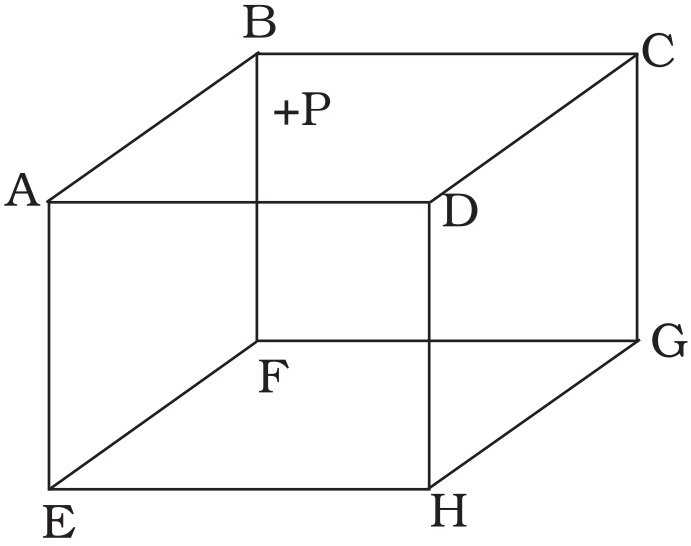
$\text{ABCDEFGH}$ is a hollow cube made of an insulator $($figure$)$ face $\text{ABCD}$ has positive charge on it. Inside the cube, we have ionised hydrogen. The usual kinetic theory expression for pressure.
A rocket is fired vertically frorn the earth with an acceleration of  $2\,g,$  where $g$  is the gravitational acceleration. On an inclined plane inside the rocket, making an angle $\theta $ with the horizontal, a point object of mass $m$ is kept. The minimum coefficient of friction $\mu _{min}$  between the mass and the inclined surface such that the mass does not move is
An aeroplane is moving with a velocity $u$. It drops a packet from a height $h$. The time $t$ taken by the packet in reaching the ground will be
The radius of gyration of an uniform rod of length $l$ about an axis passing through one  of its ends and perpendicular to its length is
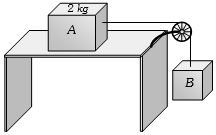
The coefficient of static friction, ${\mu _s},$ between block $A$ of mass $2\, kg$ and the table as shown in the figure is $0.2$. ........ $kg$ would be the maximum mass value of block $B$ so that the two blocks do not move. The string and the pulley are assumed to be smooth and massless. $(g = 10\,m/{s^2})$
Consider a spacecraft in an elliptical orbit around the earth. At the low point, or perigee, of its orbit, it is $400 \ km$ above the earth's surface; at the high point, or apogee, it is $4000 \ km$ above the earth's surface. Using conservation of energy, find the speed at perigee and the speed at apogee. It is necessary to have the spacecraft escape from the earth completely.